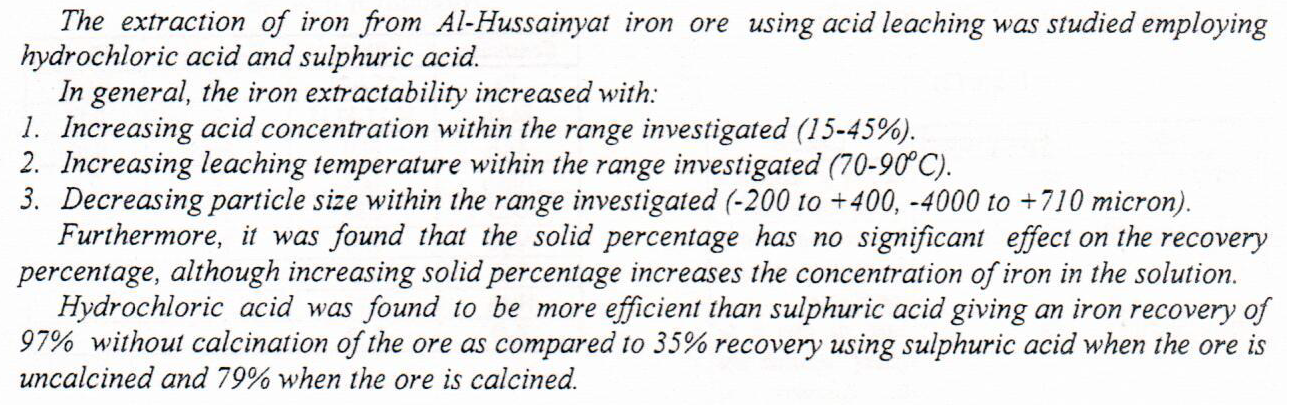
Extraction of Iron from Al-Hussainyat Iron Ore using Acid Leaching

The objective of this work is to study the influence of end milling cutting process parameters, tool material and geometry on multi-response outputs for 4032 Al-alloy. This can be done by proposing an approach that combines Taguchi method with grey relational analysis. Three cutting parameters have been selected (spindle speed, feed rate and cut depth) with three levels for each parameter. Three tools with different materials and geometry have been also used to design the experimental tests and runs based on matrix L9. The end milling process with several output characteristics is solved using a grey relational analysis. The results of analysis of variance (ANOVA) showed that the major influencing parameters on multi-objective response w
... Show More (1)
(1)
 (2)
(2)


Conjugated Linoleic Acid (CLA) is an essential polyunsaturated omega fatty acid that occurs naturally in vegetable oils. It also plays an important role in preserving meat for longer periods by preventing oxidation of other fats. Thus, it can be used in the production of functional foods with high biological value and low cholesterol levels by adding poultry diets. Objective: The aim of the present study was to evaluate the effect of adding CLA to broiler diets on production performance and fatty acid content in the meat. Methodology: One-day-old Ross-308 chicks were randomly distributed into four dietary treatment groups: control (0 g CLA kgG1 diet; A1), 0.5 g CLA kgG1 diet (A2), 0.75 g CLA kgG1 diet (A3) and 1 g CLA kgG1 diet (A4). Diets
... Show More
(1)
(8)
(5)
Steps were taken to obtain the Kojic acid crystals from local fungal isolation A. flavus WJF81 by separating the fermentation products from the fungus mycelium from the production plant at the centrifuge at a speed of 5000 cycles for 10 minutes. The extraction was followed by ethyl acetate then supernatant concentrate by using rotary evaporator, and dried with heat oven 37ºC. Long, yellowish, pristine acid crystals were obtained that examined the optical microscope with a magnification force of 10x and 40x. The melting point of kojic acid was determined between 152.9-153.5 °C Results of the diagnosis of Kojic acid by applying High pressure liquid chromatography HPLC technique showed that the acid was at one peak, which was close to the
... Show MoreKE Sharquie, AA Noaimi, GA Ibrahim, AS Al-Husseiny, Our Dermatology Online, 2016 - Cited by 3
novel spectrofluorimetric flow injection analysis (FIA) method was developed for the selective quantification of ascorbic acid via fluorescence quenching of serotonin hydrochloride. The system employs a custom-designed photometric array comprising 16 irradiation sources arranged in a dual-axis matrix—eight aligned horizontally and eight orthogonally, enabling multi-angle excitation and enhanced spectral resolution. Fluorescence signals were captured using a twin-pair solar cell detector, offering high sensitivity and minimal optical interference. The method exhibited a linear calibration range of 0.1–30 limit of detection (LOD) of 0.025 μ μ g/mL with a correlation coefficient (r mol /L, equivalent to 4.403 * 10 4 μ 2 ) of 0.9966, a g
... Show More
(1)
Specimens of the sesarmid crab Nanonsesarma sarii (Naderloo and Türkay 2009) were collected from the intertidal zone of Khor Al-Zubair, Basrah, Iraq 2012 far from the Arabian Gulf coasts. Morphological features of this species are highlighted and a figure is provided.
(4)
 (10)
(10)
(10)
(10)
Bacterial contamination of AL-Habania and AL-Tharthar reservoirs were studied during the period from February 2001 to January 2002, samples were collected from four stations in AL-Habania reservoir (AL-Warrar, AL-Theban regulator, middle of the reservoir and the fourth was towards AL-Razzaza reservoir) and from two stations at AL-Tharthar reservoir (Ein AL-Hilwa and the middle of the reservoir). Coliform bacteria, faecal Coliforms, Streptococci, faecal Streptococci and total count of bacteria were used as parameters of bacterial contamination in waters of both reservoirs through calculating the most probable number. Highest count of Coliform bacteria (15000 cell/100ml) was recorded at Ein AL-Hilwa and lowest count at AL-Theban regulator
... Show More