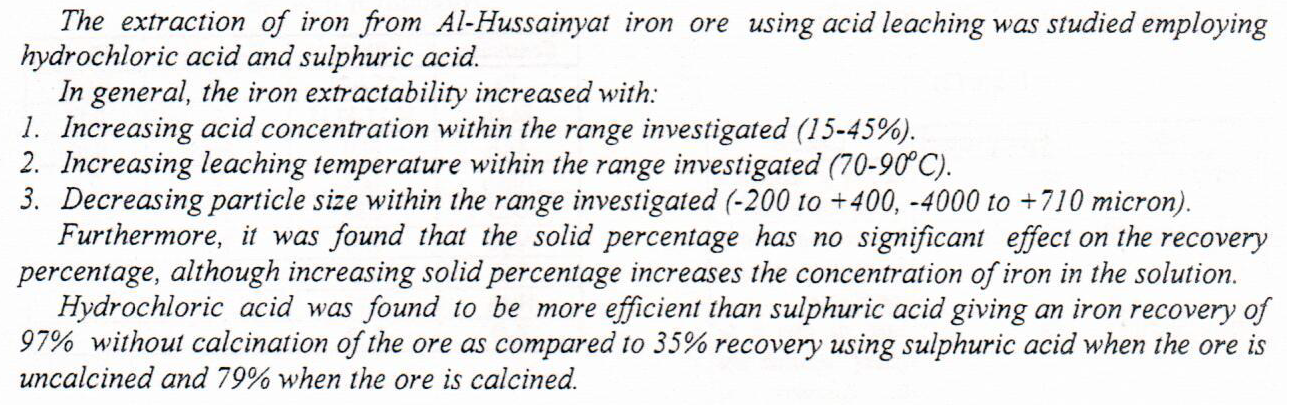
Extraction of Iron from Al-Hussainyat Iron Ore using Acid Leaching

This work describes the development of new spectrophotometric techniques for 3-aminophenol assessment. The first technique involves using benzidine in an alkaline solution to convert 3-aminophenol into a colored complex. The produced complex has a red color with an absorbance of 462 nm. Between the concentration range 5–14 μg mL−1, Beer's law is obeyed with a correlation coefficient (R2) of 0.99781, a limit of detection (LOD) of 0.0423 μg mL−1, and a limit of quantification (LOQ) of 0.1411 μg mL−1. The recovery was between 87.2–95.43%, the relative standard deviation (%RSD) was 2.40–3.31% and the molar absorptivity was 3.545 × 10³ L mol−1 cm−1. Secondly, cloud point extraction (CPE) was used to determ
... Show More (3)
(3)
 (1)
(1)


Oil from Brassca campestris (local variety) was extracted with hexane using Soxhlet. The extracted oil was characterized and its antimicrobial activity was determined as well. The content of extracted oil was 40% with 0.5% of volatile oil .Oil was immiscible with polar solvent such as ethanol, acetone and water, while it was easily miscible with chloroform due to its hydrophobicity. The result of organoleptic tests revealed that the oil is clear yellow in color and odorless with acceptable taste. The oil was stable at 4 -25 C? for a month. Refractive index (RI) of oil was 1.4723 with density of 0.914, [both at 4-25 C?]. Boiling point 386 C?. Infra red spectroscopy (IR) indicated the presence of different chemical groups (C=C
... Show More
Image classification is the process of finding common features in images from various classes and applying them to categorize and label them. The main problem of the image classification process is the abundance of images, the high complexity of the data, and the shortage of labeled data, presenting the key obstacles in image classification. The cornerstone of image classification is evaluating the convolutional features retrieved from deep learning models and training them with machine learning classifiers. This study proposes a new approach of “hybrid learning” by combining deep learning with machine learning for image classification based on convolutional feature extraction using the VGG-16 deep learning model and seven class
... Show More
(6)
(4)

This work reports the development of an analytical method for the simultaneous analysis of three fluoroquinolones; ciprofloxacin (CIP), norfloxacin (NOR) and ofloxacin (OFL) in soil matrix. The proposed method was performed by using microwave-assisted extraction (MAE), solid-phase extraction (SPE) for samples purification, and finally the pre-concentrated samples were analyzed by HPLC detector. In this study, various organic solvents were tested to extract the test compounds, and the extraction performance was evaluated by testing various parameters including extraction solvent, solvent volume, extraction time, temperature and number of the extraction cycles. The current method showed a good linearity over the concentration ranging from
... Show More
(7)
(3)
This study aims to assess the water quality index (WQI) according to the Canadian Council of Ministers of the Environment's Water Quality Index method (CCME WQI). Four locations (measurement stations) are selected along the Tigris River, in Iraq. Two of them are located in the north near Mosul City, (Mosul Dam and Mosul city), and the other two are located in the south near Al-Amarah city, (Ali Garbi and Al-Amarah). The water data collected is for the period 2011 to 2013, including eleven water quality parameters. These are magnesium (Mg+2), calcium (Ca2+), potassium (K+), sodium (Na+), sulfate (SO42-), chloride (Cl-), nitrate (NO3<
... Show More
Water quality planning relies on Biochemical Oxygen Demand BOD. BOD testing takes five days. The Particle Swarm Optimization (PSO) is increasingly used for water resource forecasting. This work designed a PSO technique for estimating everyday BOD at Al-Rustumiya wastewater treatment facility inlet. Al-Rustumiya wastewater treatment plant provided 702 plant-scale data sets during 2012-2022. The PSO model uses the daily data of the water quality parameters, including chemical oxygen demand (COD), chloride (Cl-), suspended solid (SS), total dissolved solids (TDS), and pH, to determine how each variable affects the daily incoming BOD. PSO and multiple linear regression (MLR) findings are compared, and their performance is evaluated usin
... Show More
Heat exchanger is an important device in the industry for cooling or heating process. To increase the efficiency of heat exchanger, nanofluids are used to enhance the convective heat . transfer relative to the base fluid. - Al2O3/water nanofluid is used as cold stream in the shell and double concentric tube heat exchanger counter current to the hot stream basis oil. These nanoparticles were of particle size of 40 nm and it was mixed with a base fluid (water) at volume
concentrations of 0.002% and 0.004%. The results showed that each of Nusselt number and overall heat transfer coefficient increased as nanofluid concentrations increased. The pressure drop of nanofluid increased slightly than the base fluid because
(2)
Water quality planning relies on Biochemical Oxygen Demand BOD. BOD testing takes five days. The Particle Swarm Optimization (PSO) is increasingly used for water resource forecasting. This work designed a PSO technique for estimating everyday BOD at Al-Rustumiya wastewater treatment facility inlet. Al-Rustumiya wastewater treatment plant provided 702 plant-scale data sets during 2012-2022. The PSO model uses the daily data of the water quality parameters, including chemical oxygen demand (COD), chloride (Cl-), suspended solid (SS), total dissolved solids (TDS), and pH, to determine how each variable affects the daily incoming BOD. PSO and multiple linear regression (MLR) findings are compared, and their perfor
... Show More
Earth dams in regions with moderate to high seismic activity are crucial for protecting downstream communities. Iraq and its neighboring areas have seen recurrent seismic activity, notably the 2017 Halabja Earthquake, which potentially compromised the integrity of the existing earth dam. The Darbandikhan Dam, affected by an earthquake, has inadequacies in its crest and downstream slope, presenting a greater danger of significant earthquake-induced damage compared to cyclic shocks. Consequently, evaluating the dam's safety is essential for safeguarding downstream residents and identifying optimal ways to avert slope stability failure amid recurrent seismic activity. Iraq's seismicity map is being updated to reflect earthquake magni
... Show More