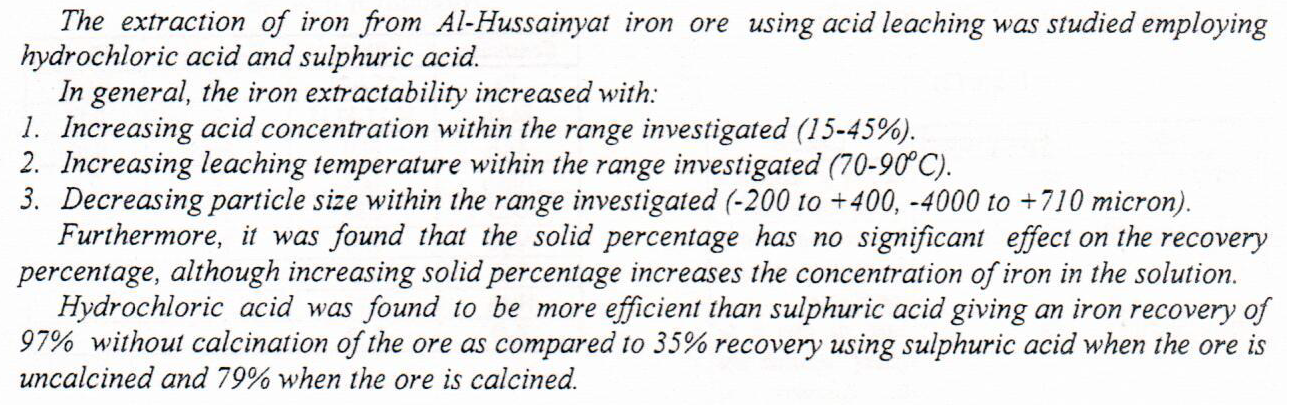
Extraction of Iron from Al-Hussainyat Iron Ore using Acid Leaching

The ligand [Potassium (E)-(4-(((2-((1-(3-aminophenyl) ethylidene) amino)-4-oxo-1,4- dihydropteridin-6-yl) methyl) amino)benzoyl)-L-glutamate] was prepared from the condensation reaction of folic acid with (3-aminoacetophenone) through Schiff reaction to give a new Schiff base ligand [H2L]. The ligand [H2L] was characterized by elemental analysis CHN, atomic absorption (A.A), (FT-I.R.), (U.V.-Vis), TLC, E.S. mass (for spectroscopes), molar conductance, and melting point. The new Schiff base ligand [H2L], reacts with Mn(II), Co(II), Ni(II), Cu(II), Cr(III) and Cd(II) metal ions and (2-aminophenol), (metal : derivative ligand : 2-aminophenol) to give a series of new mixed complexes in the general formula:- K3[M2(HL)(HA)2], (where M=Mn(II) and
... Show MoreA simple chemistry method approach was used to synthesise new ligand derivate from L-ascorbic acid and its complexes. All of them were water-soluble and are used quite extensively in the medical and pharmaceutical fields. This study synthesised the new ligand derivative from L-ascorbic acid-base using the following steps: A 5,6-O-isopropylidene-L-ascorbic acid was prepared by reacting dry acetone with L-ascorbic acid followed by reacting it with trichloroacetic acid to yield [chloro(carboxylic)methylidene]-5,6-O-isopropylidene-L-ascorbic acid in the second stage. In the third stage, the derivative was reacted with (methyl(6-methyl-2-pyridylmethyl)amine to create a new ligand (ONMILA). This novel ligand was identified using a number
... Show More (6)
(6)
 (1)
(1)


In this study new derivatives of Schiff bases 5-8, 1, 3-oxazepine 9-16 and tetrazoles 17-19 have been synthesized from the new starting material 1 which has synthesized the reaction of one mole of dichloro acetic acid and two moles of thiophenol, the esters 2-3 were synthesized from the reaction of compound 1 with methanol or ethanol respectively in the presence of H2SO4 as catalyst then 2, 2-dithiophenylaceto Hydrazide 4 were synthesized from the reaction of 2 or 3 with hydrazine hydrate 80%, Schiff bases 5-8 were synthesized from the reaction of 4 with appropriate aldehyde or ketone. Treatment of Schiff bases with maleic and phathalic anhydride in dry benzene to give 1, 3-oxazepen derivatives 9-16 and with sodium azide in tetrahydrofuran
... Show More
(2)
(2)
Three isolated bacteria were examined to remove heavy metals from the industrial wastewater of the Diala State Company of Electrical Industries, Diyala-Iraq. The isolated bacteria were identified as Pseudomonas aeruginosa, Escherichia coli and Sulfate Reducing Bacteria (SRB). The three isolates were used as an adsorption factor for different concentrations of Lead and Copper (100, 150, and 200 ppm.), in order to examine the adsorption efficiency of these isolates. In addition, the effect of three factors on heavy metals adsorption were examined; temperature (25, 30, and 37 ?C), pH (3 and 4.5) and contact time (2 and 24 hrs). The results showed that the highest level of lead adsorption was obtained at 37 ?C by E. coli, P, aerugenosa and
... Show More
(5)
(33)
(33)

This work represents the set of measurements of radon and thoron concentrations levels of soil-gas in Al-Kufa city in Iraq using electric Radon meter (RAD-7). Radon and thoron concentration were measured in soil-gas in 20 location for three depth of (50, 100 and 150) cm.
The results show that the emanation rate of radon and thoron gas varied from location to anther, depending on the geological formation. The Radon concentration in soil has been found to vary from (12775±400) Bq/m3 at 150 cm depth in location (sample K2) to (41.45±17) Bq/m3, for depth 150 cm in location (sample K20). The thoron concentration in soil has been found to vary from (198±8.5) Bq/m3 at 150 cm depth in location samples (K1 & K2) to undetected in the mos
The effect of different Ti additions on the microstructure of Al-Ti alloy prepared by powder metallurgy was investigated. A certain amount of Ti (10wt%, 15wt%, and 20wt%) were added to aluminium and the tests like microhardness, density, scanning electron microscope (SEM), optical microscope (OM) and X-Ray Diffraction (XRD) were conducted to determine the influence of different Ti additives on the Al-Ti alloy properties and microstructure. The results show that the grains of α-Al changed from large grains to roughly spherical and then to small rounded grains with increasing Ti content, the micro-hardness of the alloy increases with increasing Ti, and XRD results confirm the formation of TiAl3 intermetallic co
... Show More
(3)
Milling process is a common machining operation that is used in the manufacturing of complex surfaces. Machining-induced residual stresses (RS) have a great impact on the performance of machined components and the surface quality in face milling operations with parameter cutting. The properties of engineering material as well as structural components, specifically fatigue life, deformation, impact resistance, corrosion resistance, and brittle fracture, can all be significantly influenced by residual stresses. Accordingly, controlling the distribution of residual stresses is indeed important to protect the piece and avoid failure. Most of the previous works inspected the material properties, tool parameters, or cutting parameters, bu
... Show More
(4)
(1)
The aim of this investigation was to study the impact of various reaction parameters on wastewater taken from Al-Wathba water treatment plant on Tigris River in south of Baghdad, Iraq with sodium hypochlorite solution. The parameters studied were sodium hypochlorite dose, contact time, initial fecal coliform bacteria concentration, temperature, and pH. In a batch reactor, different concentrations of sodium hypochlorite solution were used to disinfect 1L of water. The amount of hypochlorite ions in disinfected water was measured using an Iodimetry test for different reaction times, whereas the Most Probable Number (MPN) test was used to determine the concentration of coliform bacteria. Total Plate Count (TPC) was utilized in this study to
... Show More