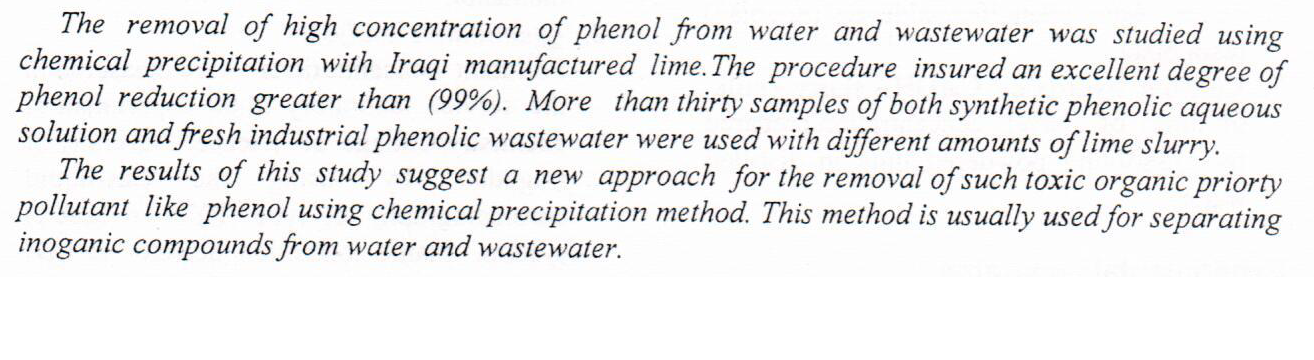
Removal of Phenol from Water and Wastewater by Chemical Precipitation with Lime

The regular job of a reservoir engineer is to put a development plan to increase hydrocarbon production as possible and within economic and technical considerations. The development strategy for the giant reservoir is a complex and challenging task through the decision-making analysis process. Due to the limited surface water treatment facility, the reservoir management team focuses on minimizing water cut as low as possible by check the flow of formation and injected water movement through the Mishrif reservoir. In this research, a representative sector was used to make the review of water injection configuration, which is considered an efficient tool to make study in a particular area of the entire field when compared with the ful
... Show More (2)
(2)


The study involved preparing a new compound by combining Schiff bases generated from compounds for antipyrine, including lanthanide ions (lanthanum, neodymium, erbium, gadolinium, and dysprosium). The preparation of the ligand from condensation reactions (4-antipyrinecarboxaldehyde with ethylene di-amine) at room temperature, and was characterization using spectroscopic and analytical studies ( FT-IR, UV-visible spectra, 1H-NMR, mass spectrometry, (C.H.N.O), thermogravimetric analysis (TGA), in addition to the magnetic susceptibility and conductivity measurement of the synthesis complexes, among the results we obtained from the tests, we showed that the ligand behaves with the (triple Valence) lanthanide ions, the multidentate
... Show More
(18)
 (3)
(3)
Objectives: The study aims at:
1- Measuring the level of lead in workers’ saliva and blood in the factory.
2- Studying the correlation between the saliva lead level and the infection that caused by microorganisms, isolation and
identification.
3-Studying the influence of high blood lead level on the total white blood cells.
Methodology: This study has been conducted for the period from March 15th, 2010 to May, 20th
, 2010. A total of (60)
saliva and blood samples were collected from workers in batteries industry factory in Baghdad and another (20) samples
were collected as a control group. Lead level had been measured in blood and saliva samples, then microorganisms were
isolated the from the saliva samples.
An experiment was carried out by using post in kalar horticulture Station/Sulaimania province on soil taked from once region sields during growing season of 2008-2009. The objective was to study adding increasing levels of urea fertilizer which is (0.0, 0.20, 0.40, 0.80) gm/Pot and superphosphate fertilizer which is (0.0, 0.24, 0.48) gm/pot in some chemical properties of grain for wheat IPA 95. This experiment was carried out by completely randomized design (CR D) with three replications. Results in dictated of clear increase in all the studied characteristics (concentration for each nitrogen, phosphorus and potassium and carbohydrate percentage with increasing levels of fertilizers).
Toxic dyes are commonly discharged into waste waters and dyes are extensively used in the textile industry so it is necessary to find out efficient and eco-friendly method for treating waste waters resulting from industrial effluences. To achieve this aim the fungus Trichoderma sp. is employed into two lines: first line was self – immobilized fungal pellets in (Czapek – Dox medium) to adsorbs two dyes crystal violet, congo red by concentrations 0.01, 0.02, 0.03, 0.04, 0.05, 0.06 mg/L to both dyes, PH 2, room temperature with shaker in ( hrs.2,hrs.4,hrs.24) , by Uv- Visible spectrum . the removal efficiency of 0.05 mg/L crystal violet by Trichoderma sp was 96%. but there was no remova
... Show More
(6)
(4)
ENGLISH
(1)
In the present study, an attempt has been to develop a new water quality index (WQI) method that depends on the Iraqi specifications for drinking water (IQS 417, 2009) to assess the validity of the Euphrates River for drinking by classifying the quality of the river water at different stations along its entire reach inside the Iraqi lands. The proposed classifications by this method are: Excellent, Good, Acceptable, Poor, and Very poor. Eight water quality parameters have been selected to represent the quality of the river water these are: Ion Hydrogen Concentration (pH), Calcium (Ca), Magnesium (Mg), Sodium (Na), Chloride (Cl), Sulphate (SO_4), Nitrate (NO_3), and Total Dissolved Solids (TDS). The variation of the water quality parameters
... Show MoreIn the present study, an attempt has been to develop a new water quality index (WQI) method that depends on the Iraqi specifications for drinking water (IQS 417, 2009) to assess the validity of the Euphrates River for drinking by classifying the quality of the river water at different stations along its entire reach inside the Iraqi lands. The proposed classifications by this method are: Excellent, Good, Acceptable, Poor, and Very poor. Eight water quality parameters have been selected to represent the quality of the river water these are: Ion Hydrogen Concentration (pH), Calcium (Ca), Magnesium (Mg), Sodium (Na), Chloride (Cl), Sulphate (SO_4), Nitrate (NO_3), and Total Dissolved Solids (TDS). The variation of the water quality p
... Show More
(24)
Researchers used different methods such as image processing and machine learning techniques in addition to medical instruments such as Placido disc, Keratoscopy, Pentacam;to help diagnosing variety of diseases that affect the eye. Our paper aims to detect one of these diseases that affect the cornea, which is Keratoconus. This is done by using image processing techniques and pattern classification methods. Pentacam is the device that is used to detect the cornea’s health; it provides four maps that can distinguish the changes on the surface of the cornea which can be used for Keratoconus detection. In this study, sixteen features were extracted from the four refractive maps along with five readings from the Pentacam software. The
... Show More
(14)
(4)
