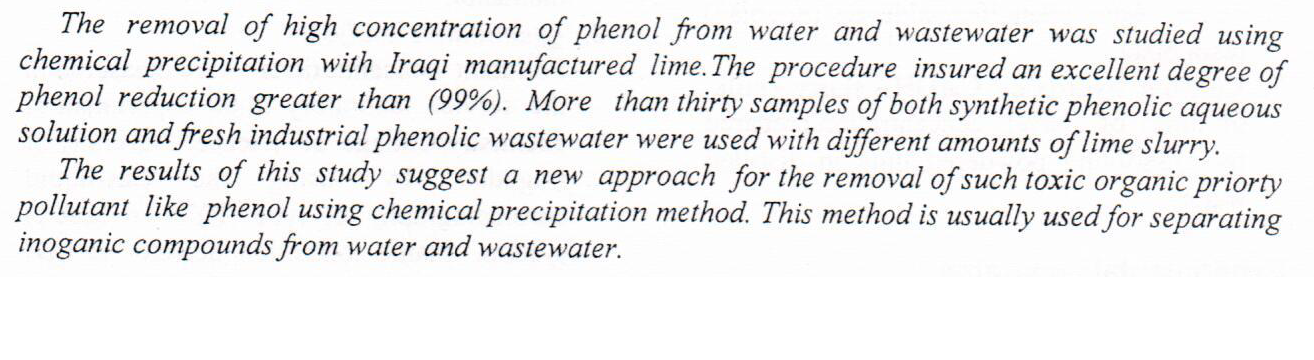
Removal of Phenol from Water and Wastewater by Chemical Precipitation with Lime

Present study was conducted in order to assess Slabiaat water quality by measuring some physical and chemical factors of river water, the study included a choice of three stations along of Slabiaat River in Samawa city, water samples collected a monthly during the period from September 2013 August 2014. The study involved measuring the Air & water temperatures, pH, Electrical conductivity, Total dissolved solids, Dissolved oxygen, Total hardness, calcium hardness, magnesium, turbidity, and some types of bacteria in River water. The study results showed that the values of air & water temperatures have ranged between (20.1-36.6)?C , (10-21.8) in Slabiaat River, respectively . pH values ranged between (6.6-8.7). Electrical conductivity in
... Show More (3)
(3)

 (16)
(16)
 (13)
(13)

Reduction of noise and vibration in spur gear experimentally by using asymmetric teeth profiles with tip relief was presented. Both of classical (symmetric) and asymmetric (with and without tip relief) spur gears are used in this work. Gear test rig was constructed to achieve torsional vibration measuring, and two modified cutters are designed and manufactured to achieve tooth profile modifications. First to cut asymmetric gear tooth with pressure angles (14.5o/25 o) without tip relief for loaded and unloaded tooth sides respectively, and second to cut asymmetric gear tooth with pressure angles (14.5o/25 o) for loaded and unloaded tooth sides respectively with tip relief to ach
... Show MoreIn this work a chemical sensor was built by using Plane Wave Expansion (PWE) modeling technique by filling the core of 1550 hollow core photonic crystal fiber with chloroform that has different concentrations after being diluted with distilled water. The minimum photonic bandgap width is.0003 and .0005 rad/sec with 19 and 7 cells respectively and a concentration of chloroform that filled these two fibers is 75%.
(8)
(6)
In this research paper, two techniques were used to treat the drill cuttings resulting from the oil-based drilling fluid. The drill cuttings were taken from the southern Rumaila fields which prepared for testing and fixed with 100 gm per sample and contaminated with two types of crude oil, one from Rumaila oilfields with Sp.gr of 0.882 and the other from the eastern Baghdad oilfield with Sp.gr of 0.924 besides contamination levels of 10% and 15% w/w in mass. Samples were treated first with microwave with a power applied of 540 & 180 watts as well as a time of 50 minutes. It was found that the results reached below 1% w/w in mass, except for two samples they reached below 1.5% w/w in mass. Then, the sample of 1.41% w/w in mass,
... Show More
Six isolates of A. pullulans were collected from many sources including Hibiscus sabdariffa (Roselle), old Roofs of houses and bathroom surface that referred as Ap ros1, Ap or2, 3, 4 and Ap bs5, 6 respectively, all these isolates were identified based on morphological characteristics and nutritional physiology profiles, all were able to utilize various carbon and nitrogen sources such as glucose, xylose, sucrose, maltose, ammonium sulfate, ammonium nitrate and ammonium chloride, also they showed positive test for starch and amylase, while α-cellulose, ethanol, and methanol were could not be ass
... Show MoreIn this study, biodiesel was prepared from chicken fat via a transesterification reaction using Mussel shells as a catalyst. Pretreatment of chicken fat was carried out using non‐catalytic esterification to reduce the free fatty acid content from 36.28 to 0.96 mg KOH/g oil using an ethanol/ fat mole ratio equal to 115:1. In the transesterification reaction, the studied variables were methanol: oil mole ratio in the range of (6:1 ‐ 30:1), catalyst loading in the range of (9‐15) wt%, reaction temperature (55‐75 °C), and reaction time (1‐7) h. The heterogeneous alkaline catalyst was greenly synthesized from waste mussel shells throughout a calcin
... Show More
(6)
(4)