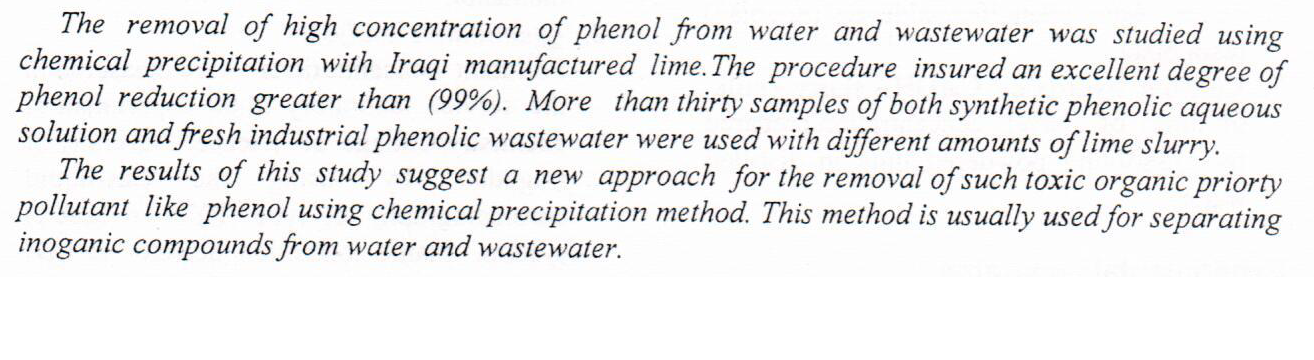
Removal of Phenol from Water and Wastewater by Chemical Precipitation with Lime

The development of economic and environmentally friendly extractants to recover cobalt metal is required due to the increasing demand for this metal. In this study, solvent extraction of Co(II) from aqueous solution using a mixture of N,N0-carbonyl difatty amides (CDFAs) synthesised from palm oil as the extractant was carried out. The effects of various parameters such as acid, contact time, extractant concentration, metal ion concentration and stripping agent and the separation of Co(II) from other metal ions such as Fe(II), Ni(II), Zn(III) and Cd(II) were investigated. It was found that the extraction of Co(II) into the organic phase involved the formation of 1:1 complexes. Co(II) was successfully separated from commonly associated metal
... Show More (27)
(27)
 (14)
(14)



Spent hydrodesulfurization (Co-Mo/γ-Al2O3) catalyst generally contains valuable metals like molybdenum (Mo), cobalt (Co), aluminium (Al) on a supporting material, such as γ-Al2O3. In the present study, a two stages alkali/acid leaching process was conducted to study leaching of cobalt, molybdenum and aluminium from Co-Mo/γ-Al2O3 catalyst. The acid leaching of spent catalyst, previously treated by alkali solution to remove molybdenum, yielded a solution rich in cobalt and aluminium.
Liquid-liquid membrane extraction technique, pertraction, using three types of solvents (methyl isobutyl ketone, n-butyl acetate, and n-amyl acetate) was used for recovery of penicillin V from simulated fermentation broth under various operating conditions of pH value (4-6) for feed and (6-8) for receiver phase, time (0-40 min), and agitation speed (300-500 rpm) in a batch laboratory unit system. The optimum conditions for extraction were at pH of 4 for feed, and 8 for receiver phase, rotation speed of 500 rpm, time of 40 min, and solvent of MIBK as membrane, where more than 98% of penicillin was extracted.
Leaching process applied for the extraction of bio active compounds from dried roots of (Elecampane) Inula helenium. Ethanol, hexane and distillated water were used as solvents. Roots were soaked with ethanol (5% w/v) with various concentration of ethanol (30 to 98%) at one day to know effect concentration of the solvent with concentration of bio active compound in Inula helenium. The same procedure was done using hexane as solvent. Also distilled water was used as solvent for extraction 5%(w/v) where plant material was soaked in water at different temperatures (25, 40, 65, 80, and 90) C. In all solvents undertaken, the effect of time duration on active ingredient (Thymol, Isoalatolactone, Alatolactone, 10-isobutyryl-oxy 8-9-epoxy thymol is
... Show More
(3)
Development and population expansion have the lion's share of driving up the fuel cost. Biodiesel has considerable attention as a renewable, ecologically friendly and alternative fuel source. In this study, CaO nanocatalyst is produced from mango leaves as a catalysis for the transesterification of waste cooking oil (WCO) to biodiesel. The mango tree is a perennial plant, and its fruit holds significant economic worth due to its abundance of vitamins and minerals. This plant has a wide geographical range and its leaves can be utilized without any negative impact on its growth and yield. An analysis was conducted to determine the calcium content in the fallen leaves, revealing a significant quantity of calcium that holds potential fo
... Show More
(15)
(9)
This research presents the possibility of using banana peel (arising from agricultural production waste) as biosorbent for removal of copper from simulated aqueous solution. Batch sorption experiments were performed as a function of pH, sorbent dose, and contact time. The optimal pH value of Copper (II) removal by banana peel was 6. The amount of sorbed metal ions was calculated as 52.632 mg/g. Sorption kinetic data were tested using pseudo-first order, and pseudo-second order models. Kinetic studies showed that the sorption followed a pseudo second order reaction due to the high correlation coefficient and the agreement between the experimental and calculated values of qe. Thermodynamic parameters such as enthalpy change (ΔH
... Show More
(2)
(153)
(141)
A novel mixed natural coagulant has been developed to remove sewage pollutants and heavy metals from Qanat- al- Jayesh by using low cost adsorbent natural materials. In these materials, significant interaction contains Arabic gum mixed with extracted silica from rice husk ash (natural coagulants) by the Batch device approach, using two variables, pH values ranging from 5-8 and contact times between 0.25-5 hrs. All wastewater samples were collected after treatment by adsorbents and examined for determination of residual heavy metal concentrations: Pb, Ni, Zn and Cu by atomic absorption spectroscopy (AAS), turbidity, pH, total dissolved salts (TDS), electrical conductivity (EC) and total salinity (TS). The results obtained indicate Th
... Show More
(2)
(2)
A novel mixed natural coagulant has been developed to remove sewage pollutants and heavy metals from Qanat- al- Jayesh by using low cost adsorbent natural materials. In these materials, significant interaction contains Arabic gum mixed with extracted silica from rice husk ash (natural coagulants) by the Batch device approach, using two variables, pH values ranging from 5-8 and contact times between 0.25-5 hrs. All wastewater samples were collected after treatment by adsorbents and examined for determination of residual heavy metal concentrations: Pb, Ni, Zn and Cu by atomic absorption spectroscopy (AAS), turbidity, pH, total dissolved salts (TDS), electrical conductivity (EC) and total salinity (TS). The results obtained indicate Th
... Show More
(2)
(2)
It included the introduction to the research and its importance, as the knee joint is one of the important joints in the human body that are susceptible to injury, and among these injuries is the roughness of the knee that occurs as a result of weakness and imbalance in the work of the quadriceps muscle, so its treatment is through rehabilitation exercises to treat weakness and gain flexibility and strength.Hence the importance of the research by developing rehabilitation exercises with different resistances in the water medium and restoring flexibility and muscular strength for patients with knee roughness for ages from 30-40 years, and the experimental method was used to solve the research problem, and the research sample included (6) of
... Show More