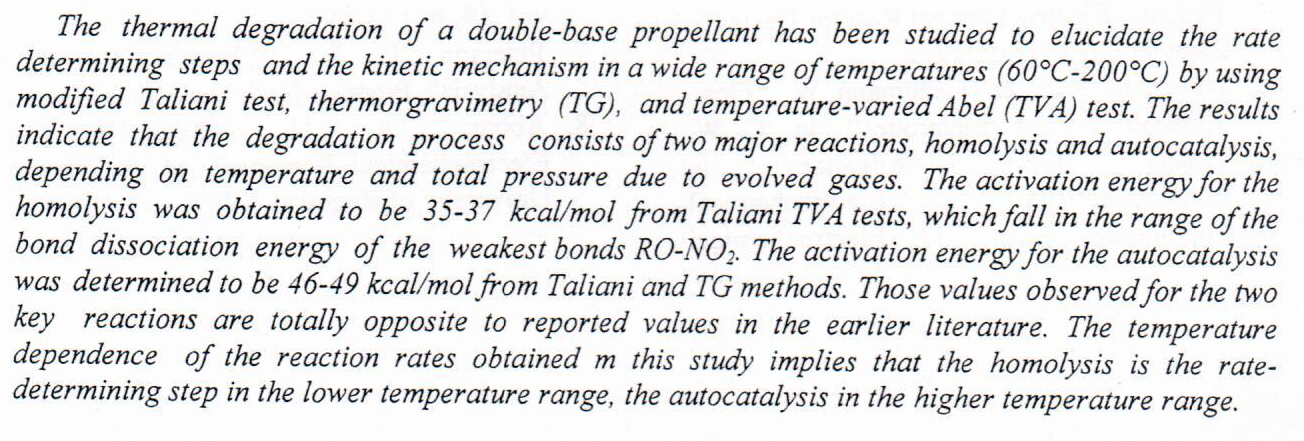
Kinetic Mechanism on Thermal Degradation of a Nitrate Ester Propellant

In this study, iron was coupled with copper to form a bimetallic compound through a biosynthetic method, which was then used as a catalyst in the Fenton-like processes for removing direct Blue 15 dye (DB15) from aqueous solution. Characterization techniques were applied on the resultant nanoparticles such as SEM, BET, EDAX, FT-IR, XRD, and zeta potential. Specifically, the rounded and shaped as spherical nanoparticles were found for green synthesized iron/copper nanoparticles (G-Fe/Cu NPs) with the size ranging from 32-59 nm, and the surface area was 4.452 m2/g. The effect of different experimental factors was studied in both batch and continuous experiments. These factors were H2O2 concentration, G-Fe/CuNPs amount, pH, initial DB15
... Show More (13)
(13)
 (8)
(8)


The Esterification kinetics of acetic acid with ethanol in the presence of sulfuric acid as a homogenous catalyst was studied with isothermal batch experiments at 50-60°C and at a different molar ratio of ethanol to acetic acid [EtOH/Ac]. Investigation of kinetics of the reaction indicated that the low of [EtOH/Ac] molar ratio is favored for esterification reaction, this is due to the reaction is catalyzed by acid. The maximum conversion, approximately 80% was obtained at 60°C for molar ratio of 10 EtOH/Ac. It was found that increasing temperature of the reaction, increases the rate constant and conversion at a certain mole ratio, that is due to the esterification is exothermic. Activity coefficients were calculated using UNIFAC progra
... Show MoreLow temperature and high relative humidity in the spring season led to decrease of field emergence ratio and growth in maize. Planting dates and seeds stimulation can be appropriate fix. Field experiment was conducted in the two spring seasons of 2022 and 2023. Randomize complete block design with split-plot arrangement and four replications was used. Planting date treatments (February 15th, March 1st and 15th and April 1st, 15th) were placed in main plots. Seeds stimulation treatments (potassium nitrate 6 mg L-1 + licorice extract 6 g L-1 as well as treatment of soaking with distilled water only) were placed in subplots. Seeds stimulation (potassium nitrate+licorice extract) or planting date of February 15th were superior at traits of fiel
... Show More
(1)
(4)
Mechanical degradation hampers the practical usage of polymers for turbulent drag reduction
application. Mechanical degradation refers to the chemical process in which the activation energy of
polymer chain scission is exceeded by mechanical action on the polymer chain, and bond rupture
occurs. When a water-soluble polymer and surfactant are mixed in water solution, the specific structures
(aggregates) are formed, in which polymer film is formed around micelle. In this work, Xanthan gum (XG) –
Sodium lauryl ether sulfate (SELS) complex formation and its effect on percentage viscosity reduction
(%VR) was studied. It was found that SELS surfactant reduced the mechanical degradation of XG much
more efficiently than th
Polyaromatic hydrocarbons (PAHs) are a group of aromatic compounds that contain at least two rings. These compounds are found naturally in petroleum products and are considered the most prevalent pollutants in the environment. The lack of microorganism capable of degrading some PAHs led to their accumulation in the environment which usually causes major health problems as many of these compounds are known carcinogens. Xanthene is one of the small PAHs which has three rings. Many xanthene derivatives are useful dyes that are used for dyeing wood and cosmetic articles. However, several studies have illustrated that these compounds have toxic and carcinogenic effects. The first step of the bacterial degradation of xanthene is conducted by d
... Show More
(7)
(6)
The art of theater penetrated various scientific and human fields, as well as touching the facts and events surrounding it, and scientific innovations had a wide field, so it adopted feedback in interactive theater performances, especially the theater of the oppressed. Then came the indicators that resulted from the theoretical framework for the formation of the tool by which the research sample is analyzed, and then the chapter concluded with previous studies. As for the third chapter, it involved the research procedures, and through the research tool and the research method, and by selecting the intentional sample, the sample represented by a play (the story of Shahrour) was analyzed. As for the fourth chapter, it included the results
... Show More
Mobile ad hoc network is nothing but the temporary network which is having the collection of mobile nodes. Routing and broadcasting are major operations of MANET network. The major operation in ad hoc mobile network is the broadcasting which sometime results to storm problem of the broadcast if the forwarding mechanism is not properly designated. Thus the challenges in the MANET are to reduce the broadcasting redundancy and under high transmission error rate provides high delivery ratio. Hence in our proposed research, we are introducing and investigating the new mechanism of broadcasting called Dual Covered Broadcast. This method takes the broadcast redundancy advantage order to improve packet delivery ratio especially under environments w
... Show More
(22)
(21)