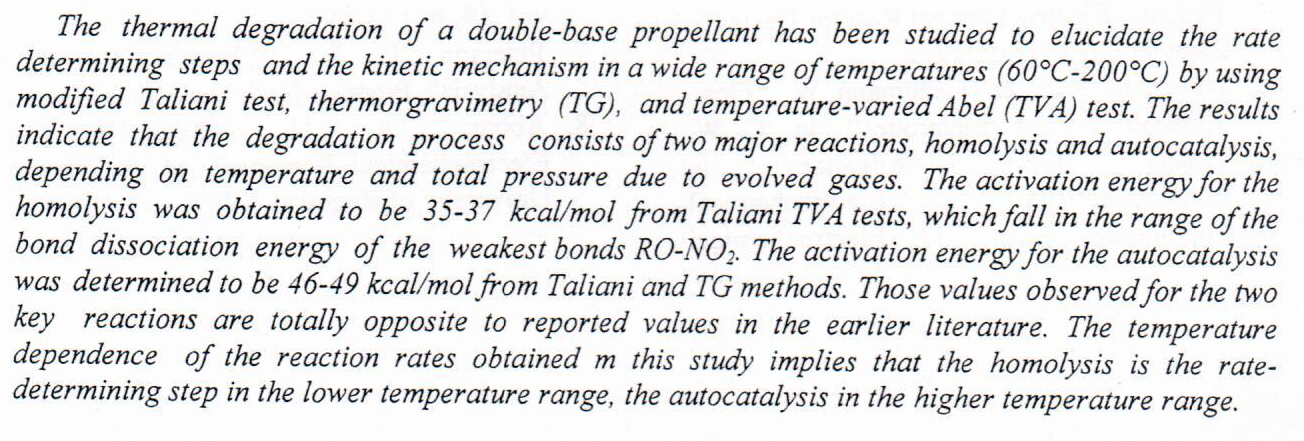
Kinetic Mechanism on Thermal Degradation of a Nitrate Ester Propellant

Toxic substances have been released into water supplies in recent decades because of fast industrialization and population growth. Fenton electrochemical process has been addressed to treat wastewater which is very popular because of its high efficiency and straightforward design. One of the advanced oxidation processes (AOPs) is electro-Fenton (EF) process, and electrode material significantly affects its performance. Nickel foam was chosen as the source of electro-generated hydrogen peroxide (H2O2) due to its good characteristics. In the present study, the main goals were to explore the effects of operation parameters (FeSO4 concentration, current density, and electrolysis time) on the catalytic performance that was optimized by r
... Show More (6)
(6)

Toxic substances have been released into water supplies in recent decades because of fast industrialization and population growth. Fenton electrochemical process has been addressed to treat wastewater which is very popular because of its high efficiency and straightforward design. One of the advanced oxidation processes (AOPs) is electro-Fenton (EF) process, and electrode material significantly affects its performance. Nickel foam was chosen as the source of electro-generated hydrogen peroxide (H2O2) due to its good characteristics. In the present study, the main goals were to explore the effects of operation parameters (FeSO4 concentration, current density, and electrolysis time) on the catalytic perform
... Show More
(6)
In this research, the mechanism of cracks propagation for epoxy/ chopped carbon fibers composites have been investigated .Carbon fibers (5%, 10%, 15%, and 20%) by weight were used to reinforce epoxy resin. Bending test was carried out to evaluate the flexural strength in order to explain the mechanism of cracks propagation. It was found that, the flexural strength will increase with increasing the percentage weight for carbon fibers. At low stresses, the cracks will state at the lower surface for the specimen. Increasing the stresses will accelerate the speed of cracks until fracture accorded .The path of cracks is changed according to the distributions of carbon fibers
Flow-injection (FI) spectrophotometric method has been developed for the analysis of thymol in pharmaceutical preparations. The method is based on organic coupling reaction between thymol and 4-amino antipyrine in the presence of alkaline medium to form an intense stable red color complex with copper nitrate that has a maximum absorption at 490 nm. Optimum conditions for determination of the drug was investigated .The calibration graph was linear over the range of 5-500 µg.ml-1 of thymol . The limit of detection (LOD) and limit of quantification (LOQ) were 1.81 ?g mL-1 and 3.60 ?g mL-1 respectively .The proposed method was applied satisfactorily to the determination of thymol in mouth wash preparations. The procedure is characterized by
... Show More
(1)
Bacterial water pollution is a genuine general wellbeing concern since it causes various maladies. Antimicrobial nanofibers can be integrated by incorporating nanobiocides, for example, silver nanoparticles into nanofibers. Nylon 6 was dissolved in formic acid at a concentration of (25 wt. %) and tough antibacterial (AgNO3/Nylon) nanofibers were produced utilizing electrospinning system. Polymer solution was tested before accomplishing electrospinning process to acquire its surface tension, electric conductivity and viscosity, where every one of those parameters increased relatively with increasing concentration of (AgNO3) additions. SEM and EDX spectra were utilized to focus on the morphology, surface elemental mem
... Show More
(4)
Mechanism of Arbitration in the Stock Exchange Disputes
This research explores the integration of multi-walled carbon nanotubes (MWCNTs) into polyvinyl alcohol (PVA) matrices to enhance their structural, electrical and thermal properties. Fourier-transform infrared spectroscopy analysis confirms the formation of a PVA-MWCNT complex. The incorporation of MWCNTs, even at low concentrations, leads to increased electrical conductivity, making the composite material suitable for applications in flexible electronics and sensors. Dielectric studies reveal frequency-dependent electrical behavior, attributed to interfacial polarization, suggesting potential uses in capacitors and energy storage devices. The introduction of MWCNTs into PVA leads to N-type semiconductor behavior, as indicated by the Hall c
... Show More (3)
(3)
(3)
(3)

Here we determined the structure of a cold active family IV esterase (EstN7) cloned
(17)
(5)
(8)
