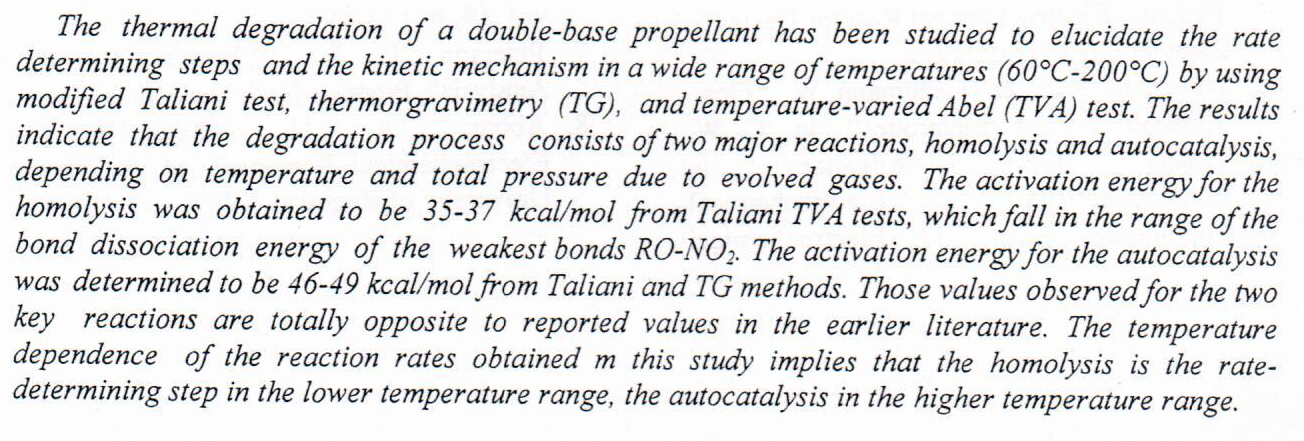
Kinetic Mechanism on Thermal Degradation of a Nitrate Ester Propellant

The research aims to develop a proposed mechanism for financial reporting on sustainable investment that takes the specificity of these investments.
To achieve this goal, the researcher used (what if scenario) where the future financial statements were prepared for the year 2026, after completion of the sustainable project and operation, as the project requires four years to be completed.
The researcher relied on the results of the researchers collected from various modern sources relevant to the research topic and published on the internet, and the financial data and information obtained to assess the reality of the company's activity and its environmental, social, and economic i
... Show More (1)
(1)

Isolated Bacteria from the roots of barley were studied; two stages of processes Isolated and screening were applied in order to nd the best bacteria to remove kerosene from soil. The acve bacteria are isolated for kerosene degradaon process. It has been found that Klebsiella pneumoniae sp. have the highest kerosene degradaon which is 88.5%. The opmum condions of kerosene degradaon by Klebsiella pneumonia sp. are pH5, 48hr incubaon period, 35°C temperature and 10000ppm the best kerosene concentraon. The results 10000ppm showed that the maximum kerosene degradaon can reach 99.58% aer 48 h of incubaon. Higher Kerosene degradaon which was 99.83% was obtained at pH5. Kerosene degradaon was found
... Show More
(7)
Isolated Bacteria from the roots of barley were studied; two stages of processes Isolated and screening were applied in order to find the best bacteria to remove kerosene from soil. The active bacteria are isolated for kerosene degradation process. It has been found that Klebsiella pneumoniae sp. have the highest kerosene degradation which is 88.5%. The optimum conditions of kerosene degradation by Klebsiella pneumonia sp. are pH5, 48hr incubation period, 35°C temperature and 10000ppm the best kerosene concentration. The results 10000ppm showed that the maximum kerosene degradation can reach 99.58% after 48 h of incubation. Higher Kerosene degradation which was 99.83% was obtained at pH5. Kerosene degradation was found to be maximum at 3
... Show More
(7)
This study include design and synthesis of 2 derivatives of compounds consisting of mefenamic acid, glycine and organic nitrates (2-nitrooxy ethanol or 1,3-dinitrooxy-2-propanol). Nitric oxide NO has been reported to support many of the same mucosal protection mechanisms as prostaglandins and is sufficient for acute gastroprotection and ulcer healing. So we suppose these 2 compounds would reduce non-steroidal anti-inflammatory drugs NSAIDs gastrointestinal side effect.
Key words: Non-Steroidal anti-inflammatory dr
... Show More
The aim of this study is to investigate the kinetics of copper removal from aqueous solutions using an electromembrane extraction (EME) system. To achieve this, a unique electrochemical cell design was adopted comprising two glass chambers, a supported liquid membrane (SLM), a graphite anode, and a stainless-steel cathode. The SLM consisted of a polypropylene flat membrane infused with 1-octanol as a solvent and bis(2-ethylhexyl) phosphate (DEHP) as a carrier. The impact of various factors on the kinetics constant rate was outlined, including the applied voltage, initial pH of the donor phase solution, and initial copper concentration. The results demonstrated a significant influence of the applied voltage on enhancing the rate of c
... Show More
(1)
 (3)
(3)

In this study, sulfur was removed from imitation oil using oxidative desulfurization process. Silicoaluminophosphate (SAPO-11) was prepared using the hydrothermal method with a concentration of carbon nanotubes (CNT) of 0% and 7.5% at 190 °C crystallization temperature. The final molar composition of the as-prepared SAPO-11 was Al2O3: 0.93P2O5: 0.414SiO2. 4% MO/SAPO-11 was prepared using impregnation methods. The produced SAPO-11 was described using X-ray diffraction (XRD) and Brunauer-Emmet-Teller (N2 adsorption–desorption isotherms). It was found that the addition of CNT increased the crystallinity of SAPO-11. The results showed that the surface area of SAPO-11 containing 7.5% CNT was 179.54 m2/g, and the pore volume was 0.31
... Show More
(6)
(12)
(11)
In this study, sulfur was removed from imitation oil using oxidative desulfurization process. Silicoaluminophosphate (SAPO-11) was prepared using the hydrothermal method with a concentration of carbon nanotubes (CNT) of 0% and 7.5% at 190 °C crystallization temperature. The final molar composition of the as-prepared SAPO-11 was Al2O3: 0.93P2O5: 0.414SiO2. 4% MO/SAPO-11 was prepared using impregnation methods. The produced SAPO-11 was described using X-ray diffraction (XRD) and Brunauer-Emmet-Teller (N2 adsorption–desorption isotherms). It was found that the addition of CNT increased the crystallinity of SAPO-11. The results showed that the surface area of SAPO-11 cont
... Show More
(6)
Background: The anticancer impact of Epigallocatechin gallate (EGCG) the highly active polyphenol of green tea was abundantly studied. Though, the exact mechanism of its cytotoxicity is still under investigation. Objectives: Hence, the current study designed to investigate the molecular target of EGCG in HepG2 cells on thirteen autophagy- and/or apoptosis- related genes. Methods: The apoptosis detection analyses such as flow cytometry and dual apoptosis assay were used. The genes expression profile was explored by the real-time quantitative-PCR. Results: EGCG increases G0/G1 cell cycle arrest and the real-time apoptosis markers proteins leading to stimulate apoptos
... Show More
(2)
(2)