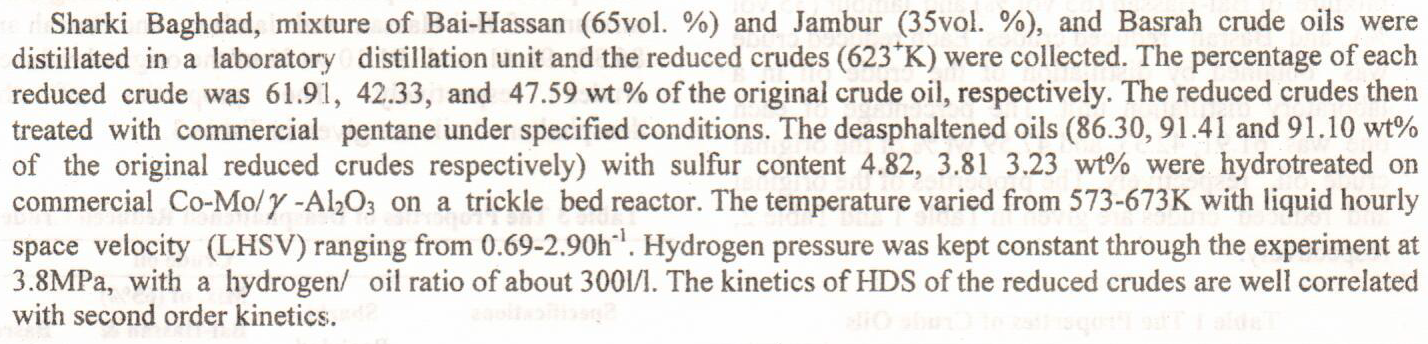
Production of Low Sulfur Fuel Oil from Different Iraqi Residues Crudes

Background: The interest in herbal extracts as antimicrobial agents has increased over the past few years in endodontic therapy. Nasturtium officinale (watercress) is a promising plant with great medicinal values. This study aimed to investigate the antifungal activity of watercress oil in combination with calcium hydroxide against Candida albicans as intracanal medicament. Materials and Methods: Candida albicans was isolated from patients with necrotic root canal or failed root canal treatment. The sensitivity of Candida albicans to different concentrations of watercress oil extract was determined by using the agar well diffusion method in comparison with calcium hydroxide paste. The agar plate method was used to determine the minimum fung
... Show More (6)
(6)
 (6)
(6)


Process capability provides a quantitative measure for gasoline production conformance to specifications.It was measured throughout four consecutive months of the last quarter of 2011. Results revealed high percentages (up to 44%) of non conforming gasoline blends to Iraqi marketing specifications for petroleum products (2000) by inspecting 122 different samples of Iraqi regular gasoline (RON 85).
Quality cost analysis as an important financial control tool was carried out to evaluate Cost of Quality (COQ) which was large due to non conforming gasoline reached up to (722.8 M.ID) in October. In this research COQ was investigated in order to identify the opportunities of gasoline quality improvements through production process. Also cus
act : A soluble cytoplasmic antigen (Brucellin) was prepared from Brucella melitensis Rev1 and used to diagnose brucellosis in experimentally infected mice with virulent strains of Brucella melitensis and Brucella abortus two weeks after infection. The best result was obtained with the third peak of the four peaks. All four peaks were used as antigen for skin test in a group of mice two weeks after vaccinated with S19 vaccine and the best result was obtained with third peak. All four peaks were also used as antigen for skin test in a group of mice previously vaccinated with Listeria monocytogenes live attenuated vaccine. All four fractions of the extracted brucellin antigens exhibited a negative skin test result in Listeria monocytogenes ex
... Show More
(4)
(1)
Natural Bauxite (BXT) mineral clay was modified with a cationic surfactant (hexadecy ltrimethy lammonium bromide (BXT-HDTMA)) and characterized with different techniques: FTIR spectroscopy, X-ray powder diffraction (XRD) and scanning electron microscopy (SEM). The modified and natural bauxite (BXT) were used as adsorbents for the adsorption of 4- Chlorophenol (4-CP) from aqueous solutions. The adsorption study was carried out at different conditions and parameters: contact time, pH value, adsorbent dosage and ionic strength. The adsorption kinetic (described by a pseudo-first order and a pseudo-second order), equilibrium experimental data (analyzed by Langmuir, Freundlich and Temkin isotherm models) and thermodynamic parameters (change in s
... Show MoreIn this study, a one-dimensional model represented by Butler-Volmer-Monod (BVM) model was proposed to compute the anode overpotential and current density in a mediator-less MFC system. The system was fueled with various organic loadings of real field petroleum refinery oily sludge to optimize the favorable organic loading for biomass to operate the suggested system. The increase in each organic loading showed higher resistance to electrons transport to the anode represented by ohmic loss. On the contrary, both activation and mass transfer losses exhibited a noticeable decrement upon the increased organic loadings. However, current density was improved throughout all increased loads achieving a maximum current density of 5.2 A/m3
... Show More
(2)
The modified Hummers method was applied to prepare graphene oxide (GO) from the graphite powder. Tin oxide nanoparticles with different loading (10-20 wt.%) supported on reduced graphene oxide were synthesized to evaluate the oxidative desulfurization efficiency. The catalyst was synthesized by the incipient wetness impregnation (IWI) technique. Different analysis methods like FT-IR, XRD, FESEM, AFM, and Brunauer-Emmett-Teller (BET) were utilized to characterize graphene oxide and catalysts. The XRD analysis showed that the average crystal size of graphene oxide was 6.05 nm. In addition, the FESEM results showed high metal oxide dispersions on the rGO. The EDX analysis shows the weight ratio of Sn is close to its theoretical weight.
... Show More
(17)
The current study deals with the performance of constructed wetland (CW) incorporating a microbial fuel cell (MFC) for wastewater treatment and electricity generation. The whole unit is referred to as CW-MFC. This technique involves two treatments; the first is an aerobic treatment which occurs in the upper layer of the system (cathode section) and the second is anaerobic biological treatment in the lower layer of the system (anode section). Two types of electrode material were tested; stainless steel and graphite. Three configurations for electrodes arrangement CW-MFC were used. In the first unit of CW-MFC, the anode was graphite plate (GPa) and cathode was also graphite plate (GPc), in the second CW-MFC unit, the anode was stainless st
... Show More
(10)
(9)

The current study deals with the performance of constructed wetland (CW) incorporating a microbial fuel cell (MFC) for wastewater treatment and electricity generation. The whole unit is referred to as CW-MFC. This technique involves two treatments; the first is an aerobic treatment which occurs in the upper layer of the system (cathode section) and the second is anaerobic biological treatment in the lower layer of the system (anode section). Two types of electrode material were tested; stainless steel and graphite. Three configurations for electrodes arrangement CW-MFC were used. In the first unit of CW-MFC, the anode was graphite plate (GPa) and cathode was also graphite plate (GPc), in the second CW-MFC unit, the anode was stainless steel
... Show More
(9)
