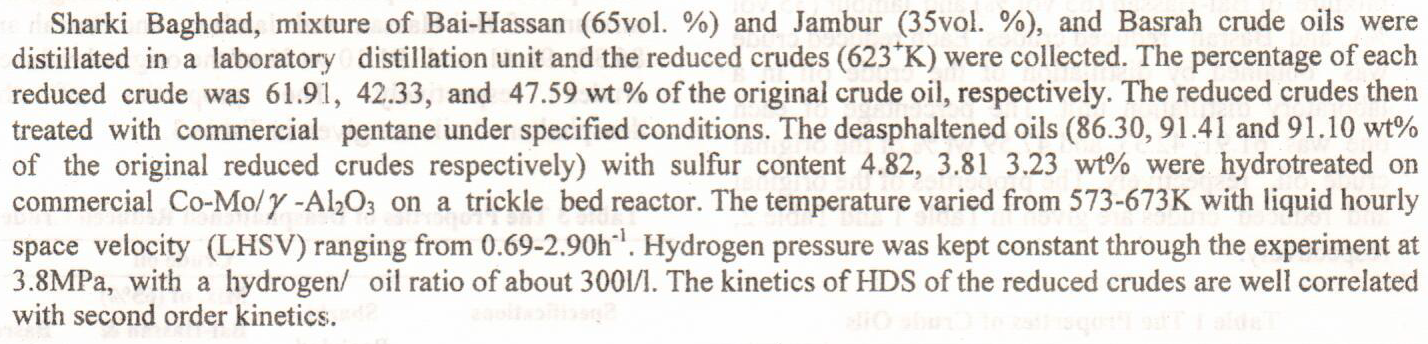
Production of Low Sulfur Fuel Oil from Different Iraqi Residues Crudes

This study investigates the possibility of removing ciprofloxacin (CIP) using three types of adsorbent based on green-prepared iron nanoparticles (Fe.NPs), copper nanoparticles (Cu. NPS), and silver nanoparticles (Ag. NPS) from synthesized aqueous solution. They were characterized using different analysis methods. According to the characterization findings, each prepared NPs has the shape of a sphere and with ranges in sizes from of 85, 47, and 32 nanometers and a surface area of 2.1913, 1.6562, and 1.2387 m2/g for Fe.NPs, Cu.NPs and Ag.NPs, respectively. The effects of various parameters such as pH, initial CIP concentration, temperature, NPs dosage, and time on CIP removal were investigated through batch experiments. The res
... Show More (3)
(3)
 (3)
(3)


Quantum key distribution (QKD) provides unconditional security in theory. However, practical QKD systems face challenges in maximizing the secure key rate and extending transmission distances. In this paper, we introduce a comparative study of the BB84 protocol using coincidence detection with two different quantum channels: a free space and underwater quantum channels. A simulated seawater was used as an example for underwater quantum channel. Different single photon detection modules were used on Bob’s side to capture the coincidence counts. Results showed that increasing the mean photon number generally leads to a higher rate of coincidence detection and therefore higher possibility of increasing the secure key rate. The secure key rat
... Show More

This studies deals with investigated the potential of a Iraqi bentonite clay for the adsorption of bromo phenol red dye from contaminated water. Impulse adsorption experiments were performed. The contact time influence of initial dye concentration, temperature, pH, ionic strength, partical size adsorbent and adsorbent dosage on bromo phenol red adsorption are investigated in a series of batch adsorption experiments. Adsorption equilibrium data were analyzed and described by the Freundlich, Langmuir and temkin isotherms equations. Thermodynamic parameters inclusive the Gibbs free energy (∆G• ), enthalpy (∆H• ), and entropy (∆S• ), were also calculated. These parameters specified that adsorption of bromo phenol red onto bentonite
... Show MoreBackground: Medical students often face substantial psychological stress, which can increase the risk of substance use, professional detriment, and insufficient patient care. However, substance use in medical students remains understudied in Iraq. This study highlights the prevalence, patterns, risk factors, and negative effects of substance use among medical students at the University of Baghdad. A cross-sectional study involving 414 medical students at the University of Baghdad was conducted. The questionnaire included sociodemographic variables and the Alcohol, Smoking, and Substance Involvement Screening Test to screen for psychoactive substance use. The lifetime prevalence of substance use was 38.9%. Among substance users, 42.8
... Show More
Three types of zeolite A were prepared from Iraqi kaoline which are 3A, 4A and 5A by ion exchange method .They were characterized by XRD and atomic absorption techniques .They were used as adsorbents to examine their applicability for H2S adsorption .The adsorption process was performed in a static form and constant volume system which constructed from stainless steel .The effect of zeolite type and temperature on the adsorption properties of H2S at -5 , 25 and 55 oC was studied .The zeolite type 5A has the highest adsorption value (79.384 µmol/g ) and the three types may be arranged in a sequence toward H2S adsorption as 5 A> 4A>3A .The amount of H2S adsorbed increased as temperature decreased from 55 to -5 for all samples. Langmuir , Fre
... Show More
(1)
The plants of genus Heliotropium L. (Boraginaceae) are well-known for containing the toxic metabolites called pyrrolizidine alkaloids (PAs) in addition to the other secondary metabolites. Its spread in the Mediterranean area northwards to central and southern Europe, Asia, South Russia, Caucasia, Afghanistan, Iran, Pakistan, and India, Saudi Arabia, Turkey, and over lower Iraq, Western desert. The present study includes the preparation of various extracts from aerial parts of the Iraqi plant. Fractionation, screening the active constituent, and identification by chromatographic techniques were carried out.Heliotropium europaeum
... Show More
(4)
(2)
Pseudomonas aeruginosa readily binds to different kind of abiotic surfaces and form biofilm. The ability of the bacterial species to form biofilm onto polyvinyl chloride (PVC) is associated with several economic, health and environmental problems. The effect of kind of water on ability of this bacterium to form biofilm is scanty in literature. In present study, the ability of different environmental isolates of P. aeruginosa to form biofilm onto polystyrene microtiter plate was evaluated. Furthermore, the effect of waters that collected from different sources on biofilm formation of this bacterium onto PVC was studied. Spectrophotometric method was used to check the ability of bacteria to form biofilm and evaluated the role of waters onto a
... Show MoreBackground: The miswak is a teeth cleaning twig made from a twig of the Salvadora persica tree (known as arak in Arabic).A traditional alternative to the modern toothbrush, it has a long, well-documented history and is reputed for its medicinal benefits. It also features prominently in Islamic hygienical jurisprudence. Materials and methods: Twenty maxillary first premolars were treated with the selected solutions which included siwak water extract (5%, 10%) and sodium fluoride 0.05% for 2minutes once daily for 20 days interval, deionized water was used as control negative. Then the concentration of the dissolved calcium ion in the etching solution of 2N HCL was measured. Results: The least amount of the dissolved calcium ion was registere
... Show More98 samples were collected from various clinical sources included (Burns, wounds, urines, sputums, blood) From the city of Baghdad, After performing the biochemical and microscopic examination, 52 isolates were obtained for Pseudomonas aeruginosa, 17 (32.7%) isolates from burn infection, 12 (23%) isolates from Wound infection 11 (21.2%) isolates from urine infection, 7 (13.5%) isolates of sputum and 5 (9.6%) isolates from blood. Bacteria susceptibility to form biofilm has been detectedby microtiter plate method, The results showed that 80% of the bacterial isolates were produced the biofilm with different proportions, alg D gene (alginate production) has been detected by polymerase chain reaction (PCR) Which plays an essential role in the fo
... Show More