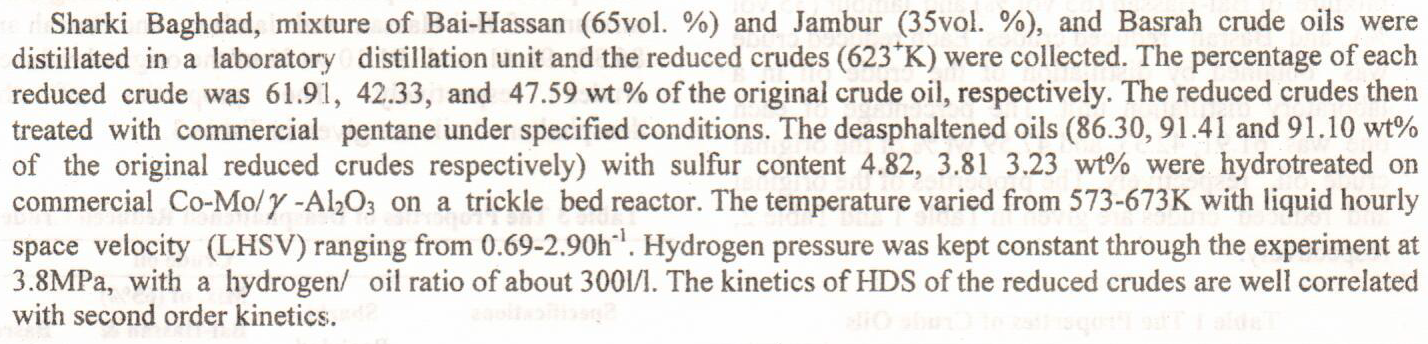
Production of Low Sulfur Fuel Oil from Different Iraqi Residues Crudes




In this paper, the time-history responses of a square plan two-story reinforced concrete prototype building, considering the elastic and inelastic behavior of the materials, were studied numerically. ABAQUS software was used in three-dimensional (3D) nonlinear dynamic analysis to predict the inelastic response of the buildings. Concrete Damage Plasticity Model (CDPM) has been used to model the inelastic behavior of the reinforced concrete building under seismic excitation. The input data included geometric information, material properties, and the ground motion. The building structure was designed only for gravity load according to ACI 318 with
... Show More
Low-pressure capacitively coupled RF discharge Ar plasma has been studied using Langmuir probe. The electron temperature, electron density and Debay length were calculated under different pressures and electrode gap. In this work the RF Langmuir probe is designed using 4MHz filter as compensation circuit and I-V probe characteristic have been investigated. The pressure varied from 0.07 mbar to 0.1 mbar while electrode gap varied from 2-5 cm. The plasma was generated using power supply at 4MHz frequency with power 300 W. The flowmeter is used to control Argon gas flow in the range of 600 standard cubic centimeters per minute (sccm). The electron temperature drops slowly with pressure and it's gradually decreased when expanding the electro
... Show More (1)
(1)
This research describes the design & implementation of frequency synthesizer using single loop Phase lock loop with the following specifications: Frequency range (1.5 – 2.75) GHz,Step size (1 MHz), Switching time 36.4 µs, & phase noise @10 kHz = -92dBc & spurious -100 dBc
The development in I.C. technology provide the simplicity in the design of frequency synthesizer because it implements the phase frequency detector(PFD) , prescalar & reference divider in single chip. Therefore our system consists of a single chip contains (low phase noise PFD, charge pump, prescalar & reference divider), voltage controlled oscillator , loop filter & reference oscillator. The single chip
... Show More (12)
(10)
(12)
(10)
The geometric morphometric technique was used to study the variables in the shape and size wings of different populations of mosquitoes Culex quinquefasciatus from different Iraqi provinces Babylon, Baghdad and Wasit. The results showed that the average of centroid size were 366, 387.5 and 407.4 Micron in Babylon, Baghdad and Kut, respectively. The statistical analysis showed that there were no significant differences in the average of centroid size of all specimens and they belong to the same species.
(2)
(12)
(11)
Abstract The surface of kaolin was diagnosed by an AFM and the results were shown The height of the highest peak reached by a quantity of Kaolin surface is 2.5 µm, the granules, and their diameter with an average diameter of 666.1nm. Using Kaolin's adsorption properties, erythrosine was removed of its aqueous solution. It was determined that the maximal dye adsorption ranged 36.53–40.61%. The results of using the Freundlich, Langmuir, and Temkin adsorption isotherms revealed that at temperatures of (298,308,318) K, the Freundlich model was followed, the Langmuir model did not match, and the Temkin model could only be partially applied. There is also physical adsorption. One of the three kinetic models of the
... Show More
The resistance of Staphylococcus aureus to ciprofloxacin has complicated the problem of treating staphylococcal associated infections in which MRSA is the causative agent since ciprofloxacin was the drug of choice to treat such infections. Our study investigated the incidence of Ciprofloxacin resistant S. aureus isolates that were also methicillin resistant among Iraqi patients. The obtained bacterial isolates were tested for Ciprofloxacin resistance using agar dilution method and the sequence of gyrA and parC. The results revealed that about 8% of the isolated MRSA strains were Ciprofloxacin resistant and the resistance was due to mutation in gyrA rather than parC.
This study utilized low-cost agricultural waste (molasses production waste powder) to extract copper ions from aqueous solutions. The present investigation explored a range of factors that influence the adsorption process, including temperature, pH, ionic strength, contact time, quantity of adsorbent, and particle size. Spectrophotometric analysis was used to determine the solution's absorbance both before and after the adsorption procedure. The Langmuir and Freundlich adsorption models were used to match the equilibrium data. The Freundlich model was determined to be the best isotherm model using the linear regression coefficient R2=0.9868. Thermodynamic parameters, including enthalpy, entropy, and Gibbs free energy, were calculate
... Show More