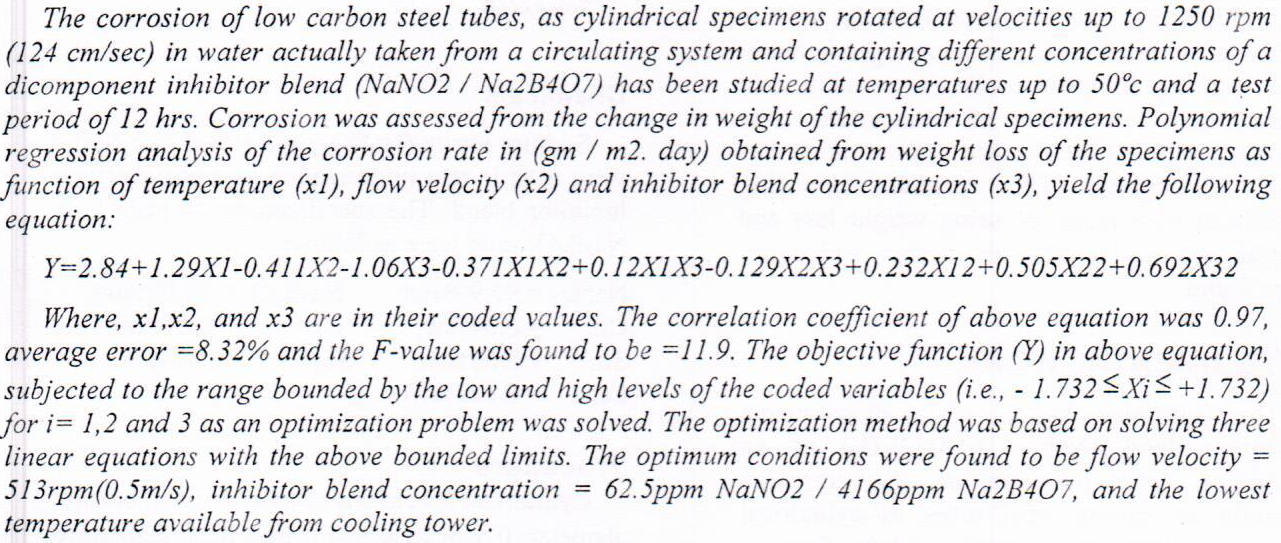
The Influence of Temperature and Flow Velocity on the Corrosion Inhibition of Low Carbon Tubes in Recirculating Water System by a Dicomponent Inhibitor Blend

The influence of fear on the dynamics of harvested prey-predator model with intra-specific competition is suggested and studied, where the fear effect from the predation causes decreases of growth rate of prey. We suppose that the predator attacks the prey under the Holling type IV functional response. he existence of the solution is investigated and the bounded-ness of the solution is studied too. In addition, the dynamical behavior of the system is established locally and globally. Furthermore, the persistence conditions are investigated. Finally, numerical analysis of the system is carried out.
 (2)
(2)
 (1)
(1)


Frictional heat is generated when the clutch starts to engag. As a result of this operation the surface temperature is increased rapidly due to the difference in speed between the driving and driven parts. The influence of the thickness of frictional facing on the distribution of the contact pressure of the multi-disc clutches has been investigated using a numerical approach (the finite element method). The analysis of contact problem has been carried out for a multiple disc dry clutch (piston, clutch discs, separators and pressure plate). The results present the distribution of the contact pressure on all tShe surfaces of friction discs that existed in the friction clutch system. Axisymmetric finite element models have been developed to ac
... Show More
(9)
(9)
 (3)
(3)
This research deals with the effects of welding variables using MIG/MAG spot by using Argon (Ar) gas and CO2 to show their effect on the mechanical characteristics and microstructure of low alloy steel type DIN15Mo3 and determine the optimum condition for the process of welding ; current & time. The results show the possibility of using CO2 and also Ar in low alloy steel welding with a little decrease in the shear force of not more than 13% for 4mm thickness and time 2sec. The shear force increased when using Ar instead of CO2 to be , The shear force reach 36KN when using Ar at 2mm thickness time of 8 sec and current of 220 Amp. , when used CO2 instead of Ar d
... Show Morehe effect of different cultural conditions on production of bioemulsifier from Serratia marcescens S10 was determined; different carbon and nitrogen sources were used such as: different oils include: edible (vegetable) oils (olive oil, sesame oil, sun flower oil and corn oil) and heavy oils (oil 150, oil 60, oil 40) as carbon sources and (NH4Cl, casein, (NH4)2SO4, peptone, tryptone, gelatin and yeast extract) as nitrogen sources were added to production media. Bioemulsifier was estimated by measuring the surface tension (S.T), emulsification activity (E.A) and emulsification index (E24%). The best results of bioemulsifier production from Serratia marcescens S10 were obtained at pH8 and incubated at 37ºC for 5days, using sesame oil
... Show More
(1)
(7)
(3)
Atenolol was used with ammonium molybdate to prove the efficiency, reliability and repeatability of the long distance chasing photometer (NAG-ADF-300-2) using continuous flow injection analysis. The method is based on reaction between atenolol and ammonium molybdate in an aqueous medium to obtain a dark brown precipitate. Optimum parameters was studied to increase the sensitivity for developed method. A linear range for calibration graph was 0.1-3.5 mmol/L for cell A and 0.3-3.5 mmol/L for cell B, and LOD 133.1680 ng/100 µL and 532.6720 ng/100 µL for cell A and cell B respectively with correlation coefficient (r) 0.9910 for cell A and 0.9901 for cell B, RSD% was lower than 1%, (n=8) for the determination of ate
... Show More
(10)
(4)
The polymer was used to inhibit the corrosion of copper metal in salt media in different concentrations at room temperature using potentiometric polarization measurement. The polymer was prepared by mixing (0.1 M) 4-Hydroxy aniline (C6H7NO) with (0.25M) of ammonium persulfate as the initiator using the electro-deposition technique. The polymer’s results showed that copper in (3.5%) NaCl had good corrosion resistance. The findings demonstrate that the %IE for polymer-induced copper corrosion is 89.32% at 10 ppm concentration as a result of the 4-hydroxy aniline polymer’s adsorption from salt solution on the surface of copper metal. The numbers from the polarization method and the acquired standard data agree well. The coated copper by po
... Show More
The polymer was used to inhibit the corrosion of copper metal in salt media in di erent concentrations at room temperature using potentiometric polarization measurement. The polymer was prepared by mixing (0.1 M) 4-Hydroxy aniline (C6H7NO) with (0.25M) of ammonium persulfate as the initiator using the electro-deposition technique. The polymer’s results showed that copper in (3.5%) NaCl had good corrosion resistance. The ndings demonstrate that the %IE for polymer-induced copper corrosion is 89.32% at 10 ppm concentration as a result of the 4-hydroxy aniline polymer’s adsorption from salt solution on the surface of copper metal. The numbers from the polarization method and the acquired standard data agree well. The coated copper by poly
... Show More