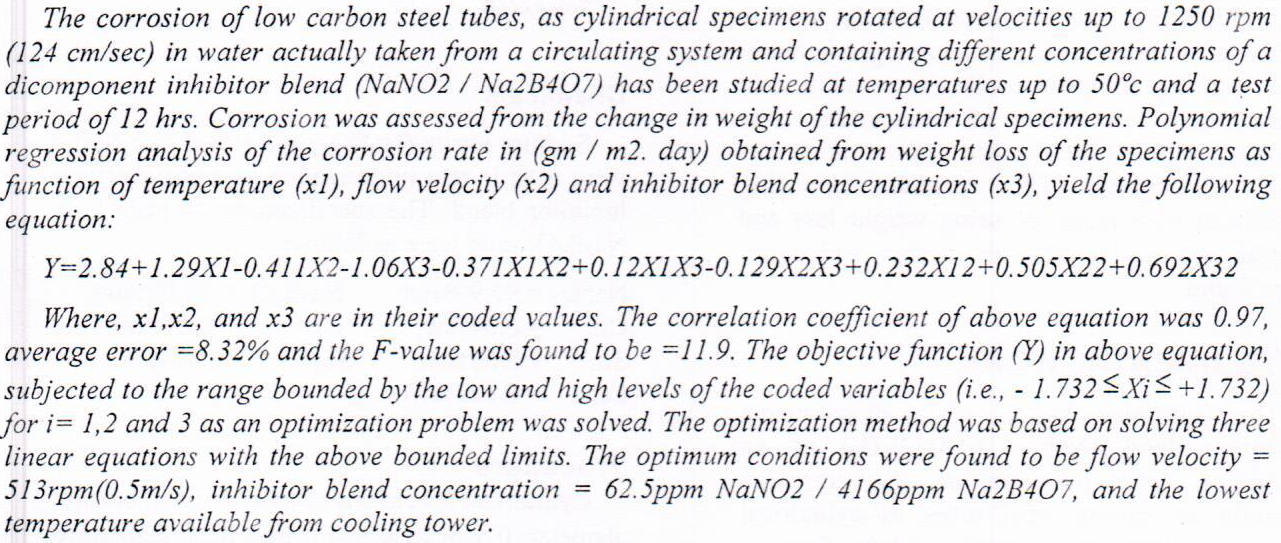
The Influence of Temperature and Flow Velocity on the Corrosion Inhibition of Low Carbon Tubes in Recirculating Water System by a Dicomponent Inhibitor Blend

This study was carried out to investigate the effects of magnetized water on accumulated infiltration depth. A test rig was designed and constructed for this purpose was installed at the water tests laboratory of the Department of Water Resources Engineering at the University of aghdad. The investigation was carried out by using two types of soil, different flow velocities throughout magnetizing device and different configuration of magnets over and under the water passage of the magnetizing device. The soils that were used in the experiments are clayey and sandy soils. Six different flow velocities throughout magnetizing device ranged between 0.29 to 1.19 cm/s and ten configurations of arranging the magnets over and under th
... Show MoreBackground: The bond strength of endodontic sealers with dentin is a very important property for maintaining the integrity and seal of the root canal filling. The aim of this study was to evaluate and compare the effect of various irrigants (QMix, 17% EDTA and 2.5% NaOCl) on the push-out bond strength of AH plus and Bioceramic sealers. Materials and methods: Forty eight freshly extracted maxillary first molars human teeth with striaght palatal root were used in the study. The collected samples were randomly divided into three groups of equal sample size (n=16), according to the final irrigation regimen as follows: Group (1): QMix 2 in 1, Group (2): 17% ethylenediaminetetraacetic acid, Group (3): 2.5% sodium hypochloride. All samples were
... Show More (4)
(4)
 (4)
(4)


Understanding the effects of fear, quadratic fixed effort harvesting, and predator-dependent refuge are essential topics in ecology. Accordingly, a modified Leslie–Gower prey–predator model incorporating these biological factors is mathematically modeled using the Beddington–DeAngelis type of functional response to describe the predation processes. The model’s qualitative features are investigated, including local equilibria stability, permanence, and global stability. Bifurcation analysis is carried out on the temporal model to identify local bifurcations such as transcritical, saddle-node, and Hopf bifurcation. A comprehensive numerical inquiry is carried out using MATLAB to verify the obtained theoretical findings and und
... Show More
(31)
(11)

Renewable energy resources have become a promissory alternative to overcome the problems related to atmospheric pollution and limited sources of fossil fuel energy. The technologies in the field of renewable energy are used also to improve the ventilation and cooling in buildings by using the solar chimney and heat exchanger. This study addresses the design, construction and testing of a cooling system by using the above two techniques. The aim was to study the effects of weather conditions on the efficiency of this system which was installed in Baghdad for April and May 2020. The common weather in these months is hot in Baghdad. The test room of the design which has a size of 1 m3 was situated to face the geographical south. The te
... Show More
(5)
(2)
(41)
(32)
A field experiment was conducted in Al-Yusufiya district - Al-Mahmoudiya district, Baghdad province during the winter season 2021, to study improving the efficiency and management of water use and the productivity of lettuce under different irrigation systems. The Nested-Factorial Experiments design was used, where the main plots include the first factor, irrigation levels (I1) 50%, (I2) 75%, (I3) 100, (I4) 125%, (I5) 150% ETpan. After depleting 35% of the available water and in terms of climatic data from the American Evaporative Basin, Class A. Then the main factor is divided into three replicates, and the coefficients of the second factor are distributed randomly within each replicate, which includes the irrigation system: surface drip i
... Show More
(10)
(3)
The corcosion behoviour of Aluminum bronze in sodium chloride solution has been studied ^tentiostatically at five temperatures in the range 293-313K.The corrosion potential shifted to more negative values with increasing temperature. The corrosion current density increased with increasing temperature. Values of Tal'el slopes and the transfer coefficients indicated hydrogen evolution reaction to occur at the cathode and mainly the dissolution at the anode.Benzotriazole (BTA) had an inhibiting effect ??? the corrosion of the Al-bronze in deaerated NaCl solution at a concentration (1*10'?- IxlO‘1) mol dm'^ over the temperature range 293-313K. Values of the protection efficiency and kinetics parameters were obtained from the corrosion current
... Show MoreA high Tc superconductor with a nominal composition
(Bi1-xPbx)2(Sr1-yBay)2Ca2Cu3O10+δ for (0 £ x £ 0.5) and (0 £ y £ 0.5) was prepared by
a solid state reaction method. The effect of the substitution of Pb for Bi and Ba for Sr and
quenching temperature on the superconductivity has been investigated to obtain the
optimum conditions for the formation and stabilization of the high Tc phase (2223).
The results showed that the optimum sintering temperature for the pure composition is
equal to 875°C and the sintering time is equal to 240h with heating and cooling rate of
60°C/h . Our results indicated that a small amount of (Ba = 0.1) could raise the transition
temperature (Tc), but enhancing Ba to 0.4 has raised