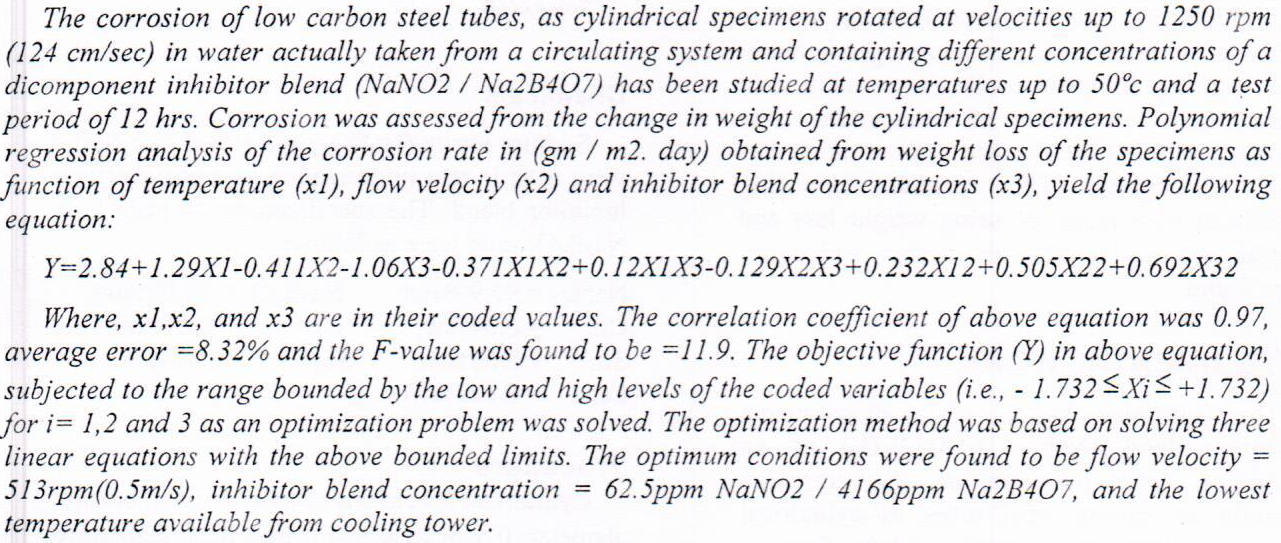
The Influence of Temperature and Flow Velocity on the Corrosion Inhibition of Low Carbon Tubes in Recirculating Water System by a Dicomponent Inhibitor Blend

A field experiment was conducted to grow the wheat crop during the fall season 2020 in Karbala province, north of Ain Al-Tamr District in two locations of different textures and parent materials. The first site (calcareous soil) with a sandy loam texture, is located at (44° 40′ 37′) east longitude and (32° 41′ 34′) north latitude, at an altitude of 32 m above sea level, and an area of 20 hectares. As for the second location (gypsum soil) with a loam texture, it is located at a longitude (45° 41′ 39′) east and a latitude (33° 43′ 34′ north) and at an altitude of 33 m above sea level and an area of 20 hectares. To find out the effect of different tillage systems on water productivity and wheat yield under center pivot irri
... Show More (6)
(6)
 (1)
(1)


The current study aimed to investigate the viability of biofilm formation klebsilla pneumoniae and Staphylococcus aureus. 440 urine samples were collected from patients suffering from urinary tract infection (UTI) from those who were admitted and visitors to Al-Ramadi Teaching Hospital, Al-Yarmouk Teaching Hospital, Al-Ramadi Teaching Hospital for women and children and , Teaching Laboratories in the Medical City for both genders for a period extended from 5 July, 2017 to 10 October, 2017. Samples were diagnosed by culturing them on a selective media and by biochemical testes , also, diagnosis was ensured by using VITEK-2 compact system. Results showed that K.pneumoniae isolation ratio was 17.1%(68) and S.aureus ratio was 13.1%(52). Thei
... Show MoreAn experimental study was performed to estimate the forced convection heat transfer performance and the pressure drop of a single layer graphene (GNPs) based DI-water nanofluid in a circular tube under a laminar flow and a uniform heat flux boundary conditions. The viscosity and thermal conductivity of nanofluid at weight concentrations of (0.1 to 1 wt%) were measured. The effects of the velocity of flow, heat flux and nanoparticle weight concentrations on the enhancement of the heat transfer are examined. The Nusselt number of the GNPs nanofluid was enhanced as the heat flux and the velocity of flow rate increased, and the maximum Nusselt number ratio (Nu nanofluid/ Nu base fluid) and thermal performance factor
... Show MoreIn this work, the effect of preparing a composite of copper oxide nanoparticles with carbon on some of its optical properties was studied. The composite preparing process was carried out by exploding graphite electrodes in an aqueous suspension of copper oxide. The properties of the plasma which is formed during the explosion were studied using emission spectroscopy in order to determine the most important elements that are present in the media. The electron’s density and their energy, which is the main factor in the composite process, were determined. The particle properties were studied before and after the exploding process. The XRD showed an additional peak in the copper oxides pattern corresponding to the hexagonal graphite struct
... Show More
Thin films of bulk heterojunction blend Ni-Phthalocyanine
Tetrasulfonic acid tetrasodium salt and dpoly
(3, 4-ethylenedioxythiophene) poly (styrenesulfonate) (NiPcTs:
PEDOT: PSS) with different (PEDOT:PSS) concentrations (0.5, 1, 2)
are prepared using spin coating technique with thickness 100 nm on
glass and Si substrate. The X-Ray diffraction pattern of NiPcTs
powder was studied and compared with NiPc powder, the pattern
showed that the structure is a polycrystalline with monoclinic phase.
XRD analysis of as-deposited (NiPcTs/PEDOT:PSS) thin films
blends in dicated that the film appeared at(100), (102) in
concentrations (0.5, 1) and (100) in concentration (2). The grain size
is increased with increasing
Most pathological effects of lead on the body are due to ability of lead to bind with important cellular molecules of various tissues and organs leading to formation abnormal molecules and thus to emergence of pathological conditions. To evaluation the risk to the health status of Iraqi workers who work in the batteries industry, expression of three types of calmodulin related genes were examined. Blood samples were collected from worker working in Iraqi industry of batteries (located in Al-Waziriya), then RNAs extraction were done thereby gene expression for Calcium/Calmodulin- dependent protein kinase2 (CaMKK2), C-X-C Chemokine receptor 4 (CXCR4) and mitogen activated protein kinase kinase 6 (MAP2K6) was done for each sample by using RT-q
... Show More
(2)
(1)

In this work, the detection of zinc (Zn) ions that cause water pollution is studied using the CSNPs- Linker-alkaloids compound that was prepared by linking extracted alkaloids from Iraqi Catharanthus roseus plant with Chitosan nanoparticles (CSNPs) using maleic anhydride. This compound is characterized by an X-ray diffractometer (XRD) which shows that it has an orthorhombic structure with crystallite size in the nano dimension. Zeta Potential results show that the CSNPs-Linker-alkaloids carried a positive charge of 54.4 mV, which means it possesses high stability. The Fourier transform infrared spectroscopy (FTIR) shows a new distinct band at 1708.93 cm-1 due to C=O esterification. Scanning electron microscope (SEM) image
... Show More
(3)
(1)
A phytoremediation experiment was carried out with kerosene as a model for total petroleum hydrocarbons. A constructed wetland of barley was exposed to kerosene pollutants at varying concentrations (1, 2, and 3% v/v) in a subsurface flow (SSF) system. After a period of 42 days of exposure, it was found that the average ability to eliminate kerosene ranged from 56.5% to 61.2%, with the highest removal obtained at a kerosene concentration of 1% v/v. The analysis of kerosene at varying initial concentrations allowed the kinetics of kerosene to be fitted with the Grau model, which was closer than that with the zero order, first order, or second order kinetic models. The experimental study showed that the barley plant designed in a subsu
... Show More
(10)
A phytoremediation experiment was carried out with kerosene as a model for total petroleum hydrocarbons. A constructed wetland of barley was exposed to kerosene pollutants at varying concentrations (1, 2, and 3% v/v) in a subsurface flow (SSF) system. After a period of 42 days of exposure, it was found that the average ability to eliminate kerosene ranged from 56.5% to 61.2%, with the highest removal obtained at a kerosene concentration of 1% v/v. The analysis of kerosene at varying initial concentrations allowed the kinetics of kerosene to be fitted with the Grau model, which was closer than that with the zero order, first order, or second order kinetic models. The experimental study showed that the barley plant designed in a subsu
... Show More
(14)
(10)
Abstract:
Through the research, I have briefly discussed the life of Imam Ali and
indicated the interpretation of the Qur'an by language and terminology, the
importance and characteristics of Sahabas', may Allah be pleased with them,
interpretation of the Qur'an. Also, the sayings of Imam Ali, wich included the
explanatory interpretation of the Qur'an by the Qura'n, Sunnah, language, and
correct opinion. I have also indicated the reasons of the Quran's revelation
and the readings of the Qura'n that had been received from him including the
interpretive meaning these readings revealed. Finally, I concluded my
research with the most important results and recommends.