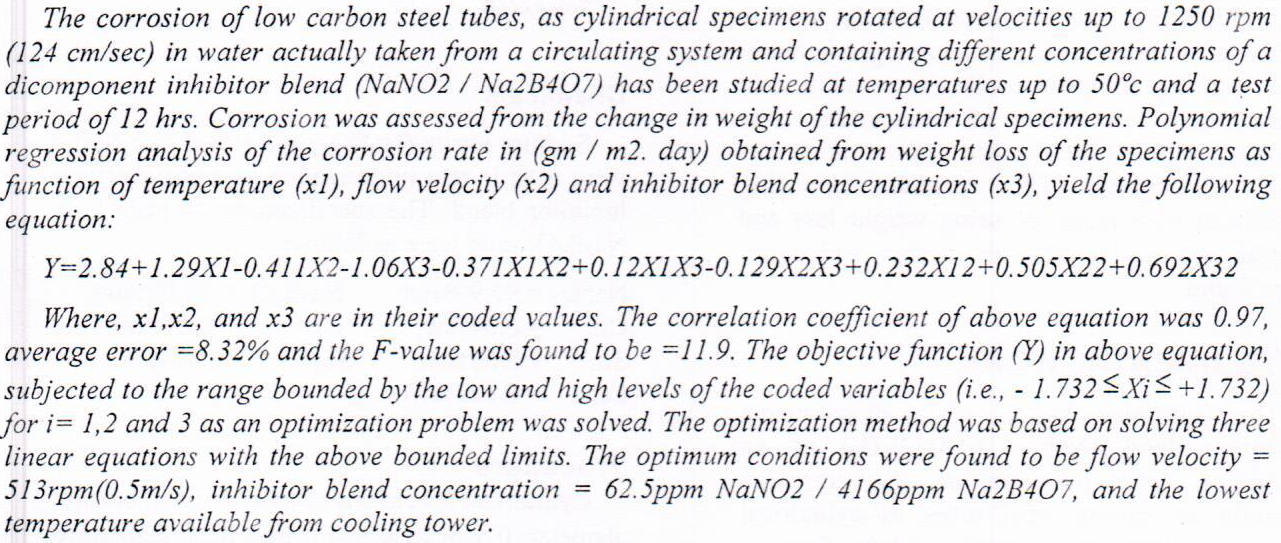
The Influence of Temperature and Flow Velocity on the Corrosion Inhibition of Low Carbon Tubes in Recirculating Water System by a Dicomponent Inhibitor Blend

Synthesis three organic inhibitors for carbon steel corrosion: 2-(propylthio)-1H-benzo[d]imidazole (PTBI), 2-(allylthio)- 1H-benzo[d]imidazole (ATBI) and 2-(prop-2-ynylthio)-1H-benzo[d]imidazole (YTBI) were prepared from reaction of 2-mercapto benzimidazole with different alkyl halide. The melting point and TLC were used to confirm the purity of the inhibitors as well as using the [FTIR, 1H-NMR and 13C-NMR] for the identify structures. The synthesized inhibitors were examined by potentiostatic polarization measurement as corrosion inhibitors of carbon steel in acidic media [1M H2SO4 ].The polarization measurement results showed that the mixed type inhibitors. In addition, the efficiency of inhibitors (YTBI) were studied at different con
... Show MoreThe corrosion behavior of carbon steel at different temperatures 100,120,140 and 160 Cͦ under different pressures 7,10 and 13 bar in pure distilled water and after adding three types of oxygen scavengers Hydroquinone, Ascorbic acid and Monoethanolamine in different concentrations 40,60 and 80 ppm has been investigated using weight loss method. The carbon steel specimens were immersed in water containing 8.2 ppm dissolved oxygen (DO) by using autoclave. It was found that corrosion behavior of carbon steel was greatly influenced by temperature with high pressure. The corrosion rate decreases, when adding any one of oxygen scavengers. The best results were obtained at a concentration of 80 ppm of each scavenger. It was observed that
... Show MoreThe inhibitive action of polyvinyl alcohol –sodium nitrite (PVASN) composite on the corrosion of mild steel in simulated cooling water (SCW) has been investigated by weight loss and potentiodynamic polarization. The effect of composite concentration (PVA/SN) , pH, and exposure time on corrosion rate of mild steel were verified using 2 levels factorial design and surface response analysis through weight loss approach, while the electrochemical measurements were used to study the behavior of mild steel in (SCW) with pH between 6 and 8 and in absence and presence of (PVA) in solution containing different concentration of NaNO2. It was verified that all three main variables studied were statistically significant while their interaction is
... Show MoreThermal energy storage is an important component in energy units to decrease the gap between energy supply and demand. Free convection and the locations of the tubes carrying the heat-transfer fluid (HTF) have a significant influence on both the energy discharging potential and the buoyancy effect during the solidification mode. In the present study, the impact of the tube position was examined during the discharging process. Liquid-fraction evolution and energy removal rate with thermo-fluid contour profiles were used to examine the performance of the unit. Heat exchanger tubes are proposed with different numbers and positions in the unit for various cases including uniform and non-uniform tubes distribution. The results show that
... Show More (14)
(14)
 (13)
(13)



Corrosion experiments were carried out to investigate the effect of several operating parameters on the corrosion rate and corrosion potential of carbon steel in turbulent flow conditions in the absence and presence of sodium benzoate inhibitor using electrochemical polarization technique. These parameters were rotational velocity (0 - 1.57 m/s), temperature (30oC – 50oC), and time. The effect of these parameters on the corrosion rate and inhibition efficiency were investigated and discussed. It was found that the corrosion rate represented by limiting current increases considerably with increasing velocity and temperature and that it decreased with time due to the formation of corrosion product layer. The corrosion potential shifted t
... Show MoreSteel corrosion in acidic environments is a critical industrial challenge, necessitating effective yet eco-friendly inhibitors. This study aims to address this problem by introducing a novel, green alternative: frankincense extract (FE). The distinctive contribution of this work lies in the comprehensive investigation of FE natural, sustainable, and economically viable resin as an effective corrosion inhibitor for carbon steel in 1 M HCl. The research employs an integrated methodology, including electrochemical techniques (potentiodynamic polarization (PDP) and electrochemical impedance spectroscopy (EIS)), adsorption isotherm modeling, surface analysis (FT-IR and FESEM/EDX), and density functional theory (DFT) calculations. Key res
... Show More
(2)
(1)
been taken at room temperature down to liquid nitrogen temperature (77K). Polar and nonpolar solvents have been used to study the solvent effect on the absorption and fluorescence spectra of solute molecules. Some of the spectroscopic parameters have been determined as functions of solvent polarity and temperature. The results indicate that the band width FWHM increases with increasing the solvent polarity and temperature, while the peak emission cross section decreases with increasing of solvent polarity and decreases with increasing the temperatures. Clear vibrational structure spectra of benzoanthracene molecules have been observed in Nonane and Hexane solvents at 77K.
This work introduces a newly synthesized triazole derivative, 5-([(2-furanyl)methyl]-thiomethyl)-4-(naphtha-2-yl)-3-hydroxyl-4H-1,2,4-triazole (FTNT), as an effective corrosion inhibitor for carbon steel A106 G/B in 0.1 M HCl solution. The structure of the novel derivative was confirmed by FTIR, 1 H NMR, and 13 C NMR spectra. Potentiodynamic polarization measurements reveal that FTNT markedly suppresses corrosion, with inhibition efficiency reaching 81.6% at 600 ppm. Thermodynamic analysis indicates spontaneous, physisorption/chemisorption-augmented adsorption of FTNT on the steel surface, best described by the Freundlich isotherm. Atomic force microscopy (AFM) surface examination demonstrated that a protective FTNT coating precipitated on
... Show MoreStabilization of phenol trapped by agricultural waste: a study of the influence of ambient temperature on the adsorbed phenol
(32)
