The Influence of Temperature and Flow Velocity on the Corrosion Inhibition of Low Carbon Tubes in Recirculating Water System by a Dicomponent Inhibitor Blend
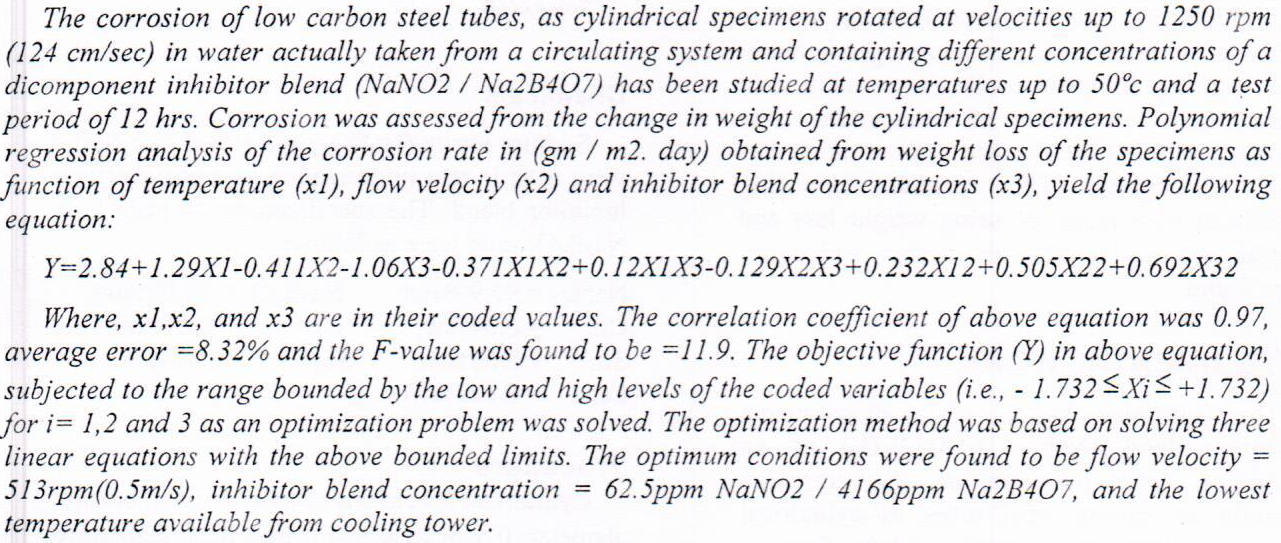

 (3)
(3)
 (1)
(1)


Objective(s): This study aims to evaluate the hardness of two commercially available cold cured acrylic resin material
(Vertex and PAN) when polymerized at different temperature in comparison to those polymerized by conventional
methods in air at 23C ± 5C.
Methodology: Eighty specimens, forty from cold cured acrylic (Vertex Type) and forty from cold cured acrylic (PAN
type) were prepared, flasking and packing procedure were done according to manufacturer direction and divided
according to processing as follow: 20 specimens (10 from Vertex type and 10 from PAN type) were processed in air for
two hours at 23C ± 5C under press (bench curing) as a control, and 60 specimens (30 from Vertex type and 30 from
PAN type) wer
Corrosion of Zn-Ni alloy coatings on stainless steel 316 SS in a chloride-sulfate bath with the addition of either triethanolamine or sucrose was examined. A constant cathode potential was used to deposit zinc-nickel alloys, while cyclic voltammetry and potentio-dynamic polarization were used to measure corrosion. In addition, scanning electron microscopy was utilized to analyse Zn-Ni alloy coating surface layers formed with¬out and with additives. The outcomes discovered that the corrosion resistance of Zn-Ni alloy coat¬ings in 3.5 % NaCl solution was highly influenced by adding triethanolamine or sucrose. Decreasing the Zn:Ni molar ratio led to an increase in corrosion resistance. All Zn-Ni alloy coatings were superior to pure Z
... Show More
(4)
(4)

In the current study, CuAl0.7In0.3Te2 thin films with 400 nm thickness were deposited on glass substrates using thermal evaporation technique. The films were annealed at various annealing temperatures of (473,573,673 and 773) K. Furthermore, the films were characterized by X-ray Diffraction spectroscopy (XRD), field emission scanning electron microscopy (FESEM), atomic force microscopy (AFM), and Ultra violet-visible (UV–vis). XRD patterns confirm that the films exhibit chalcopyrite structure and the predominant diffraction peak is oriented at (112). The grain size and surface roughness of the annealed films have been reported. Optical properties for the synthesized films including, absorbance, transmittance, dielectric constant, and refr
... Show More
(10)
(8)
(10)
(8)
This paper presents the Taguchi approach for optimization of hardness for shape memory alloy (Cu-Al-Ni) . The influence of powder metallurgy parameters on hardness has been investigated. Taguchi technique and ANOVA were used for analysis. Nine experimental runs based on Taguchi’s L9 orthogonal array were performed (OA),for two parameters was study (Pressure and sintering temperature) for three different levels (300 ,500 and 700) MPa ,(700 ,800 and 900)oC respectively . Main effect, signal-to-noise (S/N) ratio was study, and analysis of variance (ANOVA) using to investigate the micro-hardness characteristics of the shape memory alloy .after application the result of study shown the hei
... Show MoreReading roles as the third skill in the range of English as a Foreign Language (EFL) learning. Although the capability of reading in both academic and non-academic texts is assessed on standardized tests, few of oral interpretation of written language excludes images from estimating literary knowledge. This paper highlights strategies of reading comprehension and visual literacy. It aims to investigate either textual or visual reading in EFL can make an impact on students' comprehension. The effective use of visuals changes instructing reading comprehension recently.The imagery-text model can affect developing reading comprehension and enhancing intellectual thinking. The study hypothesizes that there is no relationship between reading and
... Show MoreThis research study examines the impact of information technology on firm profitability and stock returns. Using a comprehensive dataset of firms across various industries, this research employs rigorous statistical analysis techniques to investigate the relationship between IT investments, firm profitability metrics, and stock returns. The study focuses at how IT investments affect financial performance measures including return on assets (ROA) and return on equity (ROE), with P-values of 0.34 and 0.12, respectively. Furthermore, the study investigates the influence of IT on stock returns, taking into account market capitalization, industry trends, and macroeconomic variables. This study's conclusions center on the beneficial assoc
... Show More
(27)
(10)
The present paper investigates the role of fear and predator dependent refuge in the prey-predator system. The system describes the interaction between prey and a stage structure of predator that incorporates Holling II functional response. The predator splits into two compartments immature (juvenile) and mature (adult). The mature predators can hunt and reproduce but this capability is not found in the immature predators, the immature depend on their parents. The growth rate of prey decreases due to the existence of mature predators. The existence, uniqueness, and boundedness of the solution of the system are investigated. Three equilibrium points of the system are determined. The local stability of the system is studied. The global stabil
... Show More