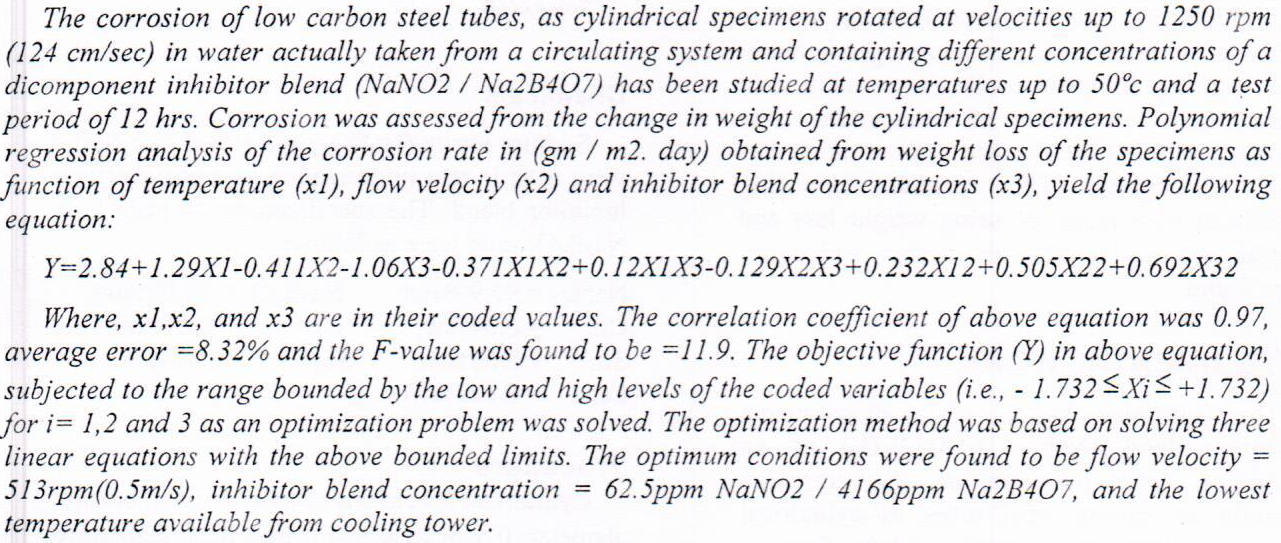
The Influence of Temperature and Flow Velocity on the Corrosion Inhibition of Low Carbon Tubes in Recirculating Water System by a Dicomponent Inhibitor Blend

One hundred and eighty five urine samples were collected eight isolates (4.3%) were obtained and diagnosed as Staphylococcus aureus. Among 8 isolates, 5 (62.5%) S. aureus isolates were found to be enterotoxigenic, most of isolates produced at least two types of Staphylococcal enterotoxins (SEs). The production of enterotoxins in the presence or absence of Thymol extracts (aqueous and alcoholic) were estimated using a reversed passive latex agglutination (SET-RPLA) kit. The extracts reduced enterotoxin production compared with the control. Enterotoxin inhibition was observed for enterotoxin C production at minimal inhibitory concentrations (MIC) at 400 µg/ml, whereas production of enterotoxins A, B, and
... Show MoreThe problem of job burnout has become one of the main problems for researchers in social welfare organizations (social protection bodies) - one of the formations of the Ministry of Labor and Social Affairs. Its negative effects increased in light of the COVID-19 pandemic, and in light of the Corona pandemic, the pressures and burdens of workers varied, which resulted in high rates of anxiety, tension, and intellectual and physical exhaustion, and then negatively affected their efficiency in performing work at the individual and organizational level, especially after the increasing tasks of these Bodies in carrying out their role in achieving the general goals and objectives as beingThe general goals are that they are responsible for providi
... Show MoreMyrtle plant was washed, dried, and powdered after harvesting to produce a fine powder used in water treatment. An alcoholic extract was created from the myrtle plant using ethanol, which was then analyzed using GC-Mass, Fourier Transform Infrared spectroscopy, and ultraviolet-visible spectroscopy to identify the active components. Zinc nanoparticles were created using alcoholic extract. FT-IR, UV-Vis, SEM, EDX, and TEM were used to characterize zinc nanoparticles. Using a continuous processing procedure, zinc nanoparticles with myrtle extract and powder were employed to clean polluted water containing pesticides and antibiotic. First, 2 g of zinc nanoparticles was mixed with 20 ml of polluted water and the result was (Tetra 44%, Levo 32%),
... Show MoreThe right of the patient to know the medical risks surrounding the medical intervention is one of the most prominent rights based on the principle of "physical safety", which has undergone several stages of development until it reached the development of the patient's independence in making medical decision without relying on the doctor, The patient's prior informed consent is informed of his / her medical condition. We will study this development in accordance with the French March 4, 2002 legislation on the rights of patients in the health system, whether it was earlier and later. We will highlight the development of the patient's right to "know the medical risks surrounding medical intervention" The legislation and its comparison with th
... Show MoreThe compounding of polyvinyl chloride (PVC) with two types of fillers and some additives were studied for the manufacturing of acid resistant tile. Various concentrations of two types of fillers namely; calcium carbonate and recycled glass powder were used along with different additives generally categorized as plasticizers, stabilizers, and lubricants were mixed in the standard concentration unit parts per hundred resins (phr) with the PVC as base polymer. The effects of filler materials on acid resistant towered different acids like sulphuric, nitric and hydrochloric at different concentration were studied. Samples which passed the test were further checked for dielectric strength and mechanical properties. It was found that the recycl
... Show More
Purpose: The research aims to study the measurement of the performance of accounting units level of the research sample by using the Federal quality Model European (EFQM) Design/methodology/approach: the (EFQM) which included seven dimensions "Leadership, Strategic Planning, External Focus, Information and Analysis, Faculty / Staff and Workplace Focus, Process Effectiveness & Outcomes and Achievements" And its effect on the Control Environment, which includes three dimensions: "Integrity, management philosophy and commitment to powers" . the sample is supervisory units of colleges affiliated with the University of Baghdad in Iraq, and a sample was chosen that included fifty-one individuals in the accounting departments.
... Show More (24)
(24)
 (4)
(4)

This research aims to investigate the effect of four types of nanomaterial on the Marshall properties and durability of warm mix asphalt (WMA). These types are; nano silica(NS), nano carbonate calcium (NCC), nano clay(NC), and nanoplatelets (NP). For each type of Nanomaterial, three contents are tried as following; NS(1%, 3%, and 5%), NCC(2%, 4%, and 6%), NC(3%, 5%, and 7%), and NP (2%, 4%, and 6%) by weight of asphalt cement. Following Marhsall mix design method, the optimum asphalt cement content is determined, thereafter the optimum dosage for each nanomaterial is obtained based on the highest Marshall stability value. The durability of the control mix (no nanomaterial) and modified mixtures have been compared based on moisture damage, r
... Show More
(10)
(8)

Electrochemical Machining is a term given to one of nontraditional machining that uses a chemical reaction associated with electric current to remove the material. The process is depending on the principle of anodic dissolution theory for evaluating material removal during electrochemical process. In this study, the electrochemical machining was used to remove 1 mm from the length of the a workpiece (stainless steel 316 H) by immersing it in to electrolyte (10, 20 and 30 g) of NaCl and Na2SO4 to every (1 litter of filtered water). The tool used was made from copper. Gap size between the workpiece and electrode is (0.5) mm. This study focuses on the effect of the changing the type and concentration of electroly
... Show MoreDyspepsia is a significant public health issue that affects the entire world population. In this work, we formulate and analyze a deterministic model for the population dynamics of Gut bacteria in the presence of antibiotics and Probiotic supplements. All the possible equilibria and their local stability are obtained. The global stability around the positive equilibrium point is established. Numerical simulations back up our analytical findings and show the temporal dynamics of gut microorganisms.
(15)