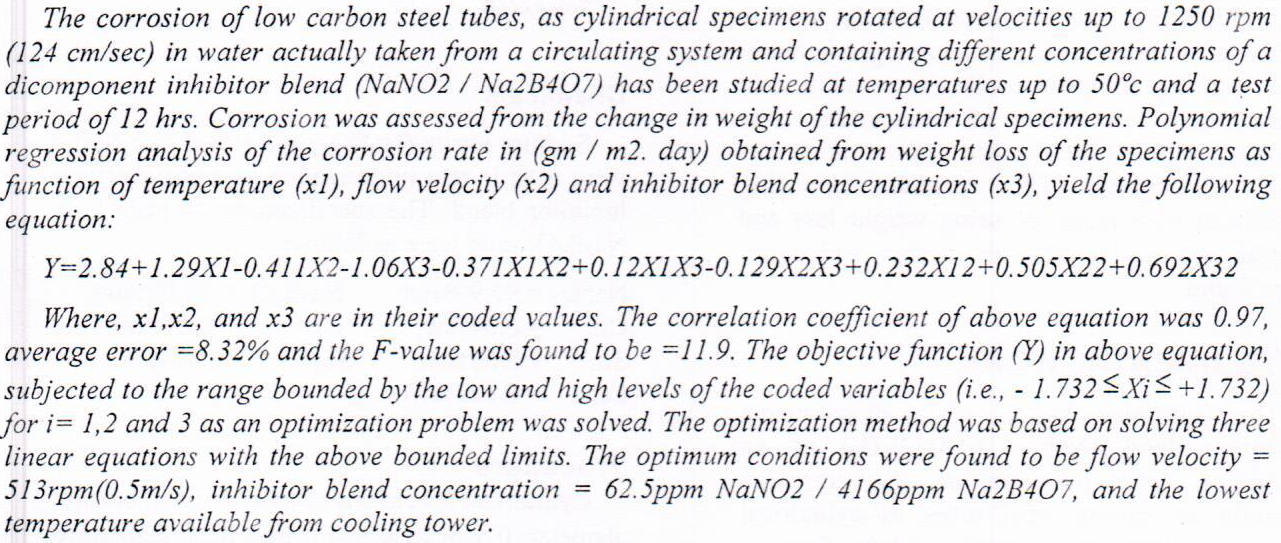
The Influence of Temperature and Flow Velocity on the Corrosion Inhibition of Low Carbon Tubes in Recirculating Water System by a Dicomponent Inhibitor Blend

Metal nanoparticles can serve as an efficient nano-heat source with confinement photothermal effects. Thermo-plasmonic technology allows researchers to control the temperature at a nanoscale due to the possibility of precise light propagation. The response of opto-thermal generation of single gold-silica core-shell nanoparticle immersed in water and Poly-vinylpyrrolidone surrounding media is theoretically investigated. Two lasers (CW and fs pulses) at the plasmonic resonance (532 nm) are utilized. For this purpose, finite element method is used via COMSOL multiphysics to find a numerical computation of absorption cross section for the proposed core –shell NP in different media. Thermo-plasmonic response for both lasers is studied. The
... Show More (21)
(21)
 (9)
(9)



In recent years, literary studies have witnessed a remarkable shift towards employing digital technologies, particularly artificial intelligence tools, in analyzing literary texts and exploring their linguistic and semantic structures. This trend has provided researchers with new possibilities for understanding texts in quantitative and qualitative ways that transcend traditional methods based solely on critical reading. The current research aims to introduce professors and students of Arabic to artificial intelligence tools that contribute to the analysis of literary texts, focusing on exploring their mechanisms for studying style, meaning, structure, and emotion. It also seeks to highlight the most prominent challenges facing researchers
... Show More
(1)
The letters are exposed in some texts of the classical Arabic language (poetry or prose), or in some of the Qur’anic texts, which are the main sources that were adopted on the day when provisions, rules and linguistic controls were established. I say that some of these letters are exposed in some contexts to deletion, mention, or change in the structure and shape of the letter. As for the omission, it is one of the aspects that distinguished Arabic, as well as other languages, for many purposes that differ among their user.
(3)
There many methods for estimation of permeability. In this Paper, permeability has been estimated by two methods. The conventional and modified methods are used to calculate flow zone indicator (FZI). The hydraulic flow unit (HU) was identified by FZI technique. This technique is effective in predicting the permeability in un-cored intervals/wells. HU is related with FZI and rock quality index (RQI). All available cores from 7 wells (Su -4, Su -5, Su -7, Su -8, Su -9, Su -12, and Su -14) were used to be database for HU classification. The plot of probability cumulative of FZI is used. The plot of core-derived probability FZI for both modified and conventional method which indicates 4 Hu (A, B, C and D) for Nahr Umr forma
... Show More
(7)
(3)
The primary objective of this paper is to improve a biometric authentication and classification model using the ear as a distinct part of the face since it is unchanged with time and unaffected by facial expressions. The proposed model is a new scenario for enhancing ear recognition accuracy via modifying the AdaBoost algorithm to optimize adaptive learning. To overcome the limitation of image illumination, occlusion, and problems of image registration, the Scale-invariant feature transform technique was used to extract features. Various consecutive phases were used to improve classification accuracy. These phases are image acquisition, preprocessing, filtering, smoothing, and feature extraction. To assess the proposed
... Show More
(2)
With wireless sensor network (WSN) wide applications in popularity, securing its data becomes a requirement. This can be accomplished by encrypting sensor node data. In this paper a new an efficient symmetric cryptographic algorithm is presented. This algorithm is called wireless sensor network wavelet curve ciphering system (WSN-WCCS). The algorithm idea based on discrete wavelet transformation to generate keys for each node in WSN. It implements on hierarchical clustering WSN using LEACH protocol. Python programming language version 2.7 was used to create the simulator of WSN framework and implement a WSN-WCCS algorithm. The simulation result of the proposed WSN-WCCS with other symmetric algorithms has show
... Show More
(12)