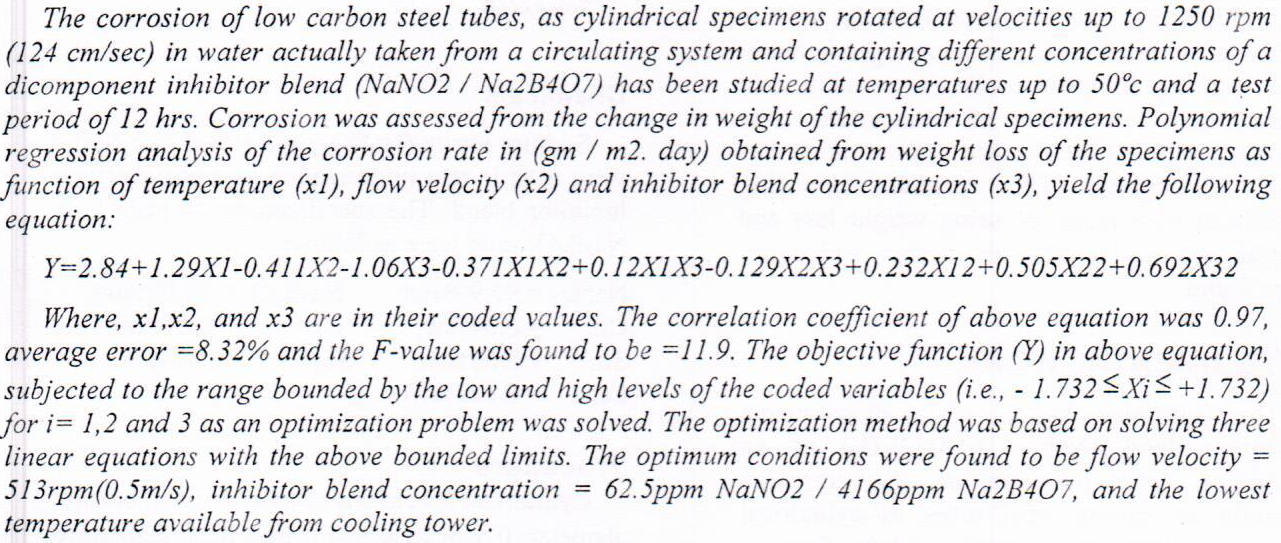
The Influence of Temperature and Flow Velocity on the Corrosion Inhibition of Low Carbon Tubes in Recirculating Water System by a Dicomponent Inhibitor Blend

This study included the preparation of the mixture aquatic extracts of Peganum harmala seeds and Pericarp of Punica granutum at concentration (10+50) ?(15+55)? (20+60) mgml .To study the influence of the mixture on the percentage of vitality of the protoscolices of E. granulosus In vitro, as the vitality of protoscolices had caused complete death when the using concentration at time 120,90,60 minute respectively. Also study the effect of mixture in white mice with infectious protoscolices In vivo and study the change occurred in the averages of the weights of the liver and spleen and the averages of its distension In vivo in processed group with mixture at concentration (15+55) , (10+50)mgml ,as which was approach to the negative gro
... Show More
Imidacloprid is systemic insecticide (1-[(6-chloro-3-pyridinyl) methyl]-N-nitro-2-imidazolidinimine) and the world’s most widely used has significant efficacy against a broad variety of pests and a unique mode of action by using it spreader and irrigation. The persistence of this pesticide in the soil means that it causes environmental damage that must be cleaned up. In this study collected and identified the best bacteria isolate that breakdown imidacloprid from the Plant Protection Director in Baghdad, which has been using neonicotinoid pesticides for years in their own greenhouse for pest control. Using high-performance liquid chromatography HPLC to measuring the residual concentrations of imidacloprid in MSM media at a concentration o
... Show More
 (10)
(10)
 (7)
(7)

A simple , sensitive and accurate spectrophotometric method for the trace determination of bismuth (III) has been developed .This method is based on the reaction of bismuth (III) with arsenazo(III) in acid solution (pH=1.9) to form a blue water soluble complex which exhibits maximum absorption at 612nm .Beer's law is obeyed over the concentration range of 2-85 ?g bismuth (III) in a final volume of 20 mL( i.e. 0.1 – 4.25?g.mL-1) with a correlation coefficient of (0.9981) and molar absorptivity 1.9×10⁴ L.mol-1.cm-1 . The limit of detection (LOD) and the limit of quantification (LOQ) are 0.0633 and 0.0847 ?g.mL-1 , respectively . Under optimum conditions,the stoichiometry of the reaction between bismuth (III) and arsenazo(III) r
... Show More
Natural polymers are often non-toxic, biodegradable, biocompatible, and safe. A novel ligand was synthesized as a natural polymer using chitosan and oleander plant extract [(2R,3S,4R,5S)-5-(acetoxyamino)-4-hydroxy-3,6-dimethoxytetrahydro-2H-pyran-2-yl) methyl (16R)-3-(((2S,4S,5R)-4-methoxy-2,5-dimethyltetrahydro-2H-pyran-2-yl)oxy-10,13,16-trimethyl-17-(5-oxo-2,5-dihydrofuran-3-yl) hexadecahydro-14H-cyclopenta [a] phenanthren-14-yl) phthalate] (Chitosan-Ph-Oleander). This ligand and its complexes with several metals (Cr+3, Mn+2, Fe+3, Ni+2, Cu+2, Zn+2) were characterized using FTIR, UV-visible and 1H-NMR spectroscopy, as well as by molar conductivity, magnetic moment, and TGA analysis. The biological activity for the prepared polymer
... Show More
(2)
Groundwater quality deterioration due to anthropogenic natural activities and its immense utilization in various sectors is considered a great concern. The aim of this study is to determine the groundwater quality parameters at various sources in and around Dhaka city and compare them with Bangladesh drinking water standards. In this study, six groundwater quality parameters (pH, DO, COD, TS, TDS, and arsenic) and ten groundwater samples are analyzed to determine the water quality. The collected samples have maximum and minimum pH values of 6.9 and 6.4, respectively. Maximum and minimum DO values are 0.3 and 0.1 mg/L, respectively. The arsenic concentration is 0 mg/L for all collected groundwater samples. The maximum and minimum COD
... Show More
(21)
(16)