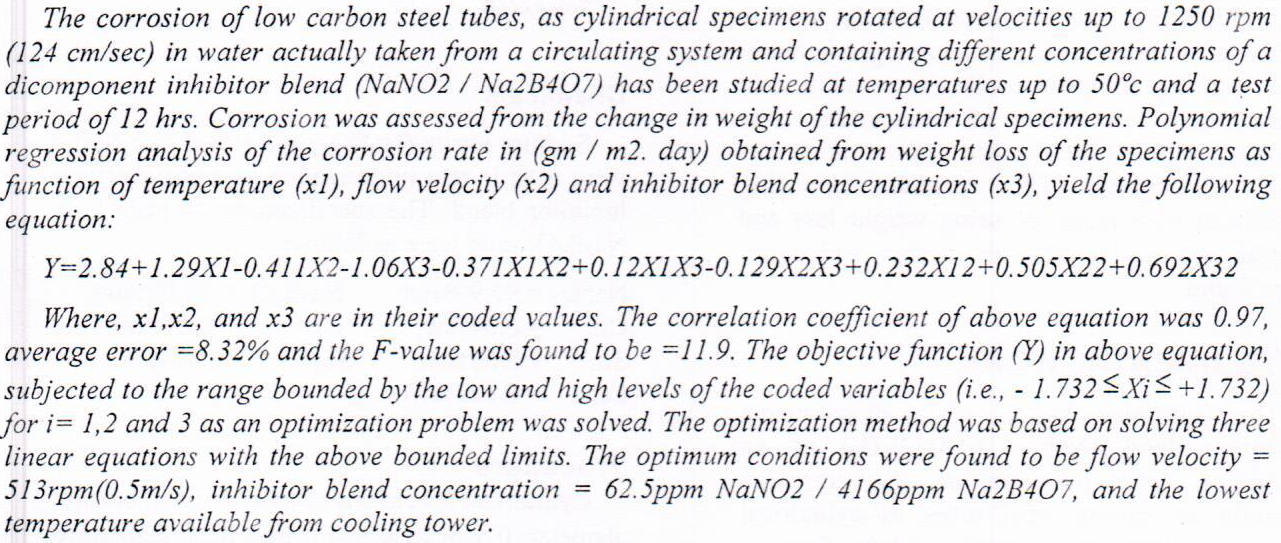
The Influence of Temperature and Flow Velocity on the Corrosion Inhibition of Low Carbon Tubes in Recirculating Water System by a Dicomponent Inhibitor Blend

Sphingolipids (SLs) are major structural constituents of eukaryotes, including the kinetoplastid parasite Leishmania. SLs are important for cellular trafficking and signaling and participate in different cell functions, such as, differentiation and cell death (apoptosis). In this study we have investigated the viability of Leishmania major wild type (W.T) and L. major knockout LmLCB2, one of two subunits of serine palmitoyl transferase (SPT) after treatment with myriocin (potent inhibitor of SPT) in order to detect the survival and proliferation of the parasites in vitro. This is to focus on the de novo sphingolipids biosynthesis pathway in both Leishmania wild type which can synthesize SPT and knockout Leishmania which genetically ablated
... Show More (24)
(24)
 (28)
(28)



Tin dioxide (SnO2) were mixed with (TiO2 and CuO) with concentration ratio (50, 60, 70, 80 and 90) wt% films deposited on single crystal Si and glass substrates at (523 K) by spray pyrolysis technique from aqueous solutions containing tin (II) dichloride Dihydrate (SnCl2, 2H2O), dehydrate copper chloride (CuCl2.2H2O) and Titanium(III) chloride (TiCl3) with molarities (0.2 M). The results of electrical properties and analysis of gas sensing properties of films are presented in this report. Hall measurement showed that films were n-type converted to p- type as titanium and copper oxide added at (50) % ratio. The D.C conductivity measurements referred that there are two mechanisms responsible about the conductivity, hence it possess two act
... Show More
(4)
In this paper, we calculate and measure the SNR theoretically and experimental for digital full duplex optical communication systems for different ranges in free space, the system consists of transmitter and receiver in each side. The semiconductor laser (pointer) was used as a carrier wave in free space with the specification is 5mW power and 650nm wavelength. The type of optical detector was used a PIN with area 1mm2 and responsively 0.4A/W for this wavelength. The results show a high quality optical communication system for different range from (300-1300)m with different bit rat (60-140)kbit/sec is achieved with best values of the signal to noise ratio (SNR).
(1)
Geologic modeling is the art of constructing a structural and stratigraphic model of a reservoir from analyses and interpretations of seismic data, log data, core data, etc. [1].
A static reservoir model typically involves four main stages, these stages are Structural modeling, Stratigraphic modeling, Lithological modeling and Petrophysical modeling [2].
Ismail field is exploration structure, located in the north Iraq, about 55 km north-west of Kirkuk city, to the north-west of the Bai Hassan field, the distance between the Bai Hassan field and Ismael field is about one kilometer [3].
Tertiary period reservoir sequences (Main Limestone), which comprise many economica
... Show More
<span lang="EN-GB">Transmitting the highest capacity throughput over the longest possible distance without any regeneration stage is an important goal of any long-haul optical network system. Accordingly, Polarization-Multiplexed Quadrature Phase-Shift-Keying (PM-QPSK) was introduced lately to achieve high bit-rate with relatively high spectral efficiency. Unfortunately, the required broad bandwidth of PM-QPSK increases the linear and nonlinear impairments in the physical layer of the optical fiber network. Increased attention has been spent to compensate for these impairments in the last years. In this paper, Single Mode Fiber (SMF), single channel, PM-QPSK transceiver was simulated, with a mix of optical and electrical (Digi
... Show More
(4)
(1)
(5)
(4)
This paper presents a study to investigate the behavior of post-tensioned segmental concrete beams that exposed to high-temperature. The experimental program included fabricating and testing twelve simply supported beams that divided into three groups depending on the number of precasting concrete segments. All specimens were prepared with an identical length of 3150 mm and differed in the number of the incorporated segments of the beam (9, 7, or 5 segments). To simulate the genuine fire disasters, nine out of twelve beams were exposed to a high-temperature flame for one hour. Based on the standard fire curve (ASTM – E119), the temperatures of 300◦C (572◦F), 500◦C (932◦F), and 700◦C (1292◦F) were adopted. Consequently,
... Show More
(1)
(1)