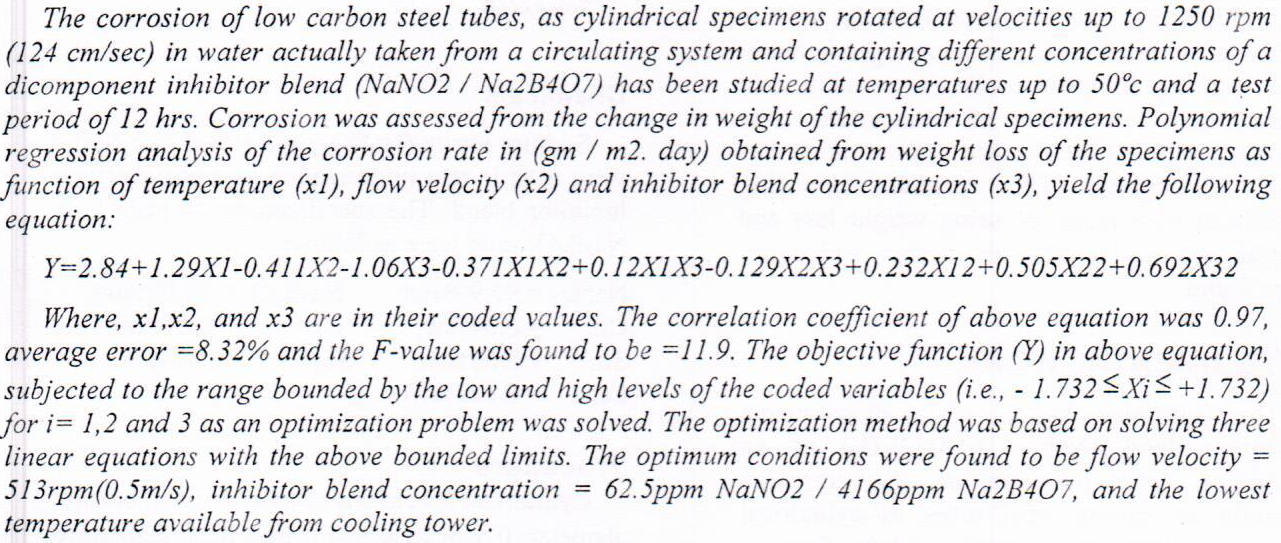
The Influence of Temperature and Flow Velocity on the Corrosion Inhibition of Low Carbon Tubes in Recirculating Water System by a Dicomponent Inhibitor Blend

Glass Fiber Reinforced Polymer (GFRP) beams have gained attention due to their promising mechanical properties and potential for structural applications. Combining GFRP core and encasing materials creates a composite beam with superior mechanical properties. This paper describes the testing encased GFRP beams as composite Reinforced Concrete (RC) beams under low-velocity impact load. Theoretical analysis was used with practical results to simulate the tested beams' behavior and predict the generated energies during the impact loading. The impact response was investigated using repeated drops of 42.5 kg falling mass from various heights. An analysis was performed using accelerometer readings to calculate the generalized inertial load. The in
... Show MoreA detailed methodology is presented in this paper for the calculation of nucleate boiling safety margin (NBSM) in nuclear research reactors using a temperature function with three different thermal-hydraulic hot-spot analyses: nominal, cumulative and statistical for normal operating condition and coolant flow variation. A computer simulation program is developed for applying the methodology to the IRT-5000 reactor based on experimental core data. According to cumulative analysis as the overconservative approach, the NBSM at normal operating condition of thermal power 5 MW and coolant velocity 1.672 m/s was 2.3% with reactor power limit 5.13 MW. However, during power or coolant flow trip condition, transient nucleate boiling would occur for
... Show More

For more than a decade, externally bonded carbon fiber reinforced polymer (CFRP) composites successfully utilized in retrofitting reinforced concrete structural elements. The function of CFRP reinforcement in increasing the ductility of reinforced concrete (RC) beam is essential in such members. Flexural and shear behaviors, ductility, and confinement were the main studied properties that used the CFRP as a strengthening material. However, limited attention has been paid to investigate the energy absorption of torsion strengthening of concrete members, especially two-span concrete beams. Hence, the target of this work is to investigate the effectiveness of CFRP-strengthening technique with regard to energy absorption of two-span RC
... Show More (26)
(26)
 (20)
(20)

Copper oxide (CuO) nanoparticles were synthesized through the thermal decomposition of a copper(II) Schiff-base complex. The complex was formed by reacting cupric acetate with a Schiff base in a 2:1 metal-to-ligand ratio. The Schiff base itself was synthesized via the condensation of benzidine and 2-hydroxybenzaldehyde in the presence of glacial acetic acid. This newly synthesized symmetric Schiff base served as the ligand for the Cu(II) metal ion complex. The ligand and its complex were characterized using several spectroscopic methods, including FTIR, UV-vis, 1H-NMR, 13C-NMR, CHNS, and AAS, along with TGA, molar conductivity and magnetic susceptibility measurements. The CuO nanoparticles were produced by thermally decomposing the
... Show More
(2)
(2)
Copper oxide (CuO) nanoparticles were synthesized through the thermal decomposition of a copper(II) Schiff-base complex. The complex was formed by reacting cupric acetate with a Schiff base in a 2:1 metal-to-ligand ratio. The Schiff base itself was synthesized via the condensation of benzidine and 2-hydroxybenzaldehyde in the presence of glacial acetic acid. This newly synthesized symmetric Schiff base served as the ligand for the Cu(II) metal ion complex. The ligand and its complex were characterized using several spectroscopic methods, including FTIR, UV-vis, 1H-NMR, 13C-NMR, CHNS, and AAS, along with TGA, molar conductivity and magnetic susceptibility measurements. The CuO nanoparticles were produced by thermally decomposing the
... Show More
(2)
(2)
(5)
Buckling analysis of a laminated composite thin plate with different boundary conditions subjected to in-plane uniform load are studied depending on classical laminated plate theory; analytically using (Rayleigh-Ritz method). Equation of motion of the plates was derived using the principle of virtual work and solved using modified Fourier displacement function that satisfies general edge conditions. The eigenvalue problem generated by using Ritz method, the set of linear algebraic equations can be solved using MATLAB for symmetric and anti-symmetric, cross and angle-ply laminated plate considering some design parameters such as aspect ratios, number of layers, lamination type and orthotropic ratio. The results obtained g
... Show More
(3)
This Action research aimed at Assisting Students of Faculty of Educational Sciences at Al-Quds Open University to design computerized lessons using the Power Point software and according to ADDIE model. The study sample consisted of 40 students who were taking a course titled Technology of Education during the second semester of the 2014-2015 academic year and three academic instructors . To collect the required date , the researchers used focus group technique and structured interviews to get information from the 40 students and the three academic instructors involved in the course Technology of Education in QOU /Nablus Branch. In addition to these methods, a workshop with a guiding checklist was employed t
... Show More