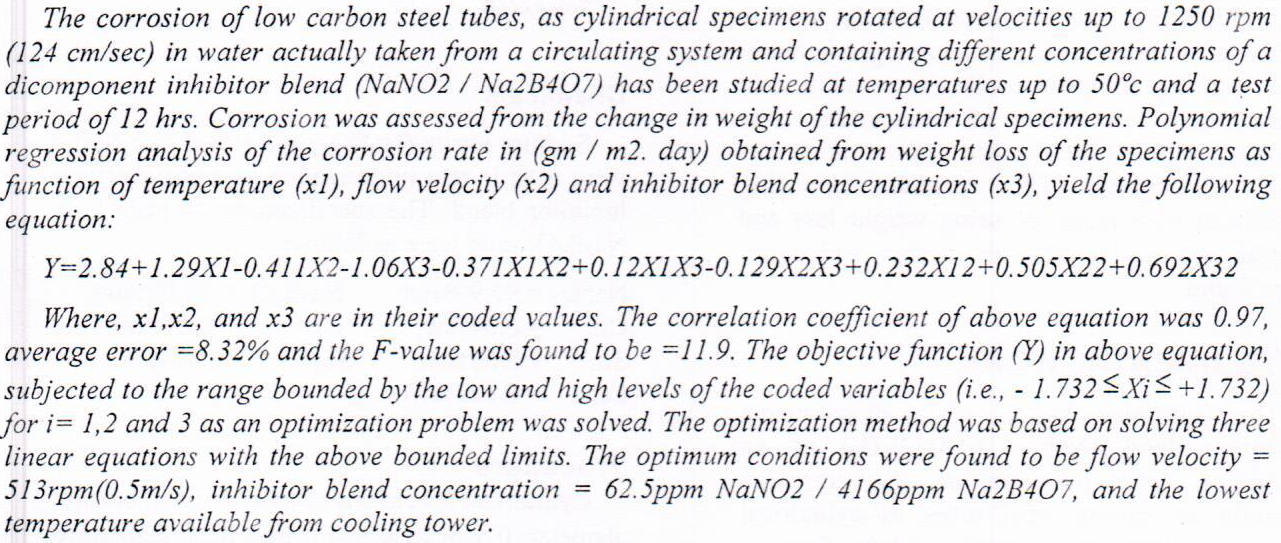
The Influence of Temperature and Flow Velocity on the Corrosion Inhibition of Low Carbon Tubes in Recirculating Water System by a Dicomponent Inhibitor Blend

Several correlations have been proposed for bubble point pressure, however, the correlations could not predict bubble point pressure accurately over the wide range of operating conditions. This study presents Artificial Neural Network (ANN) model for predicting the bubble point pressure especially for oil fields in Iraq. The most affecting parameters were used as the input layer to the network. Those were reservoir temperature, oil gravity, solution gas-oil ratio and gas relative density. The model was developed using 104 real data points collected from Iraqi reservoirs. The data was divided into two groups: the first was used to train the ANN model, and the second was used to test the model to evaluate their accuracy and trend stability
... Show MoreFeasibility of biosorbent of England bamboo plant origin was tested for removal of priority metal ions such as Cu and Zn from aqueous solutions in single metal state. Batch single metal state experiments were performed to determine the effect of dosage (0.5, 1 and 1.5 g), pH (3, 4, 4.5, 5 and 6), mixing speed (90, 111, 131, 156 and 170 rpm), temperature (20, 25, 30 and 35 °C) and metal ion concentration (10, 50, 70, 90 and 100 mg/L) on the ability of dried biomass to remove metal from solutions which were investigated. Dried powder of bamboo removed (for single metal state) about 74 % Cu and 69% Zn and maximum uptake of Cu and Zn was 7.39 mg/g and 6.96 mg/g respectively, from 100 mg/L of synthetic metal solution in 120 min. of contact t
... Show MoreEndophytic bacteria produced analogous secondary metabolites of their hosts. Similarly, the ability to generate antioxidants is not an exception. Dragon scales (Pyrrosia piloselloides), an epiphytic plant of the Polypodiaceae family, are frequently overlooked. This research aims to isolate antioxidant-producing bacteria from dragon-scale fern leaves. The antioxidant activities were tested after the extraction procedure using ethanolic extract. Bacteria were characterized and selected as candidates for antioxidant production by screening for the production of total phenolic compounds. Antioxidant levels were determined utilizing the ABTS, FRAP, and DPPH techniques. The preliminary findings of the entire phenolic compound test rev
... Show More (5)
(5)


Test results of eight reinforced concrete one way slab with lacing reinforcement are reported. The tests were designed to study the effect of the lacing reinforcement on the flexural behavior of one way slabs. The test parameters were the lacing steel ratio, flexural steel ratio and span to the effective depth ratio. One specimen had no lacing reinforcement and the remaining seven had various percentages of lacing and flexural steel ratios. All specimens were cast with normal density concrete of approximately 30 MPa compressive strength. The specimens were tested under two equal line loads applied statically at a thirds part (four point bending test) up to failure. Three percentage of lacing and flexural steel ratios wer
... Show MoreThis paper reports an experimental study of welding of dissimilar materials between transparent Polymethylmethacrylate (PMMA) and stainless steel 304 sheets using a pulsed mode Nd:YAG laser. The process was carried out for two cases; laser transmission joining (LTJ) and conduction joining (CJ). The former is achieved when the joint is irradiated from the polymer side and the latter when the joint is irradiated from the opposite side (metal side). The light and process parameters represented by the peak power (Pp), pulse duration (τ), pulse repetition rate (PRR), scanning speed (ν) and pulse shape have a significant effect on the joint strength (Fb), joint bead width (b), joint quality and appearance. The optimum parameters were determined
... Show More
(79)
 (71)
(71)

The root lesion nematode, Pratylenchus neglectus, is one of the most damaging nematodes to affect wheat worldwide. The nematode is widely distributed in Montana, primarily affecting winter wheat within the state. Managing the nematode primarily involves rotation to resistant and moderately resistant crops (peas, lentils, and barley). A nematode survey was conducted across the state nearly 10 years after an initial survey, to reassess the nematode threat and assess the impact of changing trends in crop rotations. To assess the broad applicability of rotation crops to control P. neglectus across Montana, greenhouse trials were conducted to challenge rotational crops using eight populations of P. neglectus collected from geographicall
... Show More
(6)
(6)
The current Iraqi standard specifications for roads and bridges allowed the prepared Job-Mix Formula for asphalt mixtures to witness some tolerances with regard to the following: coarse aggregate gradation by ± 6.0 %, fine aggregate gradation by ± 4.0 %, filler gradation by ± 2.0 %, asphalt cement content by ± 0.3 % and mixing temperature by ± 15 oC. The objective of this work is to evaluate the behavior of asphalt mixtures prepared by different aggregates gradations (12.5 mm nominal maximum size) that fabricated by several asphalt contents (40-50 grade) and various mixing temperature. All the tolerances specified in the specifications are taken into account, furthermore, the zones beyond these tolerances
... Show More
(2)
Four simply supported reinforced concrete (RC) beams were test experimentaly and analyzed using the extended finite element method (XFEM). This method is used to treat the discontinuities resulting from the fracture process and crack propagation in that occur in concrete. The Meso-Scale Approach (MSA) used to model concrete as a heterogenous material consists of a three-phasic material (coarse aggregate, mortar, and air voids in the cement paste). The coarse aggregate that was used in the casting of these beams rounded and crashed aggregate shape with maximum size of 20 mm. The compressive strength used in these beams is equal to 17 MPa and 34 MPa, respectively. These RC beams are designed to fail due to flexure when subjected to lo
... Show More
(1)
(3)
(3)
The utilization and incorporation of glass fiber-reinforced plastics (GFRP) in structural applications and architectural constructions are progressively gaining prominence. Therefore, this paper experimentally and numerically investigates the use of GFRP I-beams in conjunction with concrete slabs to form composite beams. The experimental design incorporated 2600 mm long GFRP I-beams which were connected compositely to concrete slabs with a 500 mm width and 80 mm thickness. The concrete slabs are categorized into two groups: concrete slabs cast using normal-strength concrete (NSC), and concrete slabs prepared using high-strength concrete (HSC). Various parameters like the type of concrete (normal and high-strength concrete), type of
... Show More
(20)
(25)