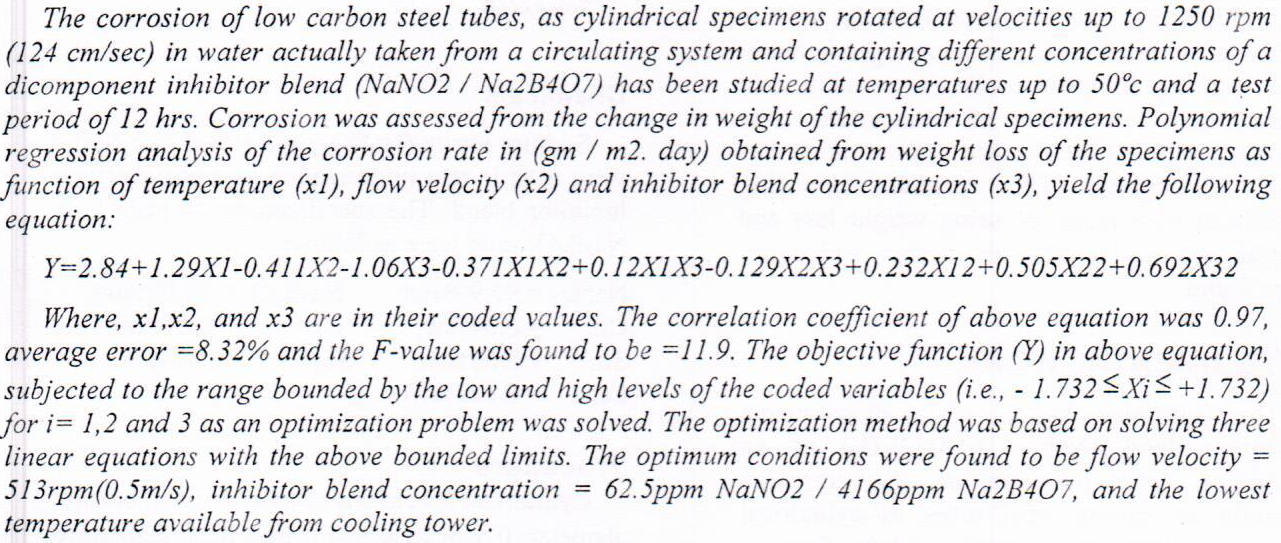
The Influence of Temperature and Flow Velocity on the Corrosion Inhibition of Low Carbon Tubes in Recirculating Water System by a Dicomponent Inhibitor Blend

The main objective of this research is to design and select a composite plate to be used in fabricating wing skins of light unman air vehicle (UAV). The mechanical properties, weight and cost are the basis criteria of this selection. The fiber volume fraction, fillers and type of fiber with three levels for each were considered to optimize the composite plate selection. Finite element method was used to investigate the stress distribution on the wing at cruise flight condition in addition to estimate the maximum stress. An experiments plan has been designed to get the data on the basis of Taguchi technique. The most effective parameters at the process to be find out by employing L9
... Show More
 (17)
(17)
In this research, the methods of Kernel estimator (nonparametric density estimator) were relied upon in estimating the two-response logistic regression, where the comparison was used between the method of Nadaraya-Watson and the method of Local Scoring algorithm, and optimal Smoothing parameter λ was estimated by the methods of Cross-validation and generalized Cross-validation, bandwidth optimal λ has a clear effect in the estimation process. It also has a key role in smoothing the curve as it approaches the real curve, and the goal of using the Kernel estimator is to modify the observations so that we can obtain estimators with characteristics close to the properties of real parameters, and based on medical data for patients with chro
... Show More
Response of cross-ply plates subjected to transient load is obtained using five variables refined plate theory, and four variables plate theory. Equations of motion are derived through the principleof virtual work. Navier series used for simply supported laminated plates. The results of this work are presented for different parameters, such as the ply number, thickness, and modulus ratio with mechanical load (sinusoidal and step pulses), which are compared with those obtained using high-order shear plate theory. Five variables of refined plate theory give results that are considerably different from the four variables of refined plate theory and higher-order theory. The obtained results from the four variables theory have the same behavior
... Show MoreThis work bases on encouraging a generous and conceivable estimation for modified an algorithm for vehicle travel times on a highway from the eliminated traffic information using set aside camera image groupings. The strategy for the assessment of vehicle travel times relies upon the distinctive verification of traffic state. The particular vehicle velocities are gotten from acknowledged vehicle positions in two persistent images by working out the distance covered all through elapsed past time doing mollification between the removed traffic flow data and cultivating a plan to unequivocally predict vehicle travel times. Erbil road data base is used to recognize road locales around road segments which are projected into the commended camera
... Show More (1)
(1)
(1)
(1)
 (14)
(13)
(14)
(13)

The massive growth of the automotive industry and the development of vehicles use lead to produce a huge amount of waste tire rubber. Rubber tires are non-biodegradable, resulting in environmental problems such as fire risks. In this search, the flexural behavior of steel fiber reinforced self-compacting concrete (SFRSCC) beams containing different percentages and sizes of waste tire rubbers were studied and compared them with the flexural behavior of SCC and SFRSCC. Micro steel fiber (straight type) with aspect ratio 65 was used in mixes. The replacement of coarse and fine aggregate was 20% and 10% with chip and crumb rubber. Also, the replacement of limestone dust and silica fume was 50%, 25%, and 12% with ground rubbe
... Show More
(8)
the use of diffrent concectration of Na and Mg ions were shown to causes in increase in the bindings at oncentration
(1)
Samples of gasoline engine oil (SAE 5W20) that had been exposed to various oxidation times were inspected with a UV-Visible (UV-Vis) spectrophotometer to select the best wavelengths and wavelength ranges for distinguishing oxidation times. Engine oil samples were subjected to different thermal oxidation periods of 0, 24, 48, 72, 96, 120, and 144 hours, resulting in a range of total base number (TBN) levels. Each wavelength (190.5 – 849.5 nm) and selected wavelength ranges were evaluated to determine the wavelength or wavelength ranges that could best distinguish among all oxidation times. The best wavelengths and wavelength ranges were analyzed with linear regression to determine the best wavelength or range to predict oxidation t
... Show More
(17)
(17)
(13)
(10)