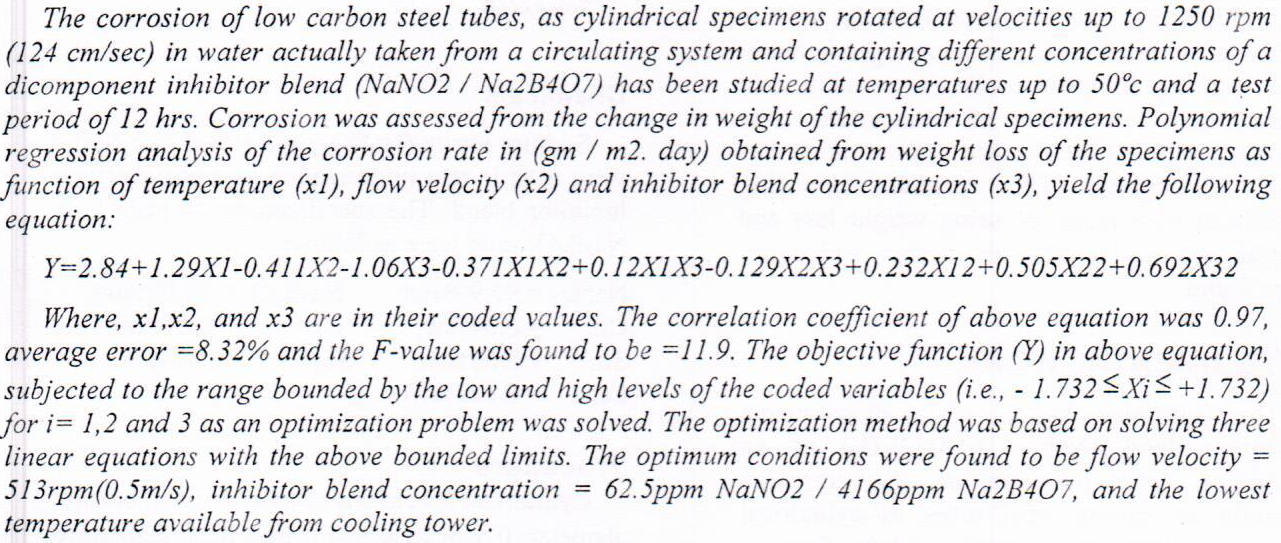
The Influence of Temperature and Flow Velocity on the Corrosion Inhibition of Low Carbon Tubes in Recirculating Water System by a Dicomponent Inhibitor Blend

Spray pyrolysis technique (SPT) is employed to synthesize cadmium oxide nanostructure with 3% and 5% Cobalt concentrations. Films are deposited on a glass substrate at 350 ᵒC with 150 nm thickness. The XRD analysis revealed a polycrystalline nature with cubic structure and (111) preferred orientation. Structural parameters represent lattice spacing, crystallite size, lattice parameter and dislocation density. Homogeneous surfaces and regular distribution of atoms were showed by atomic force microscope (AFM) with 1.03 nm average roughness and 1.22 nm root mean square roughness. Optical properties illustrated a high transmittance more than 85% in the range of visible spectrum and decreased with Co concentration increasing. The absorption
... Show More (17)
(17)
 (14)
(14)



Zinc sulfide (ZnS) thin films were deposited on glass substrates using pulsed laser deposition technique. The laser used is the Q-switched Nd: YAG laser with 1064nm wavelength and 1Hz pulse repetition rate and varying laser energy 700mJ-1000mJ with 25 pulse. The substrate temperature was kept constant at 100°C. The structural, morphological and optical properties of ZnS thin films were characterized with X-ray diffraction (XRD), scanning electron microscopy (SEM), atomic force microscope (AFM) and UV-VIS spectrophotometer.
(1)
(4)
(3)
Thin films of Magnetite have been deposited on Galvanized Steel (G-S) alloy using RF-reactive magnetron sputtering technique and protection efficiency of the corrosion of G-S. A Three-Electrodes Cell was used in saline water (3.5 % NaCl) solution at different temperatures (298, 308, 318 & 328K) using potentiostatic techniques with. Electrochemical Impedance Spectroscopy (EIS) and fitting impedance data via Frequency Response Analysis (FRA) were applied to G-S alloy with Fe3O4 and tested in 3.5 % NaCl solution at 298K.Results taken from Nyquist and Bode plots were analyzed using software provided with the instrument. The results obtained show that the rate of corrosion of G.S alloy increased with increasing the temperatures from 298 t
... Show More
The chlorine concentration variation in Baghdad water networks was studied. The
chlorine data were collected from Mayoralty of Baghdad and Ministry of Environment
(MOE) for the networks for both sides of the city Karkh and Rasafa for (2008-2009). The
study of these data indicates that there are no systematic testing program .Classified GIS
maps showed that the areas far from the treatment plants have almost always low
chlorine concentration .This indicates that the problem of the low chlorine concentration
in the far areas is due to cracks of pipe along the conveyance path ,as expected. The area's
most frequently have low concentration are Al-sadir,Al-Kadhimya, and Al-Amiria . It
was found also that the chlorine c
(31)
(25)
This paper deals with a Twin Rotor Aerodynamic System (TRAS). It is a Multi-Input Multi-Output (MIMO) system with high crosscoupling between its two channels. It proposes a hybrid design procedure that combines frequency response and root locus approaches. The proposed controller is designated as PID-Lead Compensator (PIDLC); the PID controller was designed in previous work using frequency response design specifications, while the lead compensator is proposed in this paper and is designed using the root locus method. A general explicit formula for angle computations in any of the four quadrants is also given. The lead compensator is designed by shifting the dominant closed-loop poles slightly to the left in the
... Show More
(1)
This paper deals with a Twin Rotor Aerodynamic System (TRAS). It is a Multi-Input Multi-Output (MIMO) system with high crosscoupling between its two channels. It proposes a hybrid design procedure that combines frequency response and root locus approaches. The proposed controller is designated as PID-Lead Compensator (PIDLC); the PID controller was designed in previous work using frequency response design specifications, while the lead compensator is proposed in this paper and is designed using the root locus method. A general explicit formula for angle computations in any of the four quadrants is also given. The lead compensator is designed by shifting the dominant closed-loop poles slightly to the left in the s-plane. This has the effect
... Show MoreA Geographic Information System (GIS) is a computerized database management system for accumulating, storage, retrieval, analysis, and display spatial data. In general, GIS contains two broad categories of information, geo-referenced spatial data and attribute data. Geo-referenced spatial data define objects that have an orientation and relationship in two or three-dimensional space, while attribute data is qualitative data that can be counted for recording and analysis. The main aim of this research is to reveal the role of GIS technology in the enhancement of bridge maintenance management system components such as the output results, and make it more interpretable through dynamic colour coding and more sophisticated vi
... Show More
(3)
The first chapter the importance of research and need for education scientists see that the roots of the use of a specimen Wheatley in learning and teaching back to Grayson Wheatley, one of the largest supporters of a modern construction, which lay the groundwork for the specimen stage and the form in which it is. That was attributed to him, often called his name called while some educators based learning strategy on the issue. He sees the learner in this model make him a meaningful understanding of problems during his progress, thereby acting with his colleagues to find solutions to them in small groups. He
Borders Search: Search by students is determined by th
... Show More