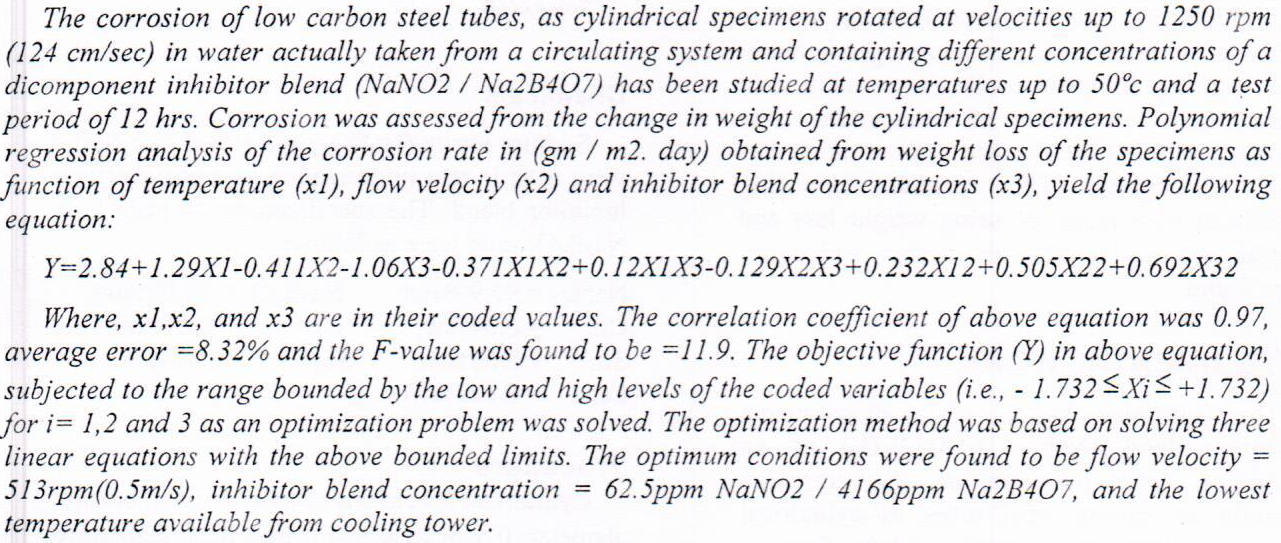
The Influence of Temperature and Flow Velocity on the Corrosion Inhibition of Low Carbon Tubes in Recirculating Water System by a Dicomponent Inhibitor Blend

This work reports the study of heat treatment effect on the structural, morphological, optical and electrical properties of poly [3-hexylthiophene] and its blend with [6,6]-phenyl C61 butyric acid methyl ester ( P3HT:PC61BM). X-ray diffraction (XRD) measurements show that the crystallinity of the films increased with annealing. The evaluation of surface roughness and morphology was investigated using atomic force microscope (AFM), and field emission scanning microscope(FESEM). The optical properties were emphasized a strong optical absorption of P3HT compared with the blend. Hall effect measurement was used to study the electrical properties which revealed there is an increase in the electrical conductivity and Hall mobility of th
... Show More (2)
(2)

In the recent decade, injection of nanoparticles (NPs) into underground formation as liquid nanodispersions has been suggested as a smart alternative for conventional methods in tertiary oil recovery projects from mature oil reservoirs. Such reservoirs, however, are strong candidates for carbon geo-sequestration (CGS) projects, and the presence of nanoparticles (NPs) after nanofluid-flooding can add more complexity to carbon geo-storage projects. Despite studies investigating CO2 injection and nanofluid-flooding for EOR projects, no information was reported about the potential synergistic effects of CO2 and NPs on enhanced oil recovery (EOR) and CGS concerning the interfacial tension (γ) of CO2-oil system. This study thus extensively inves
... Show MoreBackground: Hypertension is a major global health concern that increases the risk of cardiovascular disease. Understanding the impact of age and treatment types on blood pressure control is essential for optimizing therapeutic strategies. Aim: This study aims to assess how different treatment types and patient age influence blood pressure control in hypertensive patients. Methodology: A binary logistic regression model was employed to analyze data from 48 patients diagnosed with hypertension. The study investigated the impact of two treatment regimens and patient age on the likelihood of achieving optimal blood pressure levels. The statistical significance of the findings was evaluated using chi-square tests and p-values. Results: T
... Show More
 (24)
(17)
(24)
(17)
 (24)
(17)
(24)
(17)
Objectives: To review the failure rates of molar tubes and the effect of molar tube base design, adhesive type, and bonding technique on the failure rates of molar tubes. Data: The revolution of molar bonding greatly impacted fixed orthodontic appliance treatment by reducing chair-side time and improving patient comfort. Even with the many advantages of molar bonding, clinicians sometimes hesitate to use molar tubes due to their failure rates. Sources: Internet sources, such as Pubmed and Google Scholar. Study selection: studies testing the bond failure rate of molar tubes. Conclusions: The failure rate of the molar tubes can be reduced and the bond strength of the molar tubes can be improved by changing the design of the molar tube base
... Show More
(4)
(3)
(9)
The research aims to study the effect of adding (Li2O) to an alkaline glaze containing (K2O, Na2O). Although all the alkaline oxides have common properties, each oxide has something that distinguishes it. The molecular weight of (Li2O) is two times less than that of (Na2O) and three times that of (K2O). Therefore, it is added in small proportions. In addition, it is a very strong flux, so it is not used alone, but rather replaces a part of other alkaline oxides. It was added to an alkali glass that matured at a temperature of 980CO in proportions (2.0,1.4,1.2,0.8,0.4%) instead of (Na2O), using lithium carbonate (Li2CO3) as an oxide source. The glazes mixtures were applied to a white pottery body, and the samples were fired and cooled acc
... Show More
The purpose of this research is to investigate the impact of corrosive environment (corrosive ferric chloride of 1, 2, 5, 6% wt. at room temperature), immersion period of (48, 72, 96, 120, 144 hours), and surface roughness on pitting corrosion characteristics and use the data to build an artificial neural network and test its ability to predict the depth and intensity of pitting corrosion in a variety of conditions. Pit density and depth were calculated using a pitting corrosion test on carbon steel (C-4130). Pitting corrosion experimental tests were used to develop artificial neural network (ANN) models for predicting pitting corrosion characteristics. It was found that artificial neural network models were shown to be
... Show More
(1)
A thin CdS Films have been evaporated by thermal evaporation technique with different thicknesses (500, 1000, 1500 and 2000Å) and different duration times of annealing (60, 120 180 minutes) under 573 K annealing temperature, the vacuum was about 8 × 10⁻⁵ mbar and substrate temperature was 423 K. The structural properties of the films have been studied by X- ray diffraction technique (XRD). The crystal growth became stronger and more oriented as the film thickness (T) and duration time of annealing ( Ta) increases.