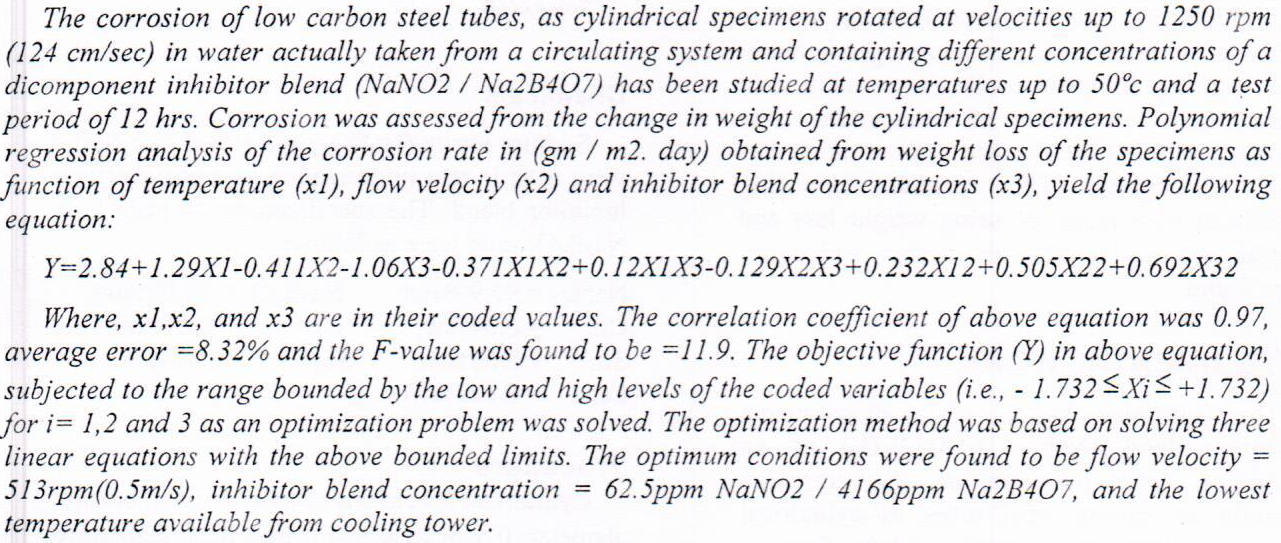
The Influence of Temperature and Flow Velocity on the Corrosion Inhibition of Low Carbon Tubes in Recirculating Water System by a Dicomponent Inhibitor Blend

There are no single materials which can withstand all the extreme operating conditions in modern technology. Protection of the metals from hostile environments has therefore become a technical and economic necessity.
In this work, for enhancing their wear-resistance, boride layers were deposited on the surface of low carbon steel by a pack cementation method at 850 °C for (2, 4, and 6) h using vacuum furnace. The boronizing process was achieved using different concentration of boron source (20, 25, and 30) % wt. into coating mixture to optimize the best conditions which ensure the higher properties with lower time. The coating was characteristic by X ray diffraction (XRD), and it is confirmed t
... Show More (24)
(24)
 (21)
(21)



Ficus (FIC) leaf extract used as corrosion inhibitor for carbon steel alloy (C.S) in two corrosive environments (saline and acidic) with four concentrations (1, 2, 3 and 4 ppm) at varied temperature range between (298-328 K) using electrochemical polarization measurements. The importance of this work focused on the use the green chemistry that is far from the chemical materials effect. The results of polarization presented the FIC inhibitor consider a mixed type (anodic and cathodic) inhibitor. Tafel curve used to evaluate the corrosion inhibition activity. In a saline medium, the best inhibitor efficiency reaches to (87%) in 2 ppm and IE% reach to (99%) for HCl medium inhibited by 1ppm. Langmuir isotherm obeys the study by thermodynamic pa
... Show More
(30)
(17)
Abstract
In this study, the effect of carboxylic methyl cellulose (CMC), and sodium dodcyl benzene sulfonate (SDBS) as an aqueous solution on the drag reduction was investigated. Different concentrations of (CMC) and (SDBS) such as (50, 100, 150, 200, 250, 300, 350, 400, 450, and 500 ppm) were used to analyze the aqueous solution properties, including surface tension, conductivity, and shear viscosity. The optimum four concentrations (i.e., 50, 100, 200, and 300 ppm) of fluid properties were utilized to find their effect on the drag reduction. Two different PVC pipe diameters (i.e., 1" and 3/4") were used in this work. The results showed that blending CMC with SDBS gives
... Show More
This study aims at suggesting flow as a strategy for training female EFL student-teachers in the teaching training course and finding out the effect of this strategy on their performance and their flow state. The training course syllabuses will be constructed according to the flow nine factors and the teaching skills. The measurement tools are the student-teacher performance checklist that has already been used by the department of English language and SHORT Flow State Scale (S FSS-2). The study population is represented with the (60) female student-teachers/ fourth stage/ evening studies at theEnglish department /college of education for women/the University of Baghdad. The study is used the experimental design in that (30) of the student-
... Show More
The V2O5 films were deposited on glass substrates which produce using "radio frequency (RF)"power supply and Argon gas technique. The optical properties were investigated by, UV spectroscopy at "radio frequency" (RF) power ranging from 75 - 150 Watt and gas pressure, (0.03, 0.05 and 0.007 Torr), and substrate temperature (359, 373,473 and 573) K. The UV-Visible analysis shows that the average transmittance of all films in the range 40-65 %. When the thickness has been increased the transhumance was decreased from (65-40) %. The values of energy band gap were lowered from (3.02-2.9 eV) with the increase of thickness the films in relation to an increase in power, The energy gap decreased (2.8 - 2.7) eV with an increase in the pressure and
... Show More
(3)
Abstract: Objectives: To investigate the effect of temperature elevation on the bonding strength of resin cement to the zirconia ceramic using fractional CO2 laser. Background: Fractional CO2 laser is an effective surface treatment of zirconia ceramic, as it increases the bonding strength of zirconia to resin cement. Methods: Thirty sintered zirconia discs (10 mm diameter, 2 mm thickness) were prepared and divided to three groups (N=10) and five diffident pulse durations were used in each group (0.1, 0.5, 1, 5 and 10 ms). Group A was treated with 10 W power setting, group B with 20 W and group C with 30 W. During laser irradiation, temperature elevation measurement was recorded for each specimen. Luting cement was bonded to the treated z
... Show MoreNanostructured Al2O3has been applied as a protective coating against corrosion of the carbon steel (C.S) in seawater environment (3.5% NaCl) at temperatures range (298-328)K. Aluminananoparticles were deposited on carbon steel substrates by cathodic electrophoretic deposition (EPD) with ethanol as suspension medium and poly(acrylic acid) (PAA) as polymeric charging agent. Meanwhile, thesurface morphology was examined using Atomic-force microscopy (AFM). The cross-section AFM showed that the particles sizes for the Al2O3 NPs is around 60-80 nm. The anticorrosion behaviour of coated C.S was investigated in 3.5% NaCl at temperature range 298-328 K by potentiodynamic polarization measurements. Results show that using PAA in suspension coat incr
... Show More
(12)
In past years, structural pavement solution has been combined with destructive testing; these destructive methods are being replaced by non-destructive testing methods (NDT). Because the destructive test causes damage due to coring conducted for testing and also the difficulty of adequately repairing the core position in the field. Ultrasonic pulse velocity was used to evaluate the strength and volumetric properties of asphalt concrete, of binder course. The impact of moisture damage and testing temperature on pulse velocity has also been studied. Data were analyzed and modeled. It was found that using non-destructive testing represented by pulse velocity could be useful to predict the quality of asphalt c
... Show More
(4)