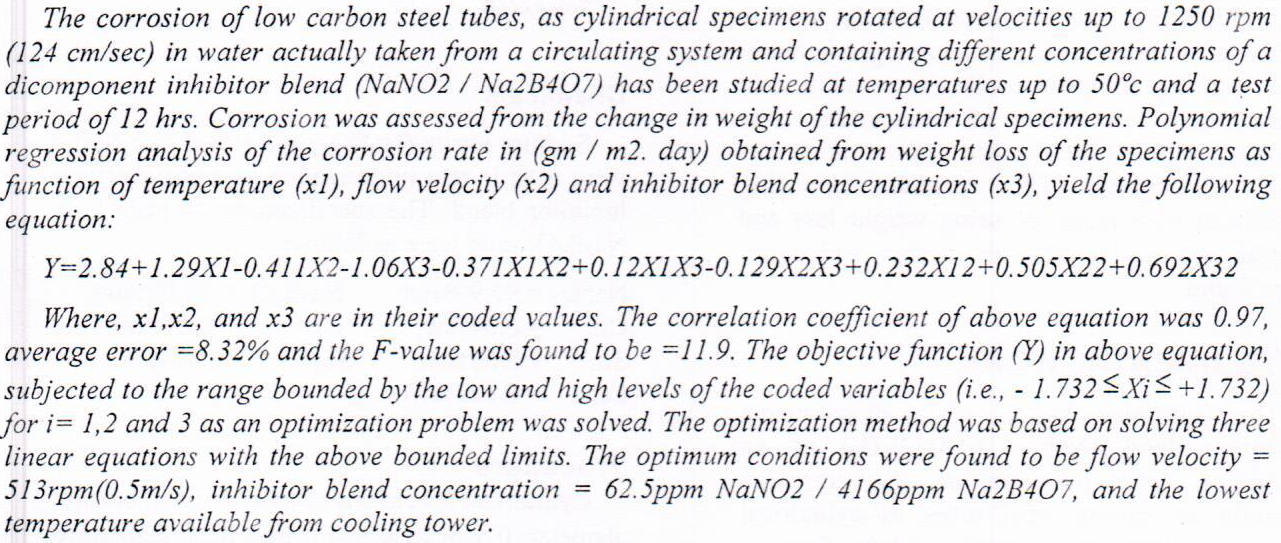
The Influence of Temperature and Flow Velocity on the Corrosion Inhibition of Low Carbon Tubes in Recirculating Water System by a Dicomponent Inhibitor Blend

Due to their recalcitrant characteristics, Azo dyes such as methyl orange (MO) are extremely poisonous substances, making their removal from textile industry wastewater a major problem. By employing various EC-Adsorption combined system configurations and reusing alum sludge as an adsorbent, the current study seeks to investigate the efficiency of these various systems in removing MO dye. To estimate their benefits and limitations, experiments were carried out utilizing nickel foam (NiF) and aluminum plate (Al plate) as anodes, and stainless-steel mesh (SS mesh) as cathode in the presence of alum sludge as an adsorbent in all systems. The EC-Adsorption combined system with NiF as anode and two SS meshes as cathodes with 10 g/L
... Show More
In this work, a composite material was prepared from Low-density polyethylene (LDPE) with different weight percent of grain and calcinations kaolin at temperature of (850oC) using single screw extruder and a mixing machine operated at a temperature between (190-200oC). Some of mechanical and physical properties such as tensile strength, tensile strength at break, Young modulus, and elongation at break, shore hardness and water absorption were determined at different weight fraction of filler (0, 2, 7, 10 and 15%). It was found that the addition of filler increases the modulus of elasticity, elongation at break, shore hardness and impact strength; on other hand, it decreases the tensile strength and tensile strength
... Show MoreThis study used a continuous photo-Fenton-like method to remediate textile effluent containing azo dyes especially direct blue 15 dye (DB15). A Eucalyptus leaf extract was used to create iron/copper nanoparticles supported on bentonite for use as catalysts (E@B-Fe/Cu-NPs). Two fixed-bed configurations were studied and compared. The first one involved mixing granular bentonite with E@B-Fe/Cu-NPs (GB- E@B-Fe/Cu-NPs), and the other examined the mixing of E@B-Fe/Cu-NPs with glass beads (glass beads-E@B-Fe/Cu-NPs) and filled to the fixed-bed column. Scanning electron microscopy (SEM), zeta potential, and atomic forces spectroscopy (AFM) techniques were used to characterize the obtained particles (NPs). The effect of flow rate and DB15 concent
... Show More (3)
(3)
 (1)
(1)

The ZnO nanoparticles were synthesized at various precursor concentrations i.e. 0.05, 0.1, and 0.5 M by biosynthesis method based on Pometia pinnata Leaf Extracts. Initial nanoparticle concentration influenced the optical bandgap, shape, and structure of nanoparticles. The photodegradation process was carried out under UV illumination. The efficiency of MB degradation was determined by measuring the decrease in MB concentration and by analyzing the optical absorption at 663 nm recorded by UV-Vis spectroscopy. Results showed that the biosynthesized ZnO nanoparticles exhibited efficient photodegradation of MB, with a maximum degradation rate of 80% after 90 minutes of exposure to UV-C light. The study highlights the potential of Pometia pi
... Show More
(7)
(2)
This study was carried out at University of Baghdad - College of Agricultural Engineering Sciences - Research Station B during the autumn season 2019-2020, in order to evaluate the effect of Ozone and the foliar application of coconut water and moringa extract on the growth of broccoli plant grown in modified NFT film technology. A factorial experiment (2*5) was carried out within Nested Design with three replicates. The ozone treatment was distributed into the main plots which consisted of oxygen (O2) and ozone (O3). The foliar application of organic nutrients were distributed randomly within each replicate including five treatments, which were the control treatment (T0), Coconut water with two concentrations of 50 (T1) and 100 ml.
... Show More
(19)
(6)
The reticuloendothelial system (RES) play an important role in immunity against bacterial infection and Klebsiella pneumoniae one of the most common causes of hospital-acquired infections. Dextran70 (D70), a polysaccharide, may alter functions of this system through changing many biological activities in the tissues.
One of the most important techniques for preparing nanoparticle material is Pulsed Laser Ablation in Liquid technique (PLAL). Carbon nanoparticles were prepared using PLAL, and the carbon target was immersed in Ultrapure water (UPW) then irradiated with Q-switched Nd:YAG laser (1064 nm) and six ns pulse duration. In this process, an Nd:YAG laser beam was focused near the carbon surface. Nanoparticles synthesized using laser irradiation were studied by observing the effects of varying incident laser pulse intensities (250, 500, 750, 1000) mJ on the particle size (20.52, 36.97, 48.72, and 61.53) nm, respectively. In addition, nanoparticles were characterized by means of the Atomic Force Microscopy (AFM) test, pH easurement
... Show More
(2)
In this work the interaction of plasma jet with water and hydrogen peroxide liquids used for assisted teeth bleaching by plasma jet had been study. A homemade plasma jet system was used. The plasma jet supply by 15 W electrical power generated by high voltage power supply of 9.6 kV peak to peak and frequency of 33 kHz .this power supply generate high electric field on electrodes that would be enough to ionize the argon gas. Some important agents were study such as the effect of the Ar gas flow rates on the length of the plasma jet, the influence of plasma jet on some properties of water and two hydrogen peroxide concentrations 25 % and 30 % like pH, conductivity and liquid temperature for different exposure time. The liquids temperature
... Show More
(2)
Copper doped Zinc oxide and (n-ZnO / p-Si and n-ZnO: Cu / p-Si) thin films thru thickness (400±20) nm were deposited by thermal evaporation technique onto two substrates. The influence of different Cu percentages (1%,3% and 5%) on ZnO thin film besides hetero junction (ZnO / Si) characteristics were investigated, with X-ray diffractions examination supports ZnO films were poly crystal then hexagonal structural per crystallite size increase from (22.34 to 28.09) nm with increasing Cu ratio. The optical properties display exceptional optically absorptive for 5% Cu dopant with reduced for optically gaps since 3.1 toward 2.7 eV. Hall Effect measurements presented with all films prepared pure and doped have n-types conductive, with a ma
... Show More
(1)
(1)
