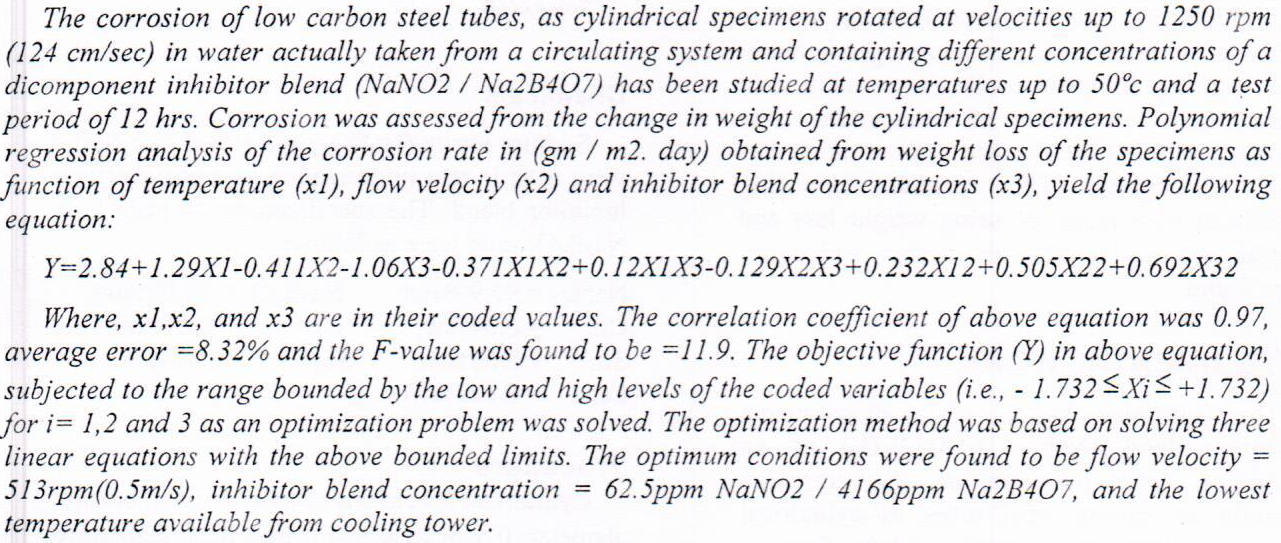
The Influence of Temperature and Flow Velocity on the Corrosion Inhibition of Low Carbon Tubes in Recirculating Water System by a Dicomponent Inhibitor Blend

Synthesis of PEG 200-Di- Acetate ant Its Influence on the Viscosity of PEG 4000 in Different Organic Solvents
ST Alawi, NA Mustafa, Al-Mustansiriyah Journal of Science, 2013
The first flow injection spectrophotometric method is characterized by its speed and sensitivity which have been developed for the determination of promethazine-HCl in pure and pharmaceutical preparation. It is based on the in situ detection of colored cationic radicals formed via oxidation of the drug with sodium persulphate to pinkish-red species and the same species was determined by using homemade Ayah 3SX3-3D solar flow injection photometer. Optimum conditions were obtained by using the high intensive green light emitted diode as a source. Linear dynamic range for the absorbance versus promethazine-HCl concentration was 0-7 mmol.L-1, with the correlation coefficient (r) was 0.9904 while the percentage linearity (r2%) was 98.09%. the L.
... Show More
A potentiostatic study of the behaviour of Inconel (600) in molar sulphuric acid has been carried out over the temperature range 293-313 K. Values have been established for the potentials and current densities of the corrosion, active-passive transition, passivity and transpassive states. For corrosion, the current density (ic) and potential (Ec) have been determined from well-defined Tafel lines. The potential and current density prior to the commencement of passivity have been obtained corresponding respectively to the critical potential (Ecr( and to the current density (icr) for the active-passive transition state. The passive range was defined by the respective potentials and current densities for passive film formation and dissolutio
... Show More
Background: Several infectious lung diseases often develop in patients with Rheumatoid arthritis (RA), especially during immunosuppressive medication, including disease-modifying anti-rheumatic drugs (DMARDs). The present study aimed to determine the role of respiratory tract bacterial infection in RA activity. Methods: Blood and sputum samples were collected from 31 patients with RA and 12 healthy subjects as control. The bacterial isolates were isolated and identified in collected sputum by biochemical tests and Vitec 2 system. Results: In the present study, thirty-one patients with RA were compared with 12 healthy subjects. Eight patients with RA were not infected with pathogenic bacteria (RA-NIPB) (25.8%). Twenty-three RA patients wer
... Show More
Abstract
This paper is an experimental work to determinate the effect of welding velocity and formed arc energy for CO2-MAG fusion weld pool. The input parameters (arc voltage, wire feed speed and gas flow rate) were investigated to find their effects on the weld joint efficiency. Design of experiment with response surface methodology technique was used to build empirical mathematical models for welding velocity and arc energy in term of the input welding parameters. The predicted quadratic models were statistically checked for adequacy purpose by ANOVA analysis. Additionally, numerical optimization was conducted to obtain the optimum values for welding velocity and arc energy. A good agree
... Show MoreWe report on using a CO2 (10.6 µm) laser to debond the lithium disilicate veneers. Sixty-four sound human premolar teeth and 64 veneer specimens were used in the study. The zigzag movement via CO2 laser handpiece along with an air-cooled jet to prevent temperature elevation above the necrosis temperature limit (5.5 C°) was applied. The optimal deboning irradiation time was super-fast, at about 5 seconds at 3 Watt CO2 laser power. It is 20 times less than any previously published work for veneers debonding. The enamel beneath the debonded veneers has been assessed by atomic force microscopy (AFM) and shear stress technique as criteria for the easiness of debonding. The
... Show More (2)
(2)
 (2)
(2)


Background A prospective clinical study was
performed to compare the efficacy of the use of lowmolecular-
weight heparin group (enoxparin group)
with control group in the prevention of deep-vein
thrombosis after total knee arthroplasty.
Aim of the study: to assess the prevalence of DVT
after total knee arthroplasty and evaluate the
importance of the use of low molecular weight
heparin in the prevention of this DVT.
Methods Thirty-three patients undergoing total
knee arthroplasty were randomly divided into two
groups. One group consisted of 12 patients who
received no prophylaxis with an anticoagulant (the
control group), other group consisted of 21 patients
who received the low-molecular-weight h