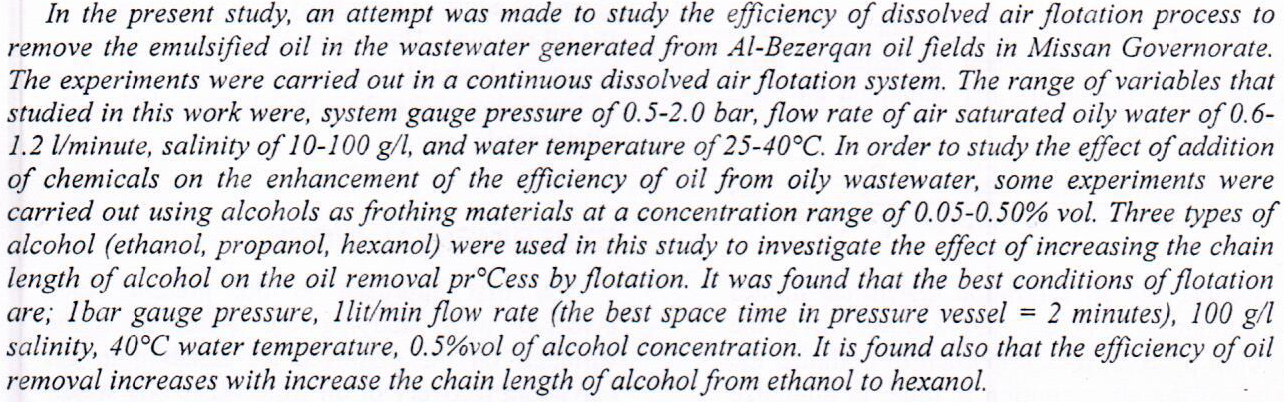
Oil Removal from Wastewater of Al-Bezerqan Crude Oil Fields by Air Flotation

The purpose of this study is to examine the dimensions of strategic intent (SI; see Appendix 1) according to the Hamel and Prahalad model as a building for the future, relying on today’s knowledge-based and proactive strategic directions of management as long-term and deep-perspective creative directions, objective vision and rational analysis, integrative in work, survival structure and comprehensiveness in perception.
The quantitative approach was used based on research, detection and proof, as data were collected from leader
 (6)
(6)
 (7)
(7)



This work was conducted to study the ability of locally prepared Zeolite NaY for the reduction of sulfur compounds from Iraqi natural gas by a continuous mode adsorption unit. Zeolite Y was hydrothermally synthesized using abundant kaolin clay as aluminum precursor. Characterization was made using chemical analysis, XRD and BET surface area. Results of the adsorption experiments showed that zeolite Y is an active adsorbent for removal H2S from natural gas and other gas streams. The effect of temperature was found inversely related to the removal efficiency. Increasing bed height was found to increase the removal efficiency at constant flow rate of natural gas. The adsorption capacity was evaluated and its maximum uptake was 5.345 mg H2S/g z
... Show MoreThis work was conducted to study the ability of locally prepared Zeolite NaY for the reduction of sulfur compounds from Iraqi natural gas by a continuous mode adsorption unit. Zeolite Y was hydrothermally synthesized using abundant kaolin clay as aluminum precursor. Characterization was made using chemical analysis, XRD and BET surface area. Results of the adsorption experiments showed that zeolite Y is an active adsorbent for removal H2S from natural gas and other gas streams. The effect of temperature was found inversely related to the removal efficiency. Increasing bed height was found to increase the removal efficiency at constant flow rate of natural gas. The adsorption capacity was evaluated and its maximum uptake was 5.345 mg H2S/g z
... Show More
(3)
This paper presents studying the performance of three types of polyethersulfone (PES) membrane for the simultaneous removal of Co2+ ions, Cd2+ ions, and Pb2+ ions from binary and ternary aqueous solutions. Co2+ ions, Cd2+ ions, and Pb2+ ions with two different initial concentrations (e.g., 10 and 50 ppm) were selected as examples of heavy metals that contaminate the groundwater as a result of geological and human activities. This study investigated the effect of types of PES membrane and metal ions concentration on the separation process. For the binary aqueous solutions, the permeation flux of the PES2 membranes was higher for the separation process of solutions containing 50 ppm of Cd2+ ions and 10 ppm of Co2+ ions (24.7 L
... Show More
(25)
(15)
The potential application of granules of brick waste (GBW) as a low-cost sorbent for removal of Ni+2ions from aqueous solutions has been studied. The properties of GBW were determined through several tests such as X-Ray diffraction (XRD), Energy dispersive X-ray (EDX), Scanning electron microscopy (SEM), and BET surface area. In batch tests, the influence of several operating parameters including contact time, initial concentration, agitation speed, and the dose of GBW was investigated. The best values of these parameters that provided maximum removal efficiency of nickel (39.4%) were 1.5 hr, 50 mg/L, 250 rpm, and 1.8 g/100mL, respectively. The adsorption data obtained by batch experiments subjected to the Three i
... Show More
(12)
(108)
(98)
An innovative desalination method called electrosorption or capacitive deionization (CDI) has significant benefits for wastewater treatment. This process is performed by using a carbon fiber electrode as a working electrode to remove hexavalent chromium ions from an aqueous solution. The pH, NaCl concentration, and cell voltage were optimized using the Box-Behnken experimental design (BDD) in response surface methodology (RSM) to study the effects and interactions of selected variables. To attain the relationship between the process variables and chromium removal, the experimental data were subjected to an analysis of variance and fitted with a quadratic model. The optimum conditions to remove Cr(VI) ions were: pH of 2, a cell voltage of 4.
... Show More
(11)
(9)
An in-depth experimental study of the matrix effect of antifreeze (ethylene glycol) and water contamination of engine oil through FT-IR spectroscopy. With a comparison of the percent by volume concentration of contaminated fresh 15W-40 engine oil, there appeared to be a noticeable reduction in the O–H stretching signal in the infrared spectrum when ethylene glycol based antifreeze was included as a contaminant. The contaminants of distilled water, a 50/50 mixture of water and commercial ethylene glycol antifreeze, and straight ethylene glycol antifreeze were compared and a signal reduction in the O–H stretch was clearly evident when glycol was present. Doubling the volume of the 50/50 mixture as compared to water alone still res
... Show More
(2)
The current study was conducted for studying the impact of cold plasma on the expression level of three genes that participate in the biosynthesis of the phenylpropanoid pathway in Ocimum basilicum. These studied genes were cinnamate 4-hydroxylase (c4h), 4-coumarate CoA ligase (4cl), and eugenol O-methyl transferase (eomt). Also, the cold plasma impact was studied on the essential oil components and their relation with the gene expression level. The results demonstrated that cold plasma seeds germination of the treated groups 2 (initially for 3 minutes and 3 minutes after 7 days) ,and group 3(initially for 5 minutes and 3 minutes after 7 days) were faster than the control group. Also, the height average of the mature plants of
... Show More
(4)
(1)
A factorial experiment was applied with four replicates on rosemary plants (Rosmarinus officinalis L.) grown in pots inside the glasshouse of the Department of Biology, College of Science, Salahaddin University, Erbil, Iraq, during April, 2019 to July, 2020, to determine the effects of soil moisture content ( SM1: 100% and SM2: 60% field capacity), nitrogen fertilizer (N1: 100, N2: 200 and N3: 300kg/hectare), and magnesium fertilizer (Mg1: 0.0, Mg2: 30 and Mg3: 60kg/hectare) and their interactions on some growth characteristics and essential oil content of rosemary plants. Two cuttings were taken from rosemary shoots (on March, 2020 and July, 2020) after 12 and 15 months of planting respectively. Results showed that cutting 1:
... Show More
(1)
(1)