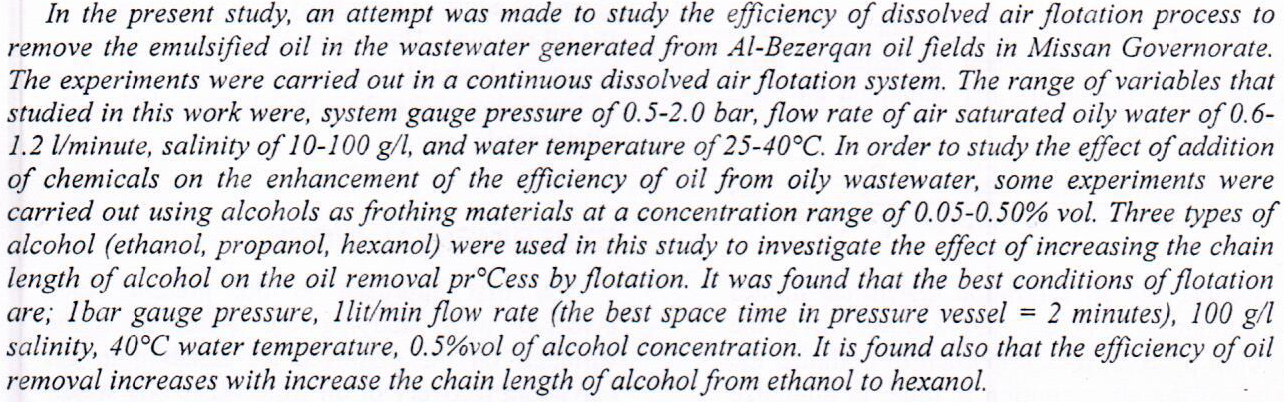
Oil Removal from Wastewater of Al-Bezerqan Crude Oil Fields by Air Flotation

The Carbonate-clastic succession in this study is represented by the Shuaiba and Nahr Umr Formations deposited during the Albian - Aptian Sequence. The present study includes petrography, microfacies analyses, and studying reservoir characterizations for 5 boreholes within West Qurna oil field in the study area. According to the type of study succession (clastic – Carbonate) there are two types of facies analyses:-Carbonate facies analysis, which showed five major microfacies were recognized in the succession of the Shuaiba Formation, bioclastic mudstones to wackstone, Orbitolina wackestone to packstone, Miliolids wackestone, Peloidal wackestone to packstone and mudstone to wackestone identified as an open shelf toward the deep basin.
... Show More (3)
(3)
 (3)
(3)


 (1)
(41)
(39)
(1)
(41)
(39)
Cladophora and Spirulina algae biomass have been used for the removal of Tetracycline (TC) antibiotic from aqueous solution. Different operation conditions were varied in batch process, such as initial antibiotic concentration, different biomass dosage and type, contact time, agitation speed, and initial pH. The result showed that the maximum removal efficiencies by using 1.25 g/100 ml Cladophora and 0.5 g/100 ml Spirulina algae biomass were 95% and 94% respectively. At the optimum experimental condition of temperature 25°C, initial TC concentration 50 mg/l, contact time 2.5hr, agitation speed 200 rpm and pH 6.5. The characterization of Cladophora and Spirulina biomass by Fourier transform infrared (FTIR) indicates that the presenc
... Show More
(4)
Modified algae with nano copper oxide (CuO) were used as adsorption media to remove tetracycline (TEC) from aqueous solutions. Functional groups, morphology, structure, and percentages of surfactants before and after adsorption were characterised through Fourier-transform infrared (FTIR), X-ray diffraction (XRD), scanning electron microscopy (SEM), and energy-dispersive spectroscopy (EDS). Several variables, including pH, connection time, dosage, initial concentrations, and temperature, were controlled to obtain the optimum condition. Thermodynamic studies, adsorption isotherm, and kinetics models were examined to describe and recognise the type of interactions involved. Resultantly, the best operation conditions were at pH 7, contact time
... Show More
(36)
(35)
Modified algae with nano copper oxide (CuO) were used as adsorption media to remove tetracycline (TEC) from aqueous solutions. Functional groups, morphology, structure, and percentages of surfactants before and after adsorption were characterised through Fourier-transform infrared (FTIR), X-ray diffraction (XRD), scanning electron microscopy (SEM), and energy-dispersive spectroscopy (EDS). Several variables, including pH, connection time, dosage, initial concentrations, and temperature, were controlled to obtain the optimum condition. Thermodynamic studies, adsorption isotherm, and kinetics models were examined to describe and recognise the type of interactions involved. Resultantly, the best operation conditions were at pH 7, contact time
... Show More
(35)
Asphaltene is one of the fractions of the crude oil which is soluble in aromatics such as benzene or toluene and insoluble in alkane such as n-heptane, n-pentane or petroleum ether (mixture of alkane compounds). Asphaltene precipitation is one of the most common problems that sometimes occurs in both oil recovery and refinery processes as a result of changing in pressure, oil composition, or temperature. Therefore the stability of asphaltene in the crude oil must be studied to show the tendency of it for precipitating asphaltene to prevent it (Asphaltene precipitation and deposition problem) and eliminate the burden of high treatment costs.
In the present study, saturate, aromatic, resin and asphaltene (SAR
... Show More
(6)
