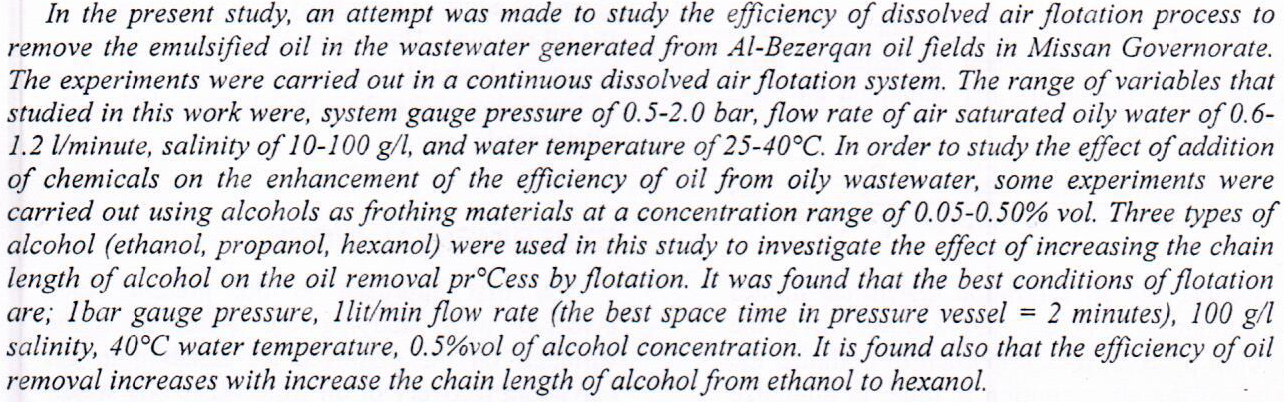
Oil Removal from Wastewater of Al-Bezerqan Crude Oil Fields by Air Flotation

Box-Wilson experimental design method was employed to optimized lead ions removal efficiency by bulk liquid membrane (BLM) method. The optimization procedure was primarily based on four impartial relevant parameters: pH of feed phase (4-6), pH of stripping phase (9-11), carrier concentration TBP (5-10) %, and initial metal concentration (60-120 ppm). maximum recovery efficiency of lead ions is 83.852% was virtually done following thirty one-of-a-kind experimental runs, as exact through 24-Central Composite Design (CCD). The best values for the aforementioned four parameters, corresponding to the most restoration efficiency were: 5, 10, 7.5% (v/v), and 90 mg/l, respectively. The obtained experimental data had been
... Show More (3)
(3)


The gas-lift method is crucial for maintaining oil production, particularly from an established field when the natural energy of the reservoirs is depleted. To maximize oil production, a major field's gas injection rate must be distributed as efficiently as possible across its gas-lift network system. Common gas-lift optimization techniques may lose their effectiveness and become unable to replicate the gas-lift optimum in a large network system due to problems with multi-objective, multi-constrained & restricted gas injection rate distribution. The main objective of the research is to determine the possibility of using the genetic algorithm (GA) technique to achieve the optimum distribution for the continuous gas-lift injectio
... Show More
(1)
Permeability estimation is a vital step in reservoir engineering due to its effect on reservoir's characterization, planning for perforations, and economic efficiency of the reservoirs. The core and well-logging data are the main sources of permeability measuring and calculating respectively. There are multiple methods to predict permeability such as classic, empirical, and geostatistical methods. In this research, two statistical approaches have been applied and compared for permeability prediction: Multiple Linear Regression and Random Forest, given the (M) reservoir interval in the (BH) Oil Field in the northern part of Iraq. The dataset was separated into two subsets: Training and Testing in order to cross-validate the accuracy
... Show More
(2)
 (8)
(9)
(8)
(9)
 (36)
(24)
(36)
(24)
Knowing the distribution of the mechanical rock properties and in-situ stresses for the field of interest is essential for many applications concerning reservoir geomechanics, including wellbore instability analysis, hydraulic fracturing, sand production, reservoir compaction, subsidence and water/gas injection throughout the filed life cycle. Determining the rock's mechanical properties is challenging because they cannot be directly measured at the borehole. The recovered carbonate core samples are limited and only provide discrete data for specific depths. This study focuses on creating a detailed 1D geomechanical model of the Mishrif reservoir in the Nasriyah oil field to identify the fault regime type for each unit in the format
... Show More
(1)
The CO2-Assisted Gravity Drainage process (GAGD) has been introduced to become one of the mostinfluential process to enhance oil recovery (EOR) methods in both secondary and tertiary recovery through immiscibleand miscible mode. Its advantages came from the ability of this process to provide gravity-stable oil displacement forenhancing oil recovery. Vertical injectors for CO2 gas have been placed at the crest of the pay zone to form a gas capwhich drain the oil towards the horizontal producing oil wells located above the oil-water-contact. The advantage ofhorizontal well is to provide big drainage area and small pressure drawdown due to the long penetration. Manysimulation and physical models of CO2-AGD process have been implemented
... Show More
I
In this study, optical fibers were designed and implemented as a chemical sensor based on surface plasmon resonance (SPR) to estimate the age of the oil used in electrical transformers. The study depends on the refractive indices of the oil. The sensor was created by embedding the center portion of the optical fiber in a resin block, followed by polishing, and tapering to create the optical fiber sensor. The tapering time was 50 min. The multi-mode optical fiber was coated with 60 nm thickness gold metal. The deposition length was 4 cm. The sensor's resonance wavelength was 415 nm. The primary sensor parameters were calculated, including sensitivity (6.25), signal-to-noise ratio (2.38), figure of merit (4.88), and accuracy (3.2)
... Show More