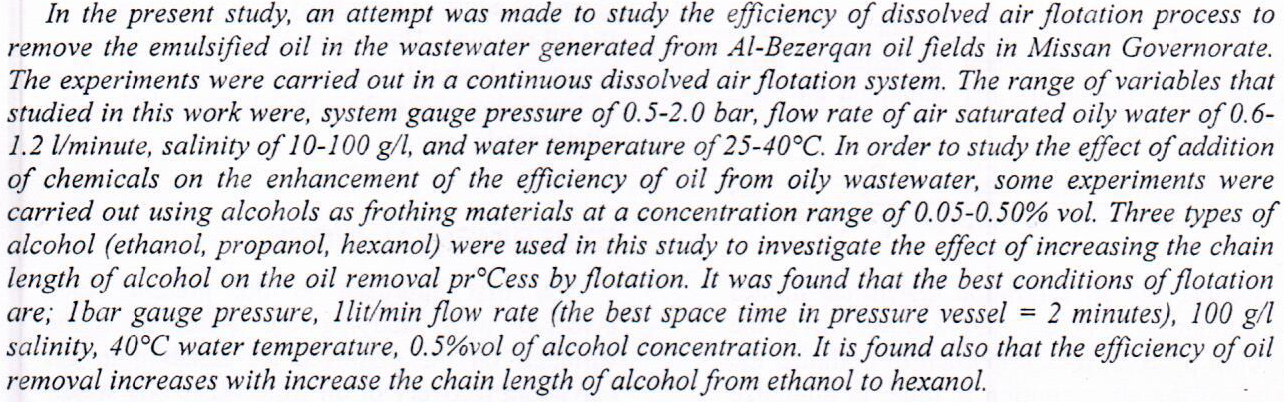
Oil Removal from Wastewater of Al-Bezerqan Crude Oil Fields by Air Flotation

A plant mixture containing indigenous Australian plants was examined for synergistic antimicrobial activity using selected test microorganisms. This study aims to investigate antibacterial activities, antioxidant potential and the content of phenolic compounds in aqueous, ethanolic and peptide extracts of plant mixture
Well diffusion, minimum inhibitory concentration (MIC) and minimum bactericidal concentration (MBC) assays were used to test antibacterial activity against four pathogenic bacteria namely
 (37)
(37)
 (31)
(31)



A study in the treatment and reuse of oily wastewater generated from the process of fuel oil treatment of gas turbine power plant was performed. The feasibility of using hollow fiber ultrafiltration (UF) membrane and nanofiltration (NF) membrane type polyamide thin-film composite in a pilot plant was investigated. Three different variables: pressure (0.5, 1, 1.5 and 2 bars), oil content (10, 20, 30 and 40 ppm), and temperature (15, 20, 30 and 40 ᵒC) were employed in the UF process while TDS was kept constant at 150 ppm. Four different variables: pressure (2, 3, 4 and 5 bar), oil content (2.5, 5, 7.5 and 10 ppm), total dissolved solids (TDS) (100, 200,300 and 400 ppm), and temperature (15, 20, 30 and 40 ᵒC) were manipulated with the h
... Show MoreOily carwash wastewater is a high organic and chemical wastewater. This paper targeted to investigate a treatment to decrease the water consumption and contaminants in car-washing stations. Electrocoagulation combined with ultrasonic energy (Sono-Electrocoagulation) was suggested so that the carwash wastewater is treated to be reused. The effect of both the voltage and time of treatment on the removal of COD, turbidity, conductivity, and total dissolved solids (TDS) were studied at constant initial pH 7 and electrode distance 2 cm. The results showed the best results of removal COD, turbidity, TDS, and reduce electrical conductivity is when the voltage was 30 V and a treatment time of 90 minutes.
<
... Show More
(3)
This study was aimed to assess the efficiency of N.oleander to remove heavy metals such as Copper (Cu) from wastewater. A toxicity test was conducted outdoor for 65-day to estimate the ability of N.oleander to tolerate Cu in synthetic wastewater. Based on a previous range-finding test, five concentrations were used in this test (0, 50, 100, 300, 510 mg/l). The results showed that maximum values of removal efficiency was found 99.9% on day-49 for the treatment 50 mg/l. Minimum removal efficiency was 94% day-65 for the treatment of 510 mg/l. Water concentration was within the permissible limits of river conservation and were 0.164 at day-35 for the 50 mg/l treatment, decreased thereafter until the end of the observation, and 0.12 at d
... Show More
This study investigated the treatment of dairy wastewater using the electrocoagulation method with iron filings as electrodes. The study dealt with real samples collected from local factory for dairy products in Baghdad. The Response Surface Methodology (RSM) was used to optimize five experimental variables at six levels for each variable, for estimating chemical oxygen demand (COD) removal efficiency. These variables were the distance between electrodes, detention time, dosage of NaCl as electrolyte, initial COD concentration, and current density. RSM was investigated the direct and complex interaction effects between parameters to estimate the optimum values. The respective optimum value was 1 cm for the distance between electrodes, (6
... Show More
(3)
(2)
(2)
(2)
This study aimed to evaluate the reservoir petrophysical properties (porosity, water saturation, and permeability) for optimal flow unit assessment within the Sadi Formation. Utilizing open hole logging data from five wells, the Sadi formation was divided into two rock units. The upper unit (A) is 45-50 meters thick, mainly consisting of limestone, mainly consisting of shaly limestone at the lower part. The lower unit (B) has a thickness of approximately 75-80 meters and is primarily composed of limestone, further subdivided into three subunits (B1, B2, B3). The average water resistivity is 0.04 ohm-m, and the average mud filtrate resistivity is 0.06 ohm-m. The Pickett plot was utilized to determine Archie parameters (tortuosit
... Show More
(1)
The applications of herbal medicine have recently acquired growing interest in range of the prophylaxis and treatment of diseases. Olibanum has been used since ancient eras and several reports studied the pharmacological characteristics of boswellic acid, particularly their effect on the inflammatory response, analgesic properties, and anti-arthritic activity mostly in cell lines, but new approaches include animal models to assess these natural derivatives effects taking into consideration of being safer than synthetic preparations. The impact of olibanum oil on several parameters was studied in rats during this study. These included white blood cell (WBC) count, lactate dehydrogenase (LDH), and C reactive protein (CRP), as well a
... Show More
(2)
An innovative two-step noncatalytic esterifcation technique was proposed to synthesize alkyl esters from free fatty acids simulated in waste cooking oil, as a pretreatment process for biodiesel production, without adding any catalyst under normal conditions of pressure and temperature. The efect of methanol:oil molar ratio, reaction time, mixing rate, and reaction temperature were investigated. The results confrmed that the conversion of the reaction was increased when increasing the methanol molar ratio and decreased in prolonged reaction temperature. High conversion (94.545%) was successfully achieved at optimized conditions of 115:1, 65:1 methanol:oil molar ratio in the frst step and second step, respectively, other conditions i
... Show More
(8)