Preferred Language
Articles
/
ijcpe-705
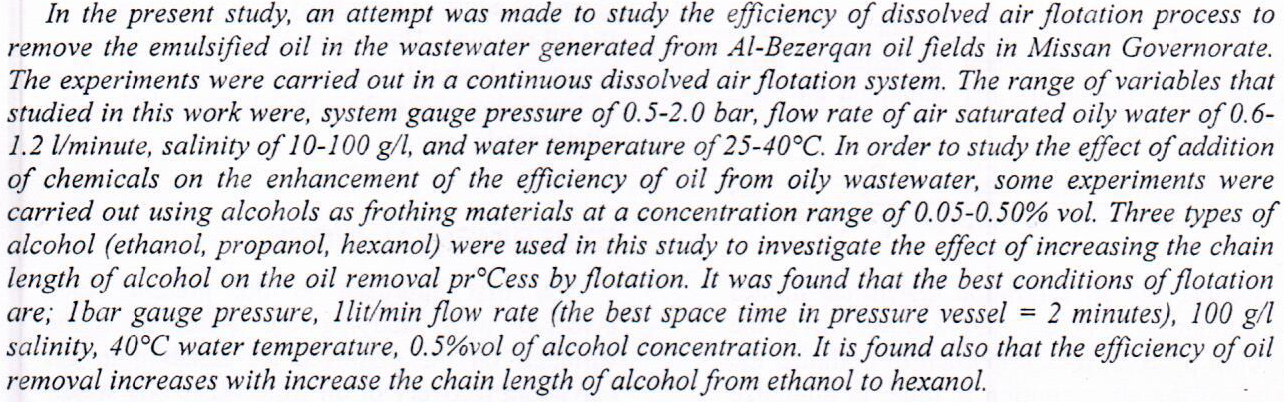
Oil Removal from Wastewater of Al-Bezerqan Crude Oil Fields by Air Flotation
...Show More Authors

View Publication Preview PDF
Quick Preview PDF
Publication Date
Mon Jan 01 2018
Journal Name
Fuel
Wettability of nanofluid-modified oil-wet calcite at reservoir conditions
...Show More Authors

Nanofluids, liquid suspensions of nanoparticles (Np), are an effective agent to alter the wettability of oil-wet reservoirs to water-wet thus promoting hydrocarbon recovery. It can also have an application to more efficient carbon storage. We present a series of contact angle (θ) investigations on initially oil-wet calcite surfaces to quantify the performance of hydrophilic silica nanoparticles for wettability alteration. These tests are conducted at typical in-situ high pressure (CO2), temperature and salinity conditions. A high pressure–temperature (P/T) optical cell with a regulated tilted surface was used to measure the advancing and receding contact angles at the desired conditions. The results showed that silica nanofluids can alte

... Show More
Scopus (141)
Crossref (134)
Scopus Clarivate Crossref
Publication Date
Mon Oct 01 2018
Journal Name
Journal Of Economics And Administrative Sciences
A comparative study of the role of monetary policies in achieving economic growth in some oil and non-oil countries during the period 1990-2017
...Show More Authors

The research problem was to identify the impact of monetary policies on economic growth in the oil and non-oil countries. The researcher chose the Republic of Iraq as an example for the oil countries and the Arab Republic of Egypt as an example for the non-oil countries to hold a comparison on the impact of monetary policies.

The research found that the monetary policies and their tools in the Iraqi economy affect the rate of GDP growth by 73%, which shows the strong impact of monetary policies on the economic growth in the Iraqi economy as an example of an oil state. GDP growth rate of 61%, indicating the impact of monetary policies on economic growth in the

... Show More
View Publication Preview PDF
Crossref
Publication Date
Sun Dec 30 2018
Journal Name
Iraqi Journal Of Chemical And Petroleum Engineering
Removal Of Dissolved Cadmium Ions from Contaminated Wastewater using Raw Scrap Zero-Valent Iron And Zero Valent Aluminum as Locally Available and Inexpensive Sorbent Wastes
...Show More Authors

The current study was to examine the reliability and effectiveness of using most abundant, inexpensive waste in the form of scrap raw zero valent aluminum ZVAI and zero valent iron ZVI for the capture, retard, and removal of one of the most serious and hazardous heavy metals cadmium dissolved in water. Batch tests were conducted to examine contact time (0-250) min, sorbent dose (0.25-1 g ZVAI/100 mL and 2-8 g ZVI/100 mL), initial pH (3-6), pollutant concentration of 50mg/L initially, and speed of agitation (0-250) rpm . Maximum contaminant removal efficiency corresponding to (90 %) for cadmium at 250 min contact time, 1g ZVAI/ 6g ZVI sorbent mass ratio, pH 5.5, pollutant concentration of 50 mg/L initially, and 250 rpm agitation speed wer

... Show More
View Publication Preview PDF
Crossref (12)
Crossref
Publication Date
Sun Dec 31 2023
Journal Name
Iraqi Geological Journal
Advanced Geostatistical Techniques for Building 3D Geological Modeling: A Case Study from Cretaceous Reservoir in Bai Hassan Oil Field
...Show More Authors

A 3D Geological model was generated using an advanced geostatistical method for the Cretaceous reservoir in the Bai Hassan oil field. In this study, a 3D geological model was built based on data from four wells for the petrophysical property distribution of permeability, porosity, water saturation, and NTG by using Petrel 2021 software. The geological model was divided into a structural model and a property model. The geological structures of the cretaceous reservoir in the Bai Hassan oil field represent elongated anticline folds with two faults, which had been clarified in the 3D Structural model. Thirteen formations represent the Cretaceous reservoir which includes (Shiranish, Mashurah, U.kometan, Kometan Shale, L. Kometan, Gulnen

... Show More
View Publication Preview PDF
Scopus (2)
Scopus Crossref
Publication Date
Sun Oct 31 2021
Journal Name
Iraqi Geological Journal
Optimizing Water Injection Performance by Using Sector Modeling of the Mishrif Formation in West Qurna-1 Oil Field, Southern Iraq
...Show More Authors

The regular job of a reservoir engineer is to put a development plan to increase hydrocarbon production as possible and within economic and technical considerations. The development strategy for the giant reservoir is a complex and challenging task through the decision-making analysis process. Due to the limited surface water treatment facility, the reservoir management team focuses on minimizing water cut as low as possible by check the flow of formation and injected water movement through the Mishrif reservoir. In this research, a representative sector was used to make the review of water injection configuration, which is considered an efficient tool to make study in a particular area of the entire field when compared with the ful

... Show More
Scopus (2)
Scopus Crossref
Publication Date
Sat Jul 01 2023
Journal Name
Journal Of Engineering
The Potential of Recycling Used Engine Oil for Biogas Generation by Co-Digestion with Animals’ Manure: Experimental and Kinetic Study
...Show More Authors

This study investigates the potential of biogas recovery from used engine oil (UEO) by co-digestion with animals’ manure, including cow dung (CD), poultry manure (PM), and cattle manure (CM). The experimental work was carried out in anaerobic biodigesters at mesophilic conditions (37°C). Two groups of biodigesters were prepared. Each group consisted of 4 digesters. UEO was the main component in the first group of biodigesters with and without inoculum, whereby a mix of UEO and petroleum refinery oily sludge (ROS) was the component in the second group of biodigesters. The results revealed that for UEO-based biodigesters, maximum biogas production was 0.98, 1.23, 1.93, and 0 ml/g VS from UEO±CD, UEO±CM, UEO±PM, and U

... Show More
View Publication Preview PDF
Crossref
Publication Date
Thu Dec 31 2015
Journal Name
Iraqi Journal Of Chemical And Petroleum Engineering
Electrolytic removal of zinc from simulated chloride wastewaters using a novel flow-by fixed bed electrochemical reactor
...Show More Authors

The cathodic deposition of zinc from simulated chloride wastewater was used to characterize the mass transport properties of a flow-by fixed bed electrochemical reactor composed of vertical stack  of stainless steel nets, operated in batch-recycle mode. The electrochemical reactor employed potential value in such a way that the zinc reduction occurred under mass transport control. This potential was determined by hydrodynamic voltammetry using a borate/chloride solution as supporting electrolyte on stainless steel rotating disc electrode. The results indicate that mass transfer coefficient (Km) increases with increasing of flow rate (Q) where .The electrochemical reactor proved to be efficient in removing zinc and was abl

... Show More
View Publication Preview PDF
Publication Date
Fri Jan 01 2021
Journal Name
Desalination And Water Treatment
Removal of nitrates from water by Amberlite IR-400 and economic Duolite A-378 ion exchange resins
...Show More Authors

View Publication
Scopus (3)
Crossref (2)
Scopus Clarivate Crossref
Publication Date
Wed Feb 01 2023
Journal Name
Chemical Data Collections
Removal of diclofenac from aqueous solution on apricot seeds activated carbon synthesized by pyro carbonic acid microwave
...Show More Authors

Pharmaceuticals have been widely remaining contaminants in wastewater, and diclofenac is the most common pharmaceutical pollutant. Therefore, the removal of diclofenac from aqueous solutions using activated carbon produced by pyrocarbonic acid and microwaves was investigated in this research. Apricot seed powder and pyrophosphoric acid (45 wt%) were selected as raw material and activator respectively, and microwave irradiation technique was used to prepare the activated carbon. The raw material was impregnated in pyrophosphoric acid at 80◦C with an impregnation ratio of 1: 3 (apricot seeds to phosphoric acid), the impregnation time was 4 h, whereas the power of the microwave was 700 watts with a radiation time of 20 min. A series o

... Show More
Crossref (16)
Crossref
Publication Date
Wed Jun 29 2022
Journal Name
Iraqi Journal Of Chemical And Petroleum Engineering
Determining Optimum Oil Separator Size and Optimum Operating Pressure
...Show More Authors

The optimum separators operating pressure is determined by using flash calculations and equilibrium ratios. In this study, the optimum separator size for Jambur field is calculated by using equations introduced by Arnold and Stewart and API12J Specification [1]. Because Jambur field has a high production rate two conditions are taken in the study to determine separator size, first based on production rate 80,000 bbl/day and second based on split the production between two banks A and B (40,000 bbl/day for each bank). The calculation resulted in optimum separator pressure for the first stage of 700 psi, and the second stage of 300 psi, and the third stage of 120 psi. The results show that as the number of stages increased above three

... Show More
View Publication Preview PDF
Crossref


