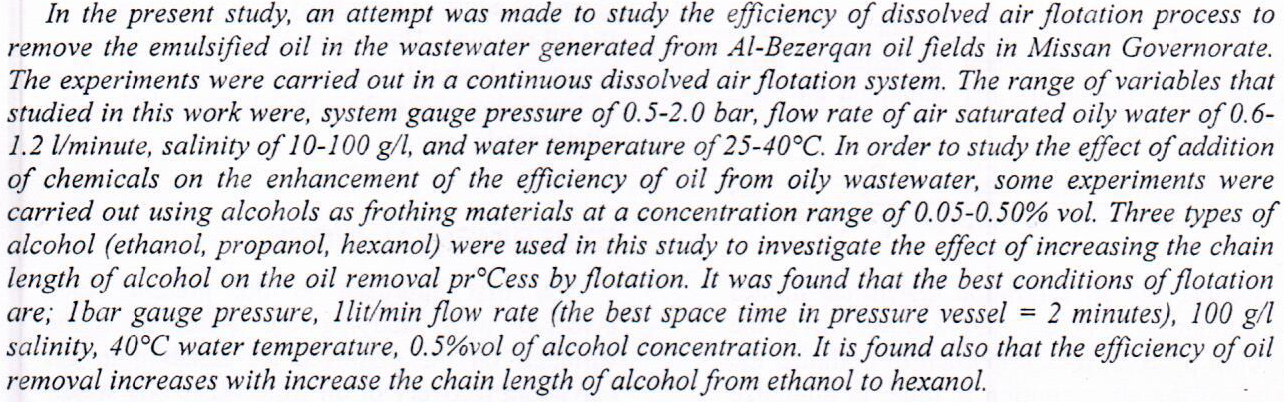
Oil Removal from Wastewater of Al-Bezerqan Crude Oil Fields by Air Flotation

This study aims to assess the removal efficiency andestablish the BOD5 and COD statisticalcorrelation of the sewage flowing in Al-Diwaniyah wastewater treatment plant in Iraq during the study period (2005-2016). The strength of the influent wastewater entering the plant varied from medium to high in strength. High concentrations of BOD5 and COD in the effluent were obtained due to the poor performance of the plant. This was observed from the BOD5 /COD ratios that did not confirm with the typical ratios for the treated sewage. To improve the performance of this plant, regression equations for BOD5 and COD removal percentages were suggested which can be used to facilitate evaluation of liquid waste and optimal control process. The equations
... Show More (9)
(9)

The increasing demand for energy has encouraged the development of renewable resources and environmentally benign fuel such as biodiesel. In this study, ethyl fatty esters (EFEs), a major component of biodiesel fuel, were synthesized from soybean oil using sodium ethoxide as a catalyst. By-products were glycerol and difatty acyl urea (DFAU), which has biological characteristics, as antibiotics and antifungal medications. Both EFEs and DFAU have been characterized using Fourier transform infrared (FTIR) spectroscopy, and 1H nuclear magnetic resonance (NMR) technique. The optimum conditions were studied as a function of reaction time, reactant molar ratios, catalyst percentage and the effect of organic solvents. The conversion ratio of soybea
... Show More
(11)
In this study, oxidative desulfurization of dibenzothiophene (DBT) with H2O2 as an oxidant was studied, whereas the catalyst used was zirconium oxide supported on Activated carbon (AC). Zirconium oxide (ZrO2) was impregnated over prepared activated carbon (AC) and characterized by various techniques such as XRD, FTIR, BET, SEM, and EDX. This composite was used as a heterogeneous catalyst for oxidation desulfurization of simulated oil. The results of this study showed that ZrO2/AC composite exhibited significant catalytic activity and stability, effectively lowering sulfur content under mild conditions. Factors such as reaction temperature (30, 40, 50, 60°C), time (5, 10, 15,20,30,60, 80 100 min), catalyst dose (0.3, 0.5,
... Show More (3)
(3)
 (3)
(3)
|
Background: Essential oils extracted from plants have been widely used in antimicrobial activity, particularly the Callistemon viminalis, with a high number of essential oils extracted. Objectives: To identify the chemical composition of essential oil derived from Callistemon viminalis and evaluates its antimicrobial activity against selected bacterial and fungal strains. Subjects and methods: During the study, the antimicrobial activity of different selected essential oils on some bacteria (Escherichia coli, Pseudomonas aeruginosa, Salmonella enteritidis, Staphylococcus aureus, and Streptococcus pneumonia) and fungus (Candida albicans) was evalua |
(2)
(1)
(5)
In the present work, the pollutants of the municipal wastewater are reduced using Chlorella vulgaris microalgae. The pollutants that were treated are: Total organic carbon (TOC), Chemical oxygen demand (COD), Nitrate (NO3), and Phosphate (PO4). Firstly, the treatment was achieved at atmospheric conditions (Temperature = 25oC), pH 7 with time (1 – 48 h). To study the effect of other microorganisms on the reduction of pollutants, sterilized wastewater and unsterilized wastewater were used for two types of packing (cylindrical plastic and cubic polystyrene) as well as algae's broth (without packing), where the microalgae are grown on the packing then transported to the wastewater for treatment. Th
... Show More
(5)
Oil flow lines are used to transport oil and its derivatives from a well over long distances, and because oil wells produce other potentially corrosive products, such as carbon dioxide and Hydrogen sulfide, it is necessary to take methods to protect the pipeline from corrosion. One of these methods is the use of corrosion inhibitors in this study. Prepare 5-acetyl-2-anilino-4-dimethylaminothiazole and test it as a corrosion inhibitor on a sample of the Rumaila flow line at a constant temperature 25°C in (3.5%) NaCl and (3.5%) KCl solution in the absence and presence of different concentrations of inhibitor (0 mM, 0.01 mM, 0.03 M, 0.05 mM). by using liner polarization (Tafel slope). The inhibiter exhibited the best performance at hi
... Show More
(2)
(9)
(6)