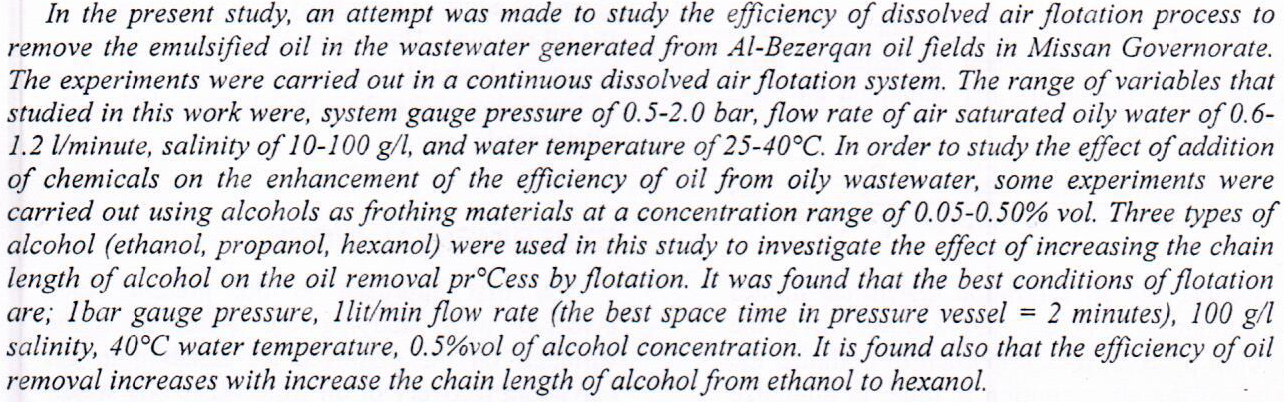
Oil Removal from Wastewater of Al-Bezerqan Crude Oil Fields by Air Flotation

Conducted Althilelat chemical models of crude oil back to the reservoir Fertile from the fields of Baghdad and Kut and models of crude oil back to the reservoir ??????? of Haklbe Tikrit and Baghdad were calculated their properties Alvezaúah Kalkthaqh and weight, quality and degree of August j (API) and know the quality Nfothma that was light or heavy and make the comparison between Alinvtin also conducted chemical analyzes of the two models of Almia associated with each of the oil above Almkmnin and measured Ktvthma and Zojithma and concentrations of some dissolved salts in them and clarify the relationship between the oil reservoir and water associated with oil fields...
The corrosion behavior of low carbon steel in washing water of crude oil solution has been studied potentiostatically at five temperatures in the range (30–70)°C .The corrosion potential shifted to more negative values with increasing temperature and the corrosion current density increased with increasing temperature. Folic acid had on inhibiting effect on the corrosion of low carbon steel in washing water at a concentration (5× 10⁻⁴-- 5× 10⁻³ ) mol/dm3 over the temperature range (30–70)°C. Values of the protection efficiency were calculated from the corrosion current density .From the general results for this study, it can be seen that thermodynamic and kinetic function were also calculated (?G, ?S, ?H and Ea )
... Show More (3)
(3)

The objective of present study was to investigate the effect of using mixture volaticle oil of rosmarinus and nigella sativa to improve some of the meat quality characteristics, physical and limited storage time of minced cold poultry meat. Duplex volaticle oil was added at 0.025, 0.050 and 0.075 g/kg to minced poultry meat, these treatments were stored individually for 0 , 4 and 7 days at 4-7C0. After making several chemical, physical and oxidation indicators, the following results were obtained:
The process of adding volaticle oil to minced poultry meat led to significant increase (P<0.01)in moisture, prot
... Show MoreThe corrosion behavior of low carbon steel in washing water of crude oil solution has been studied potentiostatically at five temperatures in the range ( 303 –343 )K, at pH ( 4 ) and at pH (4,6,7,9,11 ) at (343K)..The corrosion potential shifted to more negative values with increasing temperature and the corrosion current density increased with increasing temperature, the corrosion current density (icorr) decreased with increasing pH in the rang ( 4 – 7 ) and it increased with increasing pH in the rang ( 9 – 11 ) at ( 343 K ), while the corrosion potential generally variation with increasing pH in the rang (4-11)at(343K. From the general results for this study can be seen that thermodynamic and kinetic function were
... Show More
(1)
In this study two types of extraction solvents were used to extract the undesirable polyaromatics, the first solvent was furfural which was used today in the Iraqi refineries and the second was NMP (N-methyl-2-pyrrolidone).
The studied effecting variables of extraction are extraction temperature ranged from 70 to 110°C and solvent to oil ratio in the range from 1:1 to 4:1.
The results of this investigation show that the viscosity index of mixed-medium lubricating oil fraction increases with increasing extraction temperature and reaches 107.82 for NMP extraction at extraction temperature 110°C and solvent to oil ratio 4:1, while the viscosity index reaches to 101 for furfural extraction at the same extraction temperature and same
The aim of this study is to utilize the electromembrane extraction (EME) system as a manner for effective removal of zinc from aqueous solutions. A novel and distinctive electrochemical cell design was adopted consisting of two glass chambers, a supported liquid membrane (SLM) housing a polypropylene flat membrane infused with 1-octanol and a carrier. Two electrodes were used, a graphite as anode and a stainless steel as cathode. A comprehensive examination of several influential factors including the choice of carrier, the applied voltage magnitude, the initial pH of the donor solution, and the initial concentration of zinc was performed, all in a concerted effort to ascertain their respective impacts on the efficiency of zinc elim
... Show More (5)
(2)
(5)
(2)


Four samples were collected from the wastewater of State Battery Manufacturing Company (SBMC); Babylon 2 factory in AL-Waziriya district, as triplicates. Physical and chemical measurements were carried out such as temperature, pH, Lead concentrations and their ranges were: (19.5-34.5) °C, (6.1-6.4) and (4.5-6.5) mg/L, respectively. Six dominant Bacillus spp. isolates were isolated from these samples; namely, Bacillus subtilis N1, Bacillus subtilis N2, Bacillus subtilis N3, Bacillus cereus N4, Bacillus cereus N5 , Bacillus cereus N6. These isolates were capable of removing Lead from aqueous solutions in a capacity reached 27.6 ± 1.4, 10.1 ± 1.7, 74.5 ± 0.7, 8.93 ± 2.8, 8.1 ± 3.5, 1.6± 0.7 mg/L, respectively. Whereas cell walls,
... Show More
(5)
(5)
An environmentally friendly technique was used to prepare titanium dioxide@ silver (core shell) (TiO₂@Ag NPs) using chard leaf extract, a natural stabilizer and reductant. A nanocomposite (NCs) of TiO₂@Ag supported by halloysite nanotubes (HNTs), TiO2@Ag/HNT NCs, was prepared under microwave irradiation. The microwave technique is used to accelerate the reaction and enhance the homogeneity of nanoparticle distribution. Spectroscopic and structural analyses were performed on the resulting nanocomposite. X-ray diffraction (XRD) revealed a clear crystalline structure with grain sizes ranging from 7 to 15 nm, with an average of ~11 nm, the transmission electron microscope (TEM) revealed that the size of nanoparticles in the TiO₂@Ag/HNT N
... Show More