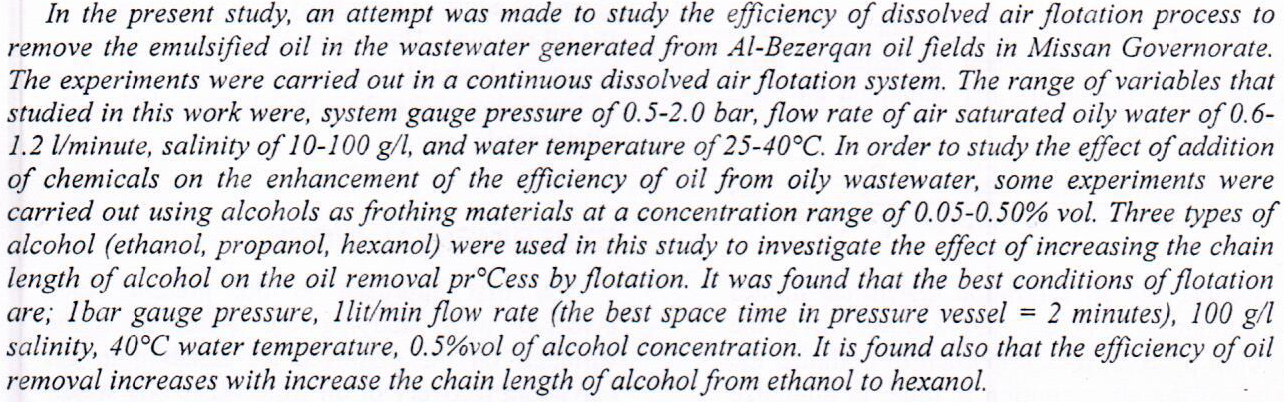
Oil Removal from Wastewater of Al-Bezerqan Crude Oil Fields by Air Flotation

Electrocoagulation is an electrochemical process of treating polluted water where sacrificial anode corrodes to produce active coagulant (usually aluminum or iron cations) into solution. Accompanying electrolytic reactions evolve gas (usually as hydrogen bubbles). The present study investigates the removal of phenol from water by this method. A glass tank with 1 liter volume and two electrodes were used to perform the experiments. The electrode connected to a D.C. power supply. The effect of various factors on the removal of phenol (initial phenol concentration, electrode size, electrodes gab, current density, pH and treatment time) were studied. The results indicated that the removal efficiency decreased as initial phenol concentration
... Show MoreThis study investigates the possibility of removing ciprofloxacin (CIP) using three types of adsorbent based on green-prepared iron nanoparticles (Fe.NPs), copper nanoparticles (Cu. NPS), and silver nanoparticles (Ag. NPS) from synthesized aqueous solution. They were characterized using different analysis methods. According to the characterization findings, each prepared NPs has the shape of a sphere and with ranges in sizes from of 85, 47, and 32 nanometers and a surface area of 2.1913, 1.6562, and 1.2387 m2/g for Fe.NPs, Cu.NPs and Ag.NPs, respectively. The effects of various parameters such as pH, initial CIP concentration, temperature, NPs dosage, and time on CIP removal were investigated through batch experiments. The res
... Show More (3)
(3)
 (3)
(3)


A field experiment was carried out during two winter season 2013, 2014 at the field of the Department of Field Crops, College of Agriculture, University of Baghdad, to study the effect of seeds soaking with Gibberellic acid and foliar with Abscisic Acid on the growth, yield, and content of Anise oil seeds using factorial experiment within RCBD design with three replicates. The seeds was treated within GA3 were soaked with two concentrations of 30, and 60 mg. litter-1 in addition to without soaking and the code has been B0 , B1 , B2 overlapped these transactions with two concentrations of Abscisic Acid 3, and 6 mg. litter-1 in addition to without foliar A0 , A1 , A2The seeds to be treated with GA3 are soaked for 24 hours prior
... Show More
(2)
Aim of the study: Is to evaluate the effect of myrrh oil local application on the healing process of skin wounds histologically , histomorphometrically and , histochemically. Materials and methods:Twenty male white New Zealand rabbits were used in this study. An incisional wounds with full thickness depth and of 2 cm length were done on both sides of the cheek skin of each rabbit. The left sided incisions (the control group) were irrigated with distilled water (10µL). The right sided incisions (the experimental groups) were treated with myrrh oil (10µL). Each group was subdivided into 4 subgroups according to the healing interval into 1,3,7 and 14 days(5 rabbits for each group). Results: Histological findings of our current study s
... Show More
(11)
(1)
The study searches for the possibility of using duckweed Lemna spp. to reduce the concentration of heavy metals (zinc and iron) in the wastewater of Baghdad by culturing two different densities of the plant with a fresh weights 5 and 10 g/l and without the plant under optimum uncontrolled conditions. The result showed that there was a significant differences at the possibility level of (p? 0.05) for the three treatments, as the highest percentages for zinc removal in the second day for the plant treatment of 5 g/l were 66.40%, while the highest percentage of iron removal were in the tenth days for the plant treatment 10 g/l were 80 %, and noticed that the increase of the heavy metals concentrations accumulated in the plant after bei
... Show More
(64)
(59)

The research deals with the collection of Allamah Ali al-Nuri’s guidance on readings, which he included in his book (Ghaith al-Naf’ fi al-Qira’at al-Sabe) and singled out it in a separate study, commenting on what needs to be commented and a statement of his guidance, and it consists of an introduction, and three chapters, the first: for the translation of Allamah Sfaxi, and the second: To define the science of guidance, its origins and authorship, and the third: to mention the readings that Al-Safaqi drew from Surat Al-An’am to the end of Surat Hud, followed by the conclusion of the research, then the index of sources and references, and I followed the inductive-analytical method in the research.
Among his most important
... Show MoreIn the present work, Response Surface Methodology (RSM) was utilized to optimize process variables and find the best circumstances for indirect electrochemical oxidation of mimicked wastewater to remove phenol contaminants using prepared ternary composite electrode. The electrodeposition process is used for the synthesis of a ternary composite electrode of Mn, Co, and Ni oxides. The selected concentrations of metal salts of these elements were 0.05, 0.1, and 1.5 M, with constant molar ratio, current density, and electrolysis time of 1:1:1, 25 mA/cm2, and 2 h. Interestedly, the gathered Mn-Co-Ni oxides were deposited at both the anode and cathode. X-ray diffraction (XRD) and scanning electron microscopy (SEM) facilitated the qualitative char
... Show More
(4)
(3)
(45)
(11)
(49)
(43)