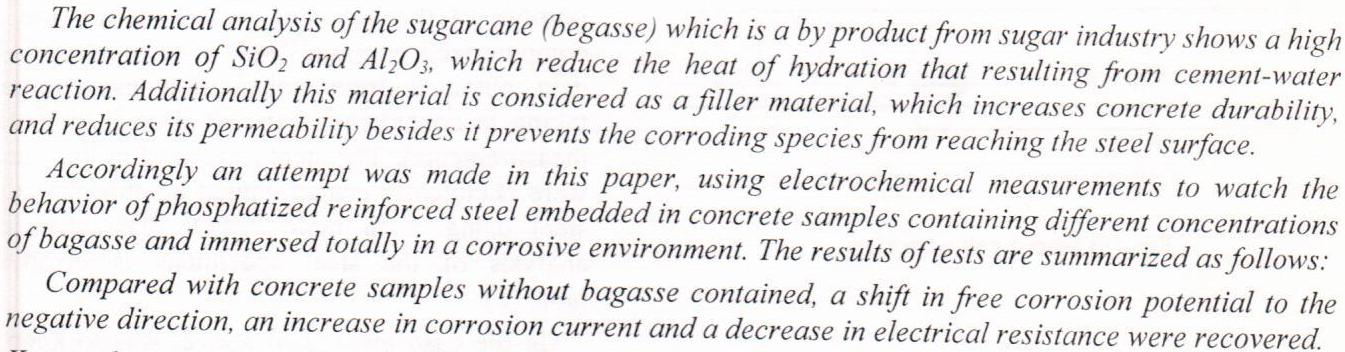
Electrochemical Behavior of Phosphotized Reinforcing Steel in Concrete in Presence of Sugar Can Ash

 (31)
(31)
 (32)
(32)



Self is the main factor of personality and the acceptance of others where each of them are connecting and plays an important role in emotional maturation. The researches affirmed that the leading behavior depending on good human relations between the employers and the employees will enhance their goals and the goals of the institution at the same time . This study aims to measure the emotional maturation among the leactures of the university according to sex variable and identify the correlation between emotional maturation and the level of leading behavior among the lecturers of the university. The sample consists of two samples where the lst is to build the measwe consisting of (200)males and famales lecturers and the 2nd which is the
... Show MoreEvaluating the behavior of a ring foundation resting on multi-layered soil is one of the important issues facing civil engineers. Many researchers have studied the behavior of ring foundation rests on multi-layered soil with vertical loads acting on the foundation. In real life ring foundation can be subjected to both vertical and horizontal loads at the same time due to wind or the presence of soil. In this research, the behavior of ring footing subjected to inclined load has been studied using PLAXIS software. Furthermore, the effect of multi-layered soil has been simulated in the model. The results showed that both vertical and horizontal stresses are mainly affected when the inclination angle of the load exceeded 45 degrees with a reduc
... Show MoreSynthesis and study liquid crystalline properties of new compounds with terminal groups of amides ([III]a-c,[IV]a-c and [VI]n), alkoxy series[V]n or ester with azo linkage ([IX]a-c and[X]a-c) containing thaizole ring. These series were synthesized by many steps starting from 4- hydroxyacetophenone or 4-aminoacetophenone. The synthesized compounds were characterized using melting points, FTIR, C.H.N.S analysis and for some of them 1H NMR spectroscopy. The liquid crystalline properties were studied by hot stage polarizing microscopy and differential scanning calorimetry DSC. All compounds of series [III]a-c,[IV]a-c and compounds [V]n showed enantiotropic liquid crystal. While the series [VI]n showed nematic mesomorphism except [VI]8 did not s
... Show MoreCeramics type Yttrium oxide with Silicon carbide. were selected to investigate its sintered density, microstructure and electrical properties, after adding V2O5, of 100 nm grain size. Different weight percentages ranging from (0.01,0.02,0.03 and 0.04) were used. Dry milling applied for twelve hours. The pelletized samples were sintered at atmospheric of static air and at sintering temperature 1400 ˚C, for three hours. The crustal structure test shoes the phase which is yttrium silicon carbide Scanning electron microscopy, scan sintered microstructure. Samples after sintering were electrically investigated by measuring its capacitance, dielectric constant and their results showed increasing after added V2O5 particles at the combinat
... Show More
In this research, experimental and numerical studies were carried out to investigate the performance of encased glass-fiber-reinforced polymer (GFRP) beams under fire. The test specimens were divided into two peer groups to be tested under the effect of ambient and elevated temperatures. The first group was statically tested to investigate the monotonic behavior of the specimens. The second group was exposed to fire loading first and then statically tested to explore the residual behavior of the burned specimens. Adding shear connectors and web stiffeners to the GFRP beam was the main parameter in this investigation. Moreover, service loads were applied to the tested beams during the fire. Utilizing shear connectors, web stiffeners,
... Show More
(32)
(33)
In this study, the effect of glass fiber reinforced polymer (GFRP) section and compressive strength of concrete in composite beams under static and low velocity impact loads was examined. Modeling was performed and the obtained results were compared with the test results and their compatibility was evaluated. Experimental tests of four composite beams were carried out, where two of them are control specimen with 20 MPa compressive strength of concrete deck slab and 50 MPa for other. Bending characteristics were affected by the strength of concrete under impact loading case, as it increased maximum impact force and damping time at a ratio of 59% and reduced the damping ratio by 47% compared to the reference hybrid beam. Under stat
... Show More
(25)
(18)
In this research, experimental and numerical studies were carried out to investigate the performance of encased glass-fiber-reinforced polymer (GFRP) beams under fire. The test specimens were divided into two peer groups to be tested under the effect of ambient and elevated temperatures. The first group was statically tested to investigate the monotonic behavior of the specimens. The second group was exposed to fire loading first and then statically tested to explore the residual behavior of the burned specimens. Adding shear connectors and web stiffeners to the GFRP beam was the main parameter in this investigation. Moreover, service loads were applied to the tested beams during the fire. Utilizing shear connectors, web stiffeners,
... Show More
(32)
(33)
The finite element method has been used in this paper to investigate the behavior of precast reinforced concrete dapped-ends beams (DEBs) numerically. A parametric investigation was performed on an experimental specimen tested by a previous researcher to show the effect of numerous parameters on the strength and behavior of RC dapped-end beams. Reinforcement details and steel arrangement, the influence of concrete compressive strength, the effect of inclined load, and the effect of support settlement on the strength of dapped-ends beams are examples of such parameters. The results revealed that the dapped-end reinforcement arrangement greatly affects the behavior of dapped end beam. The failure load decreases by 25% when
... Show More
The ejector refrigeration system is a desirable choice to reduce energy consumption. A Computational Fluid Dynamics CFD simulation using the ANSYS package was performed to investigate the flow inside the ejector and determine the performance of a small-scale steam ejector. The experimental results showed that at the nozzle throat diameter of 2.6 mm and the evaporator temperature of 10oC, increasing boiler temperature from 110oC to 140oC decreases the entrainment ratio by 66.25%. At the boiler temperature of 120oC, increasing the evaporator temperature from 7.5 to 15 oC increases the entrainment ratio by 65.57%. While at the boiler temperature of 120oC and
... Show More
(1)