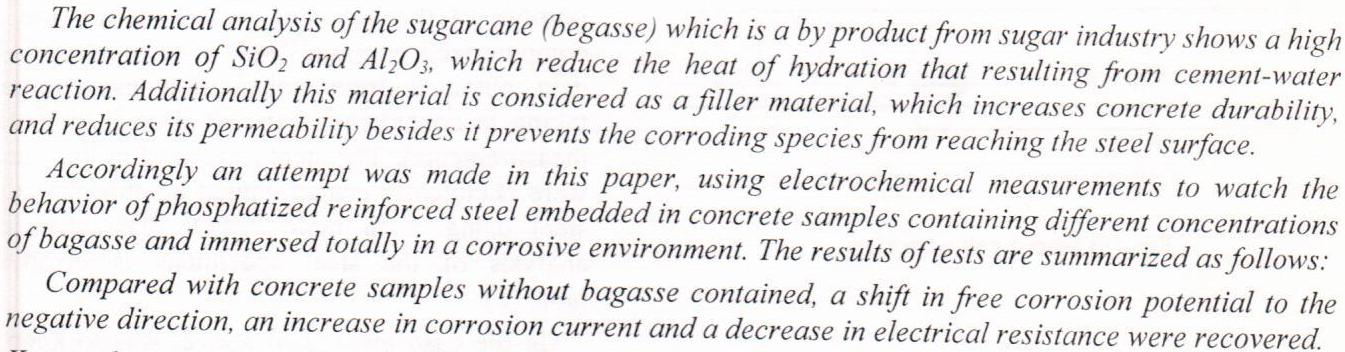
Electrochemical Behavior of Phosphotized Reinforcing Steel in Concrete in Presence of Sugar Can Ash

Strengthening of composite beams is highly needed to upgrade the capacities of existing beams. The strengthening methods can be classified as active or passive techniques. Therefore, the main purpose of this study is to provide detailed FE simulations for strengthened and unstrengthened steel–concrete composite beams at the sagging and hogging moment regions with and without profiled steel sheeting. The developed models were verified against experimental results from the literature. The verified models were used to present comparisons between the effect of using external post-tensioning and CFRP laminates as strengthening techniques. Applying external post-tensioning at the sagging moment regions is more effective because of the e
... Show More (6)
(6)
 (6)
(6)



To enhance the structural performance of concrete-filled steel tube (CFST) columns, various strengthening techniques have been proposed, including the use of internal steel stiffeners, external wrapping with carbon fiber-reinforced polymer (CFRP) sheets, and embedded steel elements. However, the behavior of concrete-filled stainless-steel tube (CFSST) columns remains insufficiently explored. This study numerically investigates the axial performance of square CFSST columns internally strengthened with embedded I-section steel profiles under biaxial eccentric loading. Finite element (FE) simulations were conducted using ABAQUS v. 6.2, and the developed models were validated against experimental results from the literature. A comprehen
... Show More
(2)
he paper presents the results of exposure of normal concrete to high temperatures (400 and 700°C). In addition to the exposure of steel reinforcement bar Ø 12 mm, where two types of steel reinforcement burning situations were performed. Directly exposed to high temperatures (400 and 700°C) and others were covered by concrete layer (15 mm). From the experimental results of fire exposure for 1 hour of 400 and 700°C and gradually cooled, it was found that the residual average percentage of compressive strength of concrete was 85.3 and 41.4%, while the residual average percentage of modulus of elasticity of concrete was 75 and 48%, respectively. The residual average percentage of yielding tensile stress (Ø 12 mm) after burning and cooling
... Show More
(5)
(4)
The conception and experimental assessment of a removable friction-based shear connector (FBSC) for precast steel-concrete composite bridges is presented. The FBSC uses pre-tensioned high-strength steel bolts that pass through countersunk holes drilled on the top flange of the steel beam. Pre-tensioning of the bolts provides the FBSC with significant frictional resistance that essentially prevents relative slip displacement of the concrete slab with respect to the steel beam under service loading. The countersunk holes are grouted to prevent sudden slip of the FBSC when friction resistance is exceeded. Moreover, the FBSC promotes accelerated bridge construction by fully exploiting prefabrication, does not raise issues relevant to precast co
... Show More
(52)
In this paper, effective slab width for the composite beams is investigated with special emphasis on the effect of web openings. A three dimensional finite element analysis, by using finite element code ANSYS, is employed to investigate shear lag phenomenon and the resulting effective slab width adopted in the classical T-beam approach. According to case studies and comparison with limitations and rules stipulated by different standards and codes of practice it is found that web openings presence and panel proportion are the most critical factors affecting effective slab width, whereas concrete slab thickness and steel beam depth are less significant. The presence of web opening reduces effective slab width by about 21%.
... Show More
(3)
(3)
The present investigation aims to study the effect of heat treatment by quenching in different quenching media (salt water, water and oil) following by tempering on wear resistance of EN25 steel. EN25 steel is an alloy of medium carbon low alloy steel which is used for many applications requiring high tensile strength and wear resistance such as connecting rods, adapters and in power sectors extensively. The specimens are machined to 20 mm in length and 10 mm in diameter. This study is done by two stages: The first stage is done by austenitizing EN25 steel to 850 for 1 hr by quenching the specimens in three different quenching media and then tempered at 300 in air. While the second stage is performed by wear
... Show More
Faces of the individual in his life many stressful events, which includes expertise undesirable, and events may involve a lot of sources of tension and the risk factors and threats in all areas of life, and this would make the stressful events play a role in the genesis of many diseases physical.
The high blood pressure is one of the most Actual manifestations of mental stress in the present scale physical disorders which may frequently in men relative to women, which may be caused by spasms in the blood vessels.
This paper demonstrates an experimental and numerical study on the behavior of reinforced concrete (RC) columns with longitudinal steel embedded tubes positioned at the center of the column cross-section. A total of 12 pin-ended square sectional columns of 150 × 150 mm having a total height of 1400 mm were investigated. The considered variables were the steel tube diameters of 29, 58, and 76 mm and the load eccentricity (0, 50, and 150) mm. Accordingly, these columns were divided into three groups (four columns in each group) depending on the load eccentricity (e) to column depth (h) ratio (e/h = 0, 1/3, and 1). For each group, one column was solid (reference), and the other three columns contained steel tubes with hollow rat
... Show More
(18)
The purpose of this study is designate quenching and tempering heat treatment by using Taguchi technique to determine optimal factors of heat treatment (austenitizing temperature, percentage of nanoparticles, type of base media, nanoparticles type and soaking time) for increasing hardness, wear rate and impact energy properties of 420 martensitic stainless steel. An (L18) orthogonal array was chosen for the design of experiment. The optimum process parameters were determined by using signal-to-noise ratio (larger is better) criterion for hardness and impact energy while (Smaller is better) criterion was for the wear rate. The importance levels of process parameters that effect on hardness, wear rate and impact energy propertie
... Show More
(2)