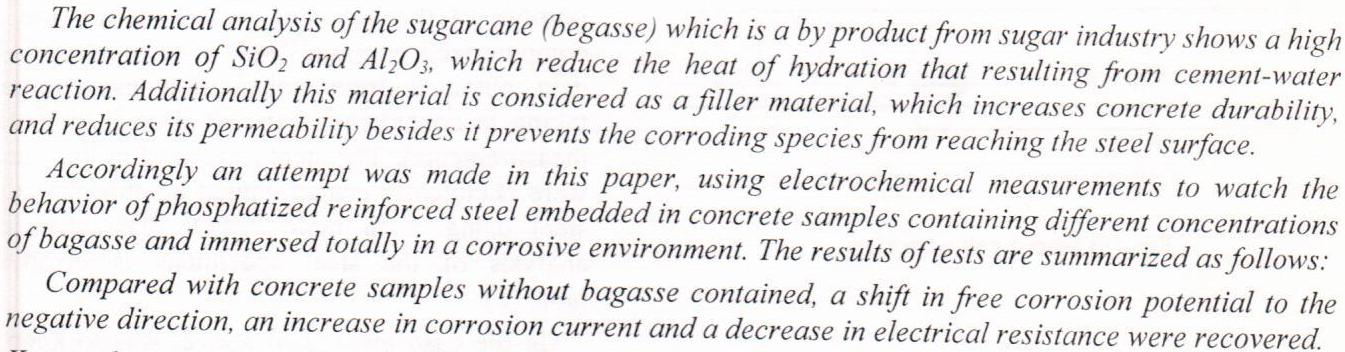
Electrochemical Behavior of Phosphotized Reinforcing Steel in Concrete in Presence of Sugar Can Ash

To decrease the impact on the environment of building waste, the recycled aggregate may be used in various sustainable engineering applications, such as roller compacted concrete pavement (RCCP). This research examined how using recycled aggregate as a partial replacement for natural aggregate as coarse or fine affected the mechanical properties of roller-compacted concrete pavement. The recycled aggregate was crushed and sieved to coarse and fine aggregate before being used in the roller-compacted concrete pavement. Compressive strength, splitting tensile strength, and flexural strength were all evaluated after the samples were prepared at 28 and 90 days of curing. According to the study's findings, the partial replacem
... Show More (2)
(2)

The aim of this study is to propose reliable equations to estimate the in-situ concrete compressive strength from the non-destructive test. Three equations were proposed: the first equation considers the number of rebound hummer only, the second equation consider the ultrasonic pulse velocity only, and the third equation combines the number of rebound hummer and the ultrasonic pulse velocity. The proposed equations were derived from non-linear regression analysis and they were calibrated with the test results of 372 concrete specimens compiled from the literature. The performance of the proposed equations was tested by comparing their strength estimations with those of related existing equations from literature. Comparis
... Show More
(6)
This research examines the use of vibratory treatments to reduce residual stresses in small welded parts. In this experimental investigation, a post weld vibration treatment was applied to T- A106 steel pipe fitting specimens to study the effect of the treatment on the residual stress and the hardness of the material. The vibratory stress relief treatment was carried out at different vibration frequency. The results have demonstrated that post-weld vibratory stress relief of small size fittings is possible and residual stress may be relieved, and the treatment may be an alternative method for heat treatment especially when unchange in dimensions and material stability are required.
The aim of this study was to evaluate tensile properties of low and medium carbon ferrite -martensite dual phase steel, and the effect cryogenic treatment at liquid nitrogen temperature (-196 ºC) on its properties. Low carbon steel (C12D) and medium carbon steels (C32D & C42D) were used in this work. For each steel grade, five groups of specimens were prepared according to the type of heat treatment. The first group was normalized, the second group was normalized and subsequently subjected to cryogenic treatment then tempered at (200 ºC) for one hour, the third group was quenched from intercritical annealing temperature of (760 ºC) to obtain dual phase (DP) steel, the fourth and fifth groups were both quenched from (760 ºC), but
... Show More
(1)
The mechanical properties and microstructure of hot-rolled steel are critical in determining its performance in industrial applications, particularly when exposed to elevated temperatures. This study examines the effects of varying temperatures and soaking times on these properties through a series of controlled experiments. The primary objective was to optimize the key response parameters, including tensile strength, yield strength, and elongation, by analyzing the influence of temperature and time. A full factorial design approach was used, applying the desirability function theory to explore all possible combinations and identify optimal processing conditions. The experimental results showed that the soaking time played a critica
... Show More (5)
(4)
(5)
(4)

In this research is to study the influence of the aging heat treatment on the pitting corrosion resistance of martensitic stainless steel (MSS), where a number of specimens from martensitic stainless steel were subjected to solution treatment at 1100 oC for one hour followed by water quenching then aging in the temperatures range (500-750) oC for different holding times (1,5,10,15&20) hr. Accelerated chemical corrosion test and immersion chemical corrosion test were performed on samples after heat treatment. The results of the research showed that the pitting corrosion resistance is significantly affected by the aging temperature. Where found that the aging samples at a temperature of 500 °C have the highest ra
... Show More
(4)
(2)
Background: Decalcification of surface enamel adjacent to fixed orthodontic appliances, in the form of white spot lesions, is a wide spread and familiar well-known side effect of orthodontic treatment. The present study was carried out to evaluate the effect of enamel protective agent (Clinpro white varnish) on shear and tensile bond strength of Dentaurum orthodontic stainless steel brackets by using 3M Unitek and Ormco as orthodontic adhesive agents. Materials and methods: Sixty-four extracted human upper first premolar teeth were selected and randomly divided into two groups with 32 teeth each, representing the shear and tensile bond strength testing groups. Then according to the type of bonding adhesive and the addition of Clinpro before
... Show More
(2)
The current article focuses on studying the social organization reality of the Iraqi society; it aims to construct an Iraqi organized personality that believe in the principles of Islamic religion by making use of the sociology thoughts in explaining the strength of social organization, and the causes of social deviance in attempt of decreasing the deviance and strengthening the cohesion of Iraqi character.
The researchers put forward some questions: to what extent the western theoretical pattern can succeed in explaining the social organization of the Iraqi society? What is the more appropriate western theory for diagnosing the cohesion and deviance of the society? What is the s
... Show More
(27)
(23)
