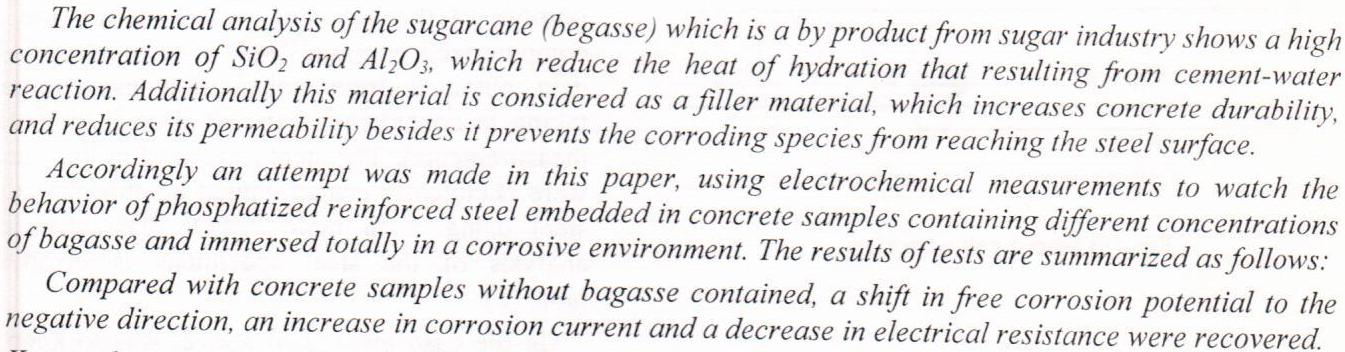
Electrochemical Behavior of Phosphotized Reinforcing Steel in Concrete in Presence of Sugar Can Ash

 (2)
(2)

Objectives: The study aims to assess the school refusal behavior of first class pupils at primary schools and identifying the relationship between the school refusal behavior and some of socio-demographic characteristics for the pupils.
Methodology: A descriptive-analytic study was initiated from November 1st, 2012 to April 1st, 2013. A random sample of 411 students is selected from a probability stratified sample of 17 primary schools for both sexes in 4 sectors in Baghdad Al-Rasafa and Al-Karkh districts which are selected randomly from first class of primary school. A Self administrative questionnaire (Parents' Version) which constructed by the rese
... Show More<span lang="EN-US">Diabetes is one of the deadliest diseases in the world that can lead to stroke, blindness, organ failure, and amputation of lower limbs. Researches state that diabetes can be controlled if it is detected at an early stage. Scientists are becoming more interested in classification algorithms in diagnosing diseases. In this study, we have analyzed the performance of five classification algorithms namely naïve Bayes, support vector machine, multi layer perceptron artificial neural network, decision tree, and random forest using diabetes dataset that contains the information of 2000 female patients. Various metrics were applied in evaluating the performance of the classifiers such as precision, area under the c
... Show More
(2)
 (1)
(1)

Creep testing is an important part of the characterization of composite materials. It is crucial to determine long-term deflection levels and time-to-failure for these advanced materials. The work is carried out to investigate creep behavior on isotropic composite columns. Isotropy property was obtained by making a new type of composite made from a paste of particles of carbon fibers mixed with epoxy resin and E-glass particles mixed with epoxy resin. This type of manufacturing process can be called the compression mold composite or the squeeze mold composite. Experimental work was carried out with changing the fiber concentration (30, 40 and 50% mass fraction), cross section shape, and type of composite. The creep results showed that th
... Show More
(1)
The Messengers and the Imam of the God-fearing, Muhammad is God, his family, and all of his companions. As for what comes after... Fainting is one of the involuntary symptoms and states that occur to a person when carrying out his life’s tasks suddenly due to his loss of sense and movement, so he loses consciousness for a period of time that is short or may be long, and the person is held accountable and responsible for every moment of his life. He is required to perform duties specified by Sharia law, such as prayer, fasting, and Hajj...and fainting prevents him from performing these actions. We must consider the opinions of jurists and know the legal implications resulting from it. It was said that a person has a capacity that enable
... Show MoreIn this work the corrosion behavior of Ti-6Al-4V alloy was studied by using galvanostatic measurements at room temperature in different media which includ sodium chloride (food salt), sodium tartrate (presence in jellies, margarine, and sausage casings,etc.), sodium oxalate (presence in fruits, vegetables,etc.), acetic acid (presence in vinegar), phosphoric acid (presence in drink), sodium carbonate (presence in 7up drink,etc.), and sodium hydroxide in order to compare.
Corrosion parameters were interpreted in th
... Show MoreThe heavy metal cadmium is extremely harmful to both humans and animals. Zinc supplementation protects the biological system and reduces cadmium-induced toxicity. This study aimed to determine whether zinc chloride (ZnCl2) could protect male mice with the damaged liver induced by cadmium chloride (CdCl2). The protective role of zinc chloride and expression of the metallothionein (MT), Ki-67, and Bcl-2 apoptotic proteins in hepatocytes were studied after subchronic exposure of mice to cadmium chloride for 21 days. Thirty male mice were randomly categorized into 6 groups (5 mice/group) as follows: a control group that did not receive any treatment, a group given ZnCl2 at 10 mg/kg alone, and two groups received ZnCl2 (10 mg/kg) i
... Show More
(10)
(8)

Recently times, industrial development has increased, including plastic industries, and since plastic has a very long analytical life, it will cause environmental pollution. Therefore studies have resorted to reusing recycled plastic waste (sustainable plastic) to produce environmentally friendly concrete (green concrete). In this research, some studies were reviewed and then summarized into several things, including the percentage of plastic replacement from the aggregate and the effect of this percentage on the fresh properties of concrete, such as the workability and the effect of plastic waste on the hardening properties of concrete such as dry density, compressive, tensile and flexural strength.
(6)
Background: Numerous methods have been described for achievement of Intermaxillary fixation in the treatment of fractures of facial skeleton. Conventional methods like Erich arch bars and eyelet wires are currently the most common methods for achieving intermaxillary fixation (IMF), however, they have their own disadvantages. Since 1989, IMF using intraoral self-tapping IMF screws has been introduced for treatment of mandibular fractures. The aim of this study was to evaluate the efficacy, advantages, disadvantages and potential complications associated with using of self-tapping IMF screws in the treatment of mandibular fractures. Material and Methods: Twenty patients with favorable mandibular fractures, attended to Oral and Maxillofacial
... Show More
The inhibitive power of Polyvinyl Alcohol (PVA) was investigated toward the corrosion of carbon steel in 0.2N H2SO4 solution in the temperature range of 30-60˚C and PVA concentration range of 150-2000 ppm.
The corrosion rate was measured using both the weight loss and the electrochemical techniques. The weight loss results showed that PVA could serve as a corrosion inhibitor but its inhibition power was found to be low for the corrosion of carbon steel in the acidic media. Electrochemical analysis of the corrosion process of carbon steel in an electrochemical corrosion cell was investigated using 3-Electrode corrosion cell. Polarization technique was used for carbon steel corrosion in 0.2N H