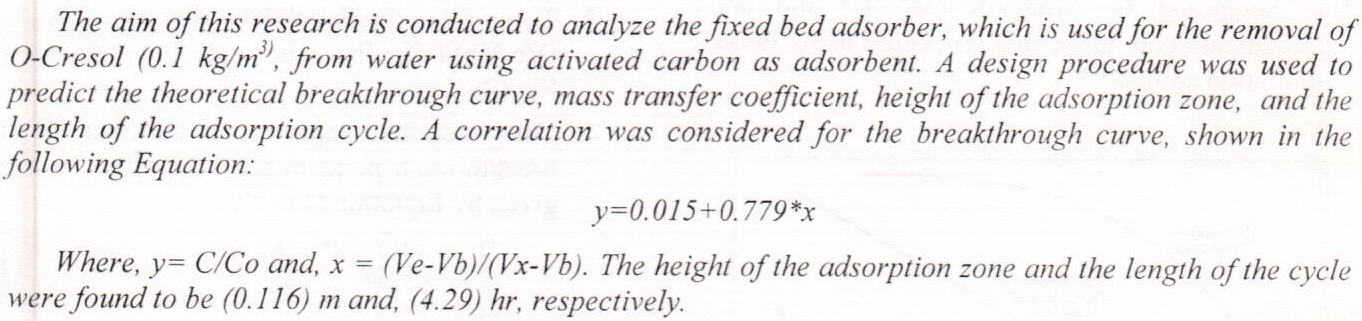
The Analysis of a Fixed Bed Absorber Used for the Removal of Pollutants from Water


The aim of the research: To identify the trends of students of the College of Physical Education and Sports Sciences towards modern teaching methods. To determine the type of strategies used that students prefer in practical lessons. In light of the research results, the researcher adopted the descriptive method because it is appropriate for the study. The research community is represented by students of the College of Physical Education and Sports Sciences (fourth stage), amounting to (320) students. Conclusions: The research results indicate that students of the College of Physical Education and Sports Sciences have positive and strong attitudes towards using modern teaching methods, and they realize their reality in improving interaction
... Show MoreThe aim of the research: To identify the trends of students of the College of Physical Education and Sports Sciences towards modern teaching methods. To determine the type of strategies used that students prefer in practical lessons. In light of the research results, the researcher adopted the descriptive method because it is appropriate for the study. The research community is represented by students of the College of Physical Education and Sports Sciences (fourth stage), amounting to (320) students. Conclusions: The research results indicate that students of the College of Physical Education and Sports Sciences have positive and strong attitudes towards using modern teaching methods, and they realize their reality in improving interaction
... Show MoreThe aim of this study is to evaluate the anti fungal activity of a combination of essential oils against water molds. HPLC analysis was done to evaluate the quantity and quality of the active compounds in this combination which extracted from three herbs( Peppermint Menthapiperita ,Thyme Thymusvulgaris, Common sage Salvia officinalis L.) and the active compounds are Camphor,Menthol,,Thujone and Thymol with different concentrations. In this study (MIC) , (MFC) were measured and (LD50) determined after 48,96 h from fingerlings treatment of common carp in aquariums .The results of (MIC) were 0.025µl/ml for Aphanomyces sp. and 0.015µl/ml for both Achlya sp. and Fusariumsolani which showed significant differences(p<0.05) from Malachite gre
... Show More
 (6)
(6)
 (5)
(5)


This study focused on treatment of real wastewater rejected from leather industry in Al-Nahrawan city in Iraq by Electrocoagulation (EC) process followed by Reverse Osmosis (RO) process. The successive treatment was applied due to high concentration of Cr3+ ions (about 1600 ppm) rejected in wastewater of this industry and for applying EC with moderate power consumption and better results of produced water. In Electrocoagulation process (EC), the effect of NaCl concentration (1.5, 3 g/l), current density (C.D.) (15-25 mA/cm2), electrolysis time (1-2 h), and distance between electrodes (E.D.) (1-2 cm) were examined in a batch cell by implementing Taguchi experimental design. According to the results obtained from multiple regression and signa
... Show More
(22)
(17)
Adsorption experiments were carried out using two different low-cost sorbent materials, date seeds and olive seeds. These sorbents used as a single phase (not as mixture) to remove cadmium ions from simulated wastewater by adsorption process. The equilibrium time was found at 2 hr. The experiments include different parameters such sorbent type and weight and contact time. It was found that both of olive seed and date seed have approximately the same adsorption capacity (qm) with 15.644 mg/g and 15.2112 mg/g, respectively. Equilibrium isotherms and kinetic studies have been carried out. Langmuir isotherm model better fits the experimental data compared with the Freundlich isotherm for olive seed, while Freundlich isotherm fits for date se
... Show MoreCadmium is one of the heavy metal found in the wastewater of many industries. The electrocoagulation offers many advantages for the removal of cadmium over other methods. So the removal of cadmium from wastewater by using electrocoagulation was studied to investigate the effect of operating parameters on the removal efficiency. The studied parameters were the initial pH, initial concentration, and applied voltage. The study experiments were conducted in a batch reactor with with two pairs of aluminum electrodes with dimension and 2mm in thick with 1.5 cm space between them. The optimum removal was obtained at pH =7, initial concentration = 50 mg/L, and applied voltage = 20 V and it was 90%.
(10)
New technologies have risen into popularity causing the Liquid membrane techniques to evolve over other separation techniques due to its high selectivity and recovery, increased fluxes, and reduced investment and operating cost. This work focuses on extracting Methylene Blue (MB), a cationic dye using a simple BLM separation technique from its aqueous phase. It combines extraction and stripping in a single unit operation. The feed phase was an aqueous solution of MB, the solvent chosen was soybean oil for the liquid/organic membrane phase, and tri-octyl amine acted as a carrier. The strip phase was a hydrochloric acid solution for this study. A two-phase equilibrium study was done to choose the correct solvent, carrier,
... Show More
(3)
(2)
