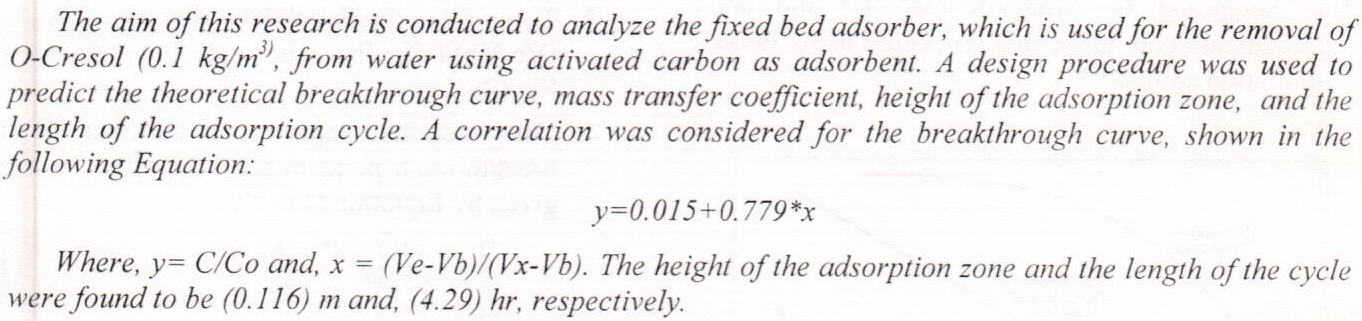
The Analysis of a Fixed Bed Absorber Used for the Removal of Pollutants from Water

The research aims to prepare a preliminary feasibility study that shows the importance of preliminary feasibility study in investment decision making, carrying out of the local demand of service provided in accordance with international standards and statement of investment opportunities available to the private sector in several investment methods. In order to reach the objectives of the study was adopted as a method of partial analysis at the level of economic unity through the study demand, supply, costs, economic and social profitability.
The health sector in Iraq is one of the service sectors facing today a continuous deficiency
... Show More
The research aims to find ways to minimize the use of quantities of chemical fertilizers in agriculture in order to get to an environment that is free of contaminants. Magnetized water technology used in the experience of planting seeds of tomatoes Thomson type to obtain a higher efficiency to absorb fertilizer NRK in the protected environment of the period from February to June. Magnetized water system used locally made levels Gaues (4800,2500,1500) concentrations of 50 to 100% for each level and the rate of (4) replicates, and results indicated that the severity of the magnet (4800 Gaues) and a concentration of 50% gave the highest percentage of tomato fruit size and intensity ( 1500 Gaues) and a concentration of 100% did not give any inc
... Show More (1)
(1)
The adsorption of copper ions onto produced activated carbon from banana peels (with particle size 250 µm) in a single component system with applying magnetic field has been studied using fixed bed adsorber. The fixed bed breakthrough curves for the copper ions were investigated. The adsorption capacity for Cu (II) was investigated. It was found that 1) the exposure distance (E.D) and strength of magnetic field (B), affected the degree of adsorption; and 2) experiments showed that removal of Cu ions and accumulative adsorption capacity of adsorbent increase as the exposure distance and strength of magnetic field increase.
 (7)
(6)
(7)
(6)


In this research, the efficiency of low-cost unmodified wool fibers were used to remove zinc ion from industrial wastewater. Removal of zinc ion was achieved at 99.52% by using simple wool column. The experiment was carried out under varying conditions of (2h) contact time, metal ion concentration (50mg/l), wool fibers quantity to treated water (70g/l), pH(7) & acid concentration (0.05M). The aim of this method is to use a high sensitive, available & cheep natural material which applied successfully for industrial wastewater& synthetic water, where zinc ion concentration was reduced from (14.6mg/l) to (0.07mg/l) & consequently the hazardous effect of contamination was minimized.
(1)
In this research an Artificial Neural Network (ANN) technique was applied for the prediction of Ryznar Index (RI) of the flowing water from WTPs in Al-Karakh side (left side) in Baghdad city for year 2013. Three models (ANN1, ANN2 and ANN3) have been developed and tested using data from Baghdad Mayoralty (Amanat Baghdad) including drinking water quality for the period 2004 to 2013. The results indicate that it is quite possible to use an artificial neural networks in predicting the stability index (RI) with a good degree of accuracy. Where ANN 2 model could be used to predict RI for the effluents from Al-Karakh, Al-Qadisiya and Al-Karama WTPs as the highest correlation coefficient were obtained 92.4, 82.9 and 79.1% respectively. For
... Show MoreThis study examines the removal of ciprofloxacin in an aqueous solution using green tea silver nanoparticles (Ag-NPs). The synthesized Ag-NPs have been classified by the different techniques of SEM, AFM, BET, FTIR, and Zeta potential. Spherical nanoparticles with average sizes of 32 nm and a surface area of 1.2387m2/g are found to be silver nanoparticles. The results showed that the ciprofloxacin removal efficiency depends on the initial pH (2.5-10), CIP (2-15 mg/L), temperature (20-50°C), time (0-180 min), and Ag-NPs dosage (0.1-1g/L). Batch experiments revealed that the removal rate with ratio (1:1) (w/w) were 52%, and 79.8% of the 10 mg/L of CIP at 60, and 180 minutes, respectively with optimal pH=4. Kinetic models for adsorpti
... Show More
(1)
(38)
(32)
Environmental pollution is experiencing an alarming surge within the global ecosystem, warranting urgent attention. Among the significant challenges that demand immediate resolution, effective treatment of industrial pollutants stands out prominently, which for decades has been the focus of most researchers for sustainable industrial development aiming to remove those pollutants and recover some of them. The liquid membrane (LM) method, specifically electromembrane extraction (EME), offers promise. EME deploys an electric field, reducing extraction time and energy use while staying eco-friendly. However, there's a crucial knowledge gap. Despite strides in understanding and applying EME, optimizing it for diverse industrial pollutant
... Show More
(4)
(4)