The Analysis of a Fixed Bed Absorber Used for the Removal of Pollutants from Water
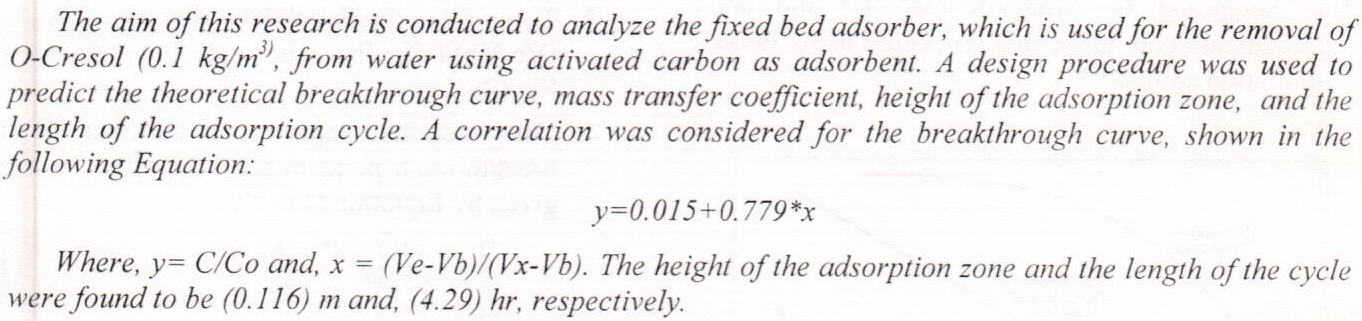

In this paper, the system of the power plant has been investigated as a special type of industrial systems, which has a significant role in improving societies since the electrical energy has entered all kinds of industries, and it is considered as the artery of modern life.
The aim of this research is to construct a programming system, which could be used to identify the most important failure modes that are occur in a steam type of power plants. Also the effects and reasons of each failure mode could be analyzed through the usage of this programming system reaching to the basic events (main reasons) that causing each failure mode. The construction of this system for FMEA is dependi
... Show MoreThis research sought to present a concept of cross-sectional data models, A crucial double data to take the impact of the change in time and obtained from the measured phenomenon of repeated observations in different time periods, Where the models of the panel data were defined by different types of fixed , random and mixed, and Comparing them by studying and analyzing the mathematical relationship between the influence of time with a set of basic variables Which are the main axes on which the research is based and is represented by the monthly revenue of the working individual and the profits it generates, which represents the variable response And its relationship to a set of explanatory variables represented by the
... Show More
Diyala river is the most important tributaries in Iraq, this river suffering from pollution, therefore, this research aimed to predict organic pollutants that represented by biological oxygen demand BOD, and inorganic pollutants that represented by total dissolved solids TDS for Diyala river in Iraq, the data used in this research were collected for the period from 2011-2016 for the last station in the river known as D17, before the river meeting Tigris river in Baghdad city. Analysis Neural Network ANN was used in order to find the mathematical models, the parameters used to predict BOD were seven parameters EC, Alk, Cl, K, TH, NO3, DO, after removing the less importance parameters. While the parameters that used to predict TDS were fourte
... Show MoreHeat transfer process and fluid flow in a solar chimney used for natural ventilation are investigated numerically in the present work. Solar chimney was tested by selecting different positions of absorber namely: at the back side, front side, and at the middle of the air gap. CFD analysis based on finite volume method is used to predict the thermal performance, and air flow in two dimensional solar chimney under unsteady state condition, to identify the effect of different parameters such as solar radiation. Results show that a solar chimney with absorber at the middle of the air gap gives better ventilation performance. A comparison between the numerical and previous experimental results shows fair agreement.
 (4)
(4)
CIGS nanoink has synthesized from molecular precursors of CuCl, InCl3, GaCl3 and Se metal heat up 240 °C for a half hour in N2-atmosphere to form CIGS nanoink, and then deposited onto substrates of soda-lime glass (SLG). This work focused on CIGS nanocrystals, indicates their synthesis and applications in photovoltaic devices (PVs) as an active light absorber layers. in this work, using spin-coating to deposit CIGS layers (75 mg/ml and 500 nm thickness), without selenization at high temperatures, were obtained up to 1.398 % power conversion efficiency (PCE) at AM 1.5 solar illumination. Structural formations of CIGS chalcopyrite structure were studied by using x ray diffraction XRD. The morphology and composition of CIGS were studied using
... Show More (6)
(6)
(6)
(6)

Heat transfer process and fluid flow in a solar chimney used for natural ventilation are investigated numerically in the present work. Solar chimney was tested by selecting different positions of absorber namely: at the back side, front side, and at the middle of the air gap. CFD analysis based on finite volume method is used to predict the thermal performance, and air flow in two dimensional solar chimney under unsteady state condition, to identify the effect of different parameters such as solar radiation. Results show that a solar chimney with absorber at the middle of the air gap gives better ventilation performance. A comparison between the numerical and previous experimental results shows fair agreement.
(4)
Used cooking oil was undergoing trans-esterification reaction to produce biodiesel fuel. Method of production consisted of pretreatment steps, trans-esterification, separation, washing and drying. Trans-esterification of treated oils was studied at different operation conditions, the methanol to oil mole ratio were 6:1, 8:1, 10:1, and 12:1, at different temperature 30, 40, 50, and 60 º C, reaction time 40, 60, 80, and 120 minutes, amount of catalyst 0.5, 1, 1.5, and 2 wt.% based on oil and mixing speed 400 rpm. The maximum yield of biodiesel was 91.68 wt.% for treated oils obtained by trans-esterification reaction with 10:1 methanol to oil mole ratio, 60 º C reaction temperature, 80 minute reactio
... Show MoreIn this paper, thermal performance of a zig-zig solar air heater (ZZSAH) with and without using steel wire mesh on the absorber plate of the collector is experimentally investigated. The experimental work includes four inclination angles of the collector 20o, 30o, 45o, and 60o and four air mass flow rates of 0.03, 0.04, 0.06, and 0.08 kg/s under varieties of operating conditions of a geographic location of Baghdad. New correlation equations of Nusselt number are obtained from experimental results for both types of collectors where the effect of varying of the inclination angle of collector taken into consideration in the experiment. The correlations show good agreement wi
... Show More
(2)
For this research, the utilisation of electrocoagulation (EC) toremove theciprofloxacin (CIP) and levofloxacin (LVX) from aqueous solutions was examined. The effective removal efficiencies are 93.47% for CIP and 88.00% for LVX, under optimum conditions. The adsorption isotherm models with suitable mechanisms were applied to determine the elimination of CIP and LVX utilizingtheEC method. Thefindingsshowed the adsorption of CIP and LVX on iron hydroxide flocs followed the Sips isotherm, with correlation coefficient values (R2) of 0.939 and 0.937. Threekinetic models were reviewed to determine the accurate CIP and LVX elimination methods using the EC method. The results showed that itfittedfor the second-order model, which indicated that the c
... Show More
(38)
The uptake of Cd(II) ions from simulated wastewater onto olive pips was modeled using artificial neural network (ANN) which consisted of three layers. Based on 112 batch experiments, the effect of contact time (10-240 min), initial pH (2-6), initial concentration (25-250 mg/l), biosorbent dosage (0.05-2 g/100 ml), agitation speed (0-250 rpm) and temperature (20-60ºC) were studied. The maximum uptake (=92 %) of Cd(II) was achieved at optimum parameters of 60 min, 6, 50 mg/l, 1 g/100 ml, 250 rpm and 25ºC respectively.
Tangent sigmoid and linear transfer functions of ANN for hidden and output layers respectively with 7 neurons were sufficient to present good predictions for cadmium removal efficiency with coefficient of correlatio
... Show More