The Analysis of a Fixed Bed Absorber Used for the Removal of Pollutants from Water
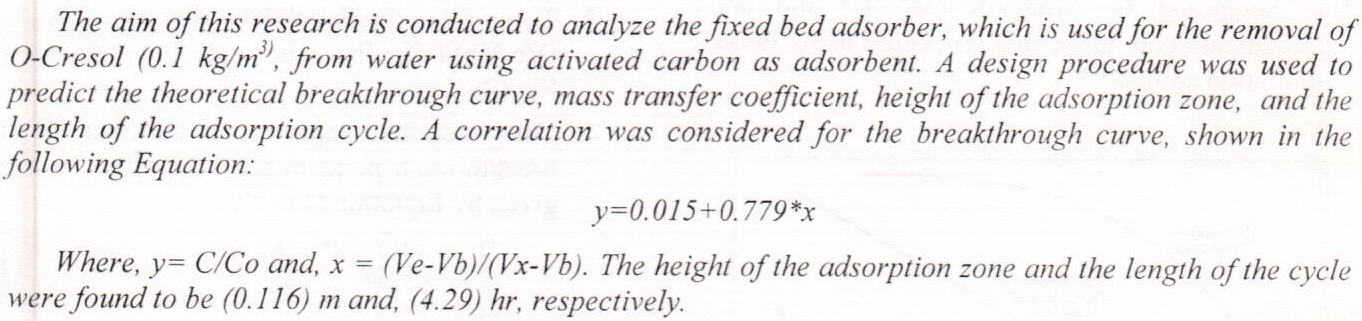

The ability of pulverized walnut-shell to remove oil from aqueous solutions has been studied. It involves two-phase process which consists of using walnut-shell as a filtering bed for the accumulation and adsorption of oil onto its surface. Up to 96% oil removal from synthetic wastewater samples was achieved while tests results showed that 75% of oil can be removed from the actual wastewater discharged from Al- Duara refinery in the south of Baghdad.
This study aims to derive a sustainable human development index for the Arab countries by using the principal components analysis, which can help in reducing the number of data in the case of multiple variables. This can be relied upon in the interpretation and tracking sustainable human development in the Arab countries in the view of the multiplicity of sustainable human development indicators and its huge data, beside the heterogeneity of countries in a range of characteristics associated with indicators of sustainable human development such as area, population, and economic activity. The study attempted to use the available data to the selected Arab countries for the recent years. This study concluded that a single inde
... Show More (1)
(1)

 (23)
(22)
(23)
(22)


Modified algae with nano copper oxide (CuO) were used as adsorption media to remove tetracycline (TEC) from aqueous solutions. Functional groups, morphology, structure, and percentages of surfactants before and after adsorption were characterised through Fourier-transform infrared (FTIR), X-ray diffraction (XRD), scanning electron microscopy (SEM), and energy-dispersive spectroscopy (EDS). Several variables, including pH, connection time, dosage, initial concentrations, and temperature, were controlled to obtain the optimum condition. Thermodynamic studies, adsorption isotherm, and kinetics models were examined to describe and recognise the type of interactions involved. Resultantly, the best operation conditions were at pH 7, contact time
... Show More
(36)
(35)
(6)
(3)
Modified algae with nano copper oxide (CuO) were used as adsorption media to remove tetracycline (TEC) from aqueous solutions. Functional groups, morphology, structure, and percentages of surfactants before and after adsorption were characterised through Fourier-transform infrared (FTIR), X-ray diffraction (XRD), scanning electron microscopy (SEM), and energy-dispersive spectroscopy (EDS). Several variables, including pH, connection time, dosage, initial concentrations, and temperature, were controlled to obtain the optimum condition. Thermodynamic studies, adsorption isotherm, and kinetics models were examined to describe and recognise the type of interactions involved. Resultantly, the best operation conditions were at pH 7, contact time
... Show More
(35)
This research is intended to high light the uses of political content in foreign Arabic / speaking websites, such as “ CNN “ and” Euro News“, The research problem stems from the main question: What is the nature of the use of the websites in the political content provided through them? A set of sub-questions that give the research aspects and aims to achieve a set of objectives , including the identification of topics that included , the political content provided through , the sample sites during the time period for analysis and determine that the study uses descriptive research based on the discovery of the researcher, describing it accurately and defining the relations between the components.
The research conducted the des
Used automobile oils were subjected to filtration to remove solid material and dehydration to remove water, gasoline and light components by using vacuum distillation under moderate pressure, and then the dehydrated waste oil is subjected to extraction by using liquid solvents. Two solvents, namely n-butanol and n-hexane were used to extract base oil from automobile used oil, so that the expensive base oil can be reused again.
The recovered base oil by using n-butanol solvent gives (88.67%) reduction in carbon residue, (75.93%) reduction in ash content, (93.73%) oil recovery, (95%) solvent recovery and (100.62) viscosity index, at (5:1) solvent to used oil ratio and (40 oC) extraction temperature, while using n-hexane solvent gives (6
(37)
(38)
The efficient removal of dissolved organic compounds (DOC) from wastewater has become a major environmental concern because of its high toxicity even at low concentrations. Therefore, a technique was needed to reduce these pollutants. Ion exchange technology (IE) was used with AmberliteTM IR120 Na, AmberliteTM IR96RF, and AmberliteTM IR402, firstly by using anion and mixed bed system, where the following variables are investigated for the process of adsorption: The height of the bed in column (8,10 and 14 cm), different concentrations of (DOC) content at constant flow rate. The use of an ion exchanger unit (continuous system) with three columns (cation, anion, and mixed bed) was studied.
... Show More
(2)