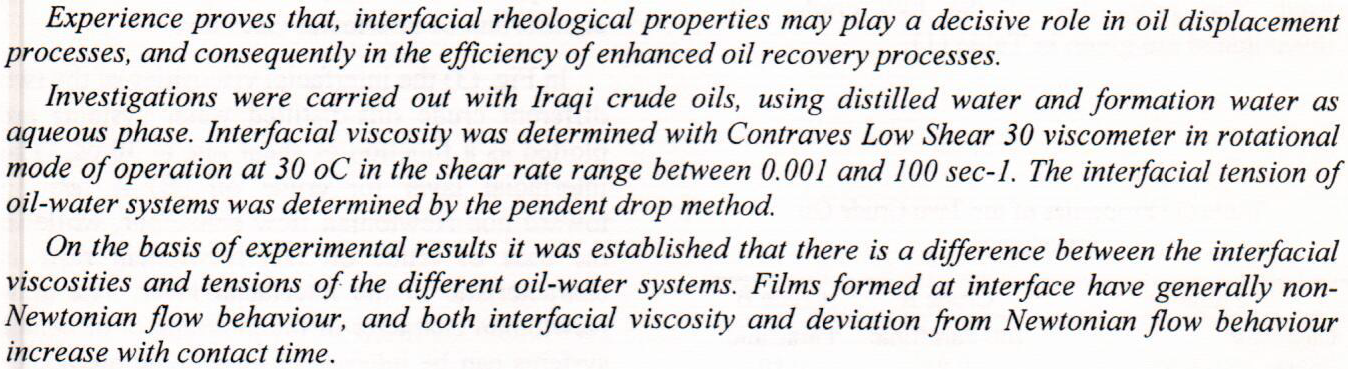
Interfacial Rheological Properties of Iraqi Crude Oils Water System

Abstract
The economic and financial crises in the world economy series led to increased awareness of the importance of the internal control system, because it is one of the main pillars of any economic unit, as it works to verify the application of policies, regulations and laws and verification of asset protection from theft and embezzlement procedures, it is also working on trust accounting information imparted through the validation of accounting information, analyze and detect the misleading.
The existence the internal control system a factor in many of the accounting practices that limit the ability of the administration to produce misleading financial reporting
The
... Show More
Background: The treatment of schizophrenia typically involves the use of olanzapine (OLZ), a typical antipsychotic drug that has poor oral bioavailability due to its low solubility and first-pass effect. Objective: To prepare and optimize OLZ as nanoparticles for transdermal delivery to avoid problems with oral administration. Methods: The nanoprecipitation technique was applied for the preparation of eight OLZ nanoparticles by using different polymers with various ratios. Nanoparticles were evaluated using different methods, including particle size, polydispersity index (PDI), entrapment efficiency (EE%), zeta potential and an in vitro release study. The morphology was evaluated by a field emission scanning electron microscope (F
... Show More (3)
(3)
 (1)
(1)

The Internet of Things (IoT) technology is every object around us and it is used to connect these objects to the Internet to verify Machine to Machine (M2M) communication. The smart house system is the most important application of IoT technology; it is increase the quality of life and decrease the efforts. There were many problems that faced the existing smart house networking systems, including the high cost of implementation and upgrading, high power consumption, and supported limited features. Therefore, this paper presents the design and implementation of smart house network system (SHNS) using Raspberry Pi and Arduino platforms as network infrastructure with ZigBee technology as wireless communication. SHNS consists of two mai
... Show More
(1)
Background: The purpose of the current study was to evaluate the efficacy of a new orthodontic bonding system (Beauty Ortho Bond) involving the shear bond strength in dry and wet environments, and adhesion remnant index (ARI) scores evaluation in regard to other bonding systems (Heliosit and Resilience Orthodontic Adhesives). Materials and methods: Sixty defect free extracted premolars were randomly divided into six groups of 10 teeth each, mounted in acrylic resin, three groups for a dry environment and three for a wet one. Shear bond strength test was performed with a cross head speed of 0.5 mm/min, while surfaces of enamel and bracket-adhesive-enamel surfaces were examined with stereomicroscope For ARI scores evaluation. Data were analyz
... Show MoreIn this present paper, an experimental study of some plasma characteristics in dielectric barrier discharge (DBD) system using several variables, such as different frequencies and using two different electrodes metals(aluminium (Al) and copper (Cu)), is represented. The discharge plasma was produced by an AC power supply source of 6 and 7 kHz frequencies for the nitrogen gas spectrum and for two different electrodes metals(Al and Cu). Optical emission spectrometer was used to study plasma properties (such as electron temperature ( ), electron number density ( ), Debye length ( ), and plasma frequency ( )). In addition, images were analysed for the plasma emission intensity at atmospheric air pressure.
SCADA is the technology that allows the operator to gather data from one or more various facilities and to send control instructions to those facilities. This paper represents an adaptable and low cost SCADA system for a particular sugar manufacturing process, by using Programmable Logic Controls (Siemens s7-1200, 1214Dc/ Dc/ Rly). The system will control and monitor the laboratory production line chose from sugar industry. The project comprises of two sections the first one is the hardware section that has been designed, and built using components suitable for making it for laboratory purposes, and the second section was the software as the PLC programming, designing the HMI, creating alarms and trending system. The system will ha
... Show More
(1)
Pick and place system is one of the significant employments of modern robots utilized in industrial environments. The objective of this research is to make a comparison of time sequences by combining multiple axes of sequences. A pick-place system implemented with pneumatic linear double-acting cylinders to applicator in automated systems processes for manufacturing. The challenge of 3-axes movement control was achieved using the PLC (Programmable Logic Controller) controller such that the merging between two or three axes was achieved according to the selected sequence of the program. The outcomes show the contrasted sequences and the reference in a constant velocity. The main variable parameter is the number of steps for each sequ
... Show More
(2)
This research is an initial attempt to explore the reality of education and its concept in Islam, and to describe the presence of educational practices in the Arab-Islamic heritage. The importance of this research lies in addressing a set of important issues related to the contemporary Islamic educational system. The research revealed the extent of the need for authentic educational values that draw their reference from the origins of Islam, and it emphasized the analysis of the reality of education in the Islamic world and the identification of its problems and the finding of solutions through a quick and comprehensive look at the diverse contributions of Muslimthinkers to Islamic educational thought, and their active ro
... Show More