Interfacial Rheological Properties of Iraqi Crude Oils Water System
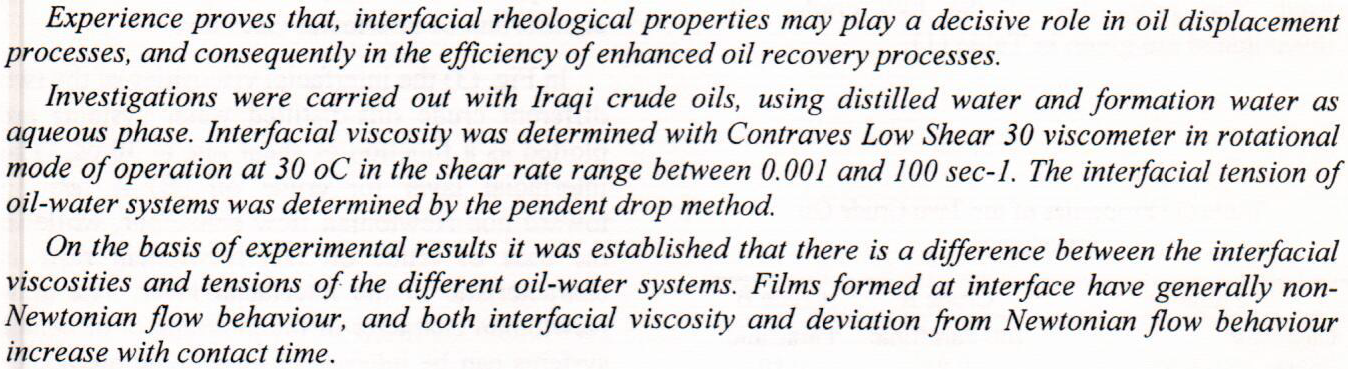

 (7)
(7)


 (8)
(8)
(8)
(8)
The current investigation examines the combined impacts of ultrasonic radiation and hydrogen donors on the viscosity of heavy crude oil. The impact of exposure time, power, duty cycle, and temperature on the viscosity of Iraqi heavy crude oil with 20.32 API was studied. Also, the viscosity of the oil samples, which were mixed with a hydrogen donor (decalin) and subjected to ultrasonic treatment under optimal conditions, was examined to evaluate the combined impact of ultrasonic radiation and hydrogen donor on the viscosity of crude oil. The viscosity experienced a decrease of 52.34% at 2 min of irradiation, 360 W ultrasonic power, 0.8 duty cycle, 35 ⁰C, and 8vol% decalin. To validate the outcomes of the experiments, asphaltene content, s
... Show More
(5)
(3)

This paper presents the thermophysical properties of zinc oxide nanofluid that have been measured for experimental investigation. The main contribution of this study is to define the heat transfer characteristics of nanofluids. The measuring of these properties was carried out within a range of temperatures from 25 °C to 45 °C, volume fraction from 1 to 2 %, and the average nanoparticle diameter size is 25 nm, and the base fluid is water. The thermophysical properties, including viscosity and thermal conductivity, were measured by using Brookfield rotational Viscometer and Thermal Properties Analyzer, respectively. The result indicates that the thermophysical properties of zinc oxide nanofluid increasing with nanoparticle volume f
... Show More
(4)
(5)
(16)
(18)
In this paper thermo-hydrodynamic characteristics were investigated experimentally for a new type shell-helical coiled tube heat exchanger used as a storage tank of closed loop solar water heater system. Triple concentric helical coils were made of copper tubes of (12.5mm OD and 10mm ID) with coils diameter of (207, 152.2, 97mm) for outer, middle and inner coils respectively. The experiments were carried out during a clear sky days of (March and April 2012). The parameters studied in this work are: history of average temperature of shell side of the storage tank, collector heat gain, heat rejected from coils to shell side of the storage tank, collector efficiency, thermal effectiveness of the heat exchanger (storage tank), and pressure d
... Show More
(1)
Oil is considered the most important source for providing the funds for the national economic sectors. The revenues of oil constitute %95 of the GPD. Therefore, the development of the remaining sectors depend on oil..
The Iraqi Oil Marketing Organization (SOMO) depended on the a unified price for all the buyers, That may not reflect the real value of market and did not contribute in marketing the type of heavy oil. Then, to what extent had SOMO been able to market the light and heavy crude oil in a way that contains the expected increase in the crude oil production.
(1)
In this study, the effects of blending the un-branched acrylate polymer known as Poly (n-decyl acrylate), and the branched acrylate polymer known as Poly (iso-octyl acrylate), on the viscosity index (VI), and the pour point of the Iraqi base stocks 40, and 60 respectively, were investigated. Toluene was used as a carrier solvent for both polymer types. The improvement level of oils (VI, & pour point) gained by blending the oil with the acrylate derived polymers was compared with the values of (VI, and pour point) gained by blending the oil with a commercial viscosity index, and pour point improver. The commercial lubricant additive was purchased and used by Al-Daura Refineries. It consisted of an un-known olefin copolymer dissolved i
... Show More