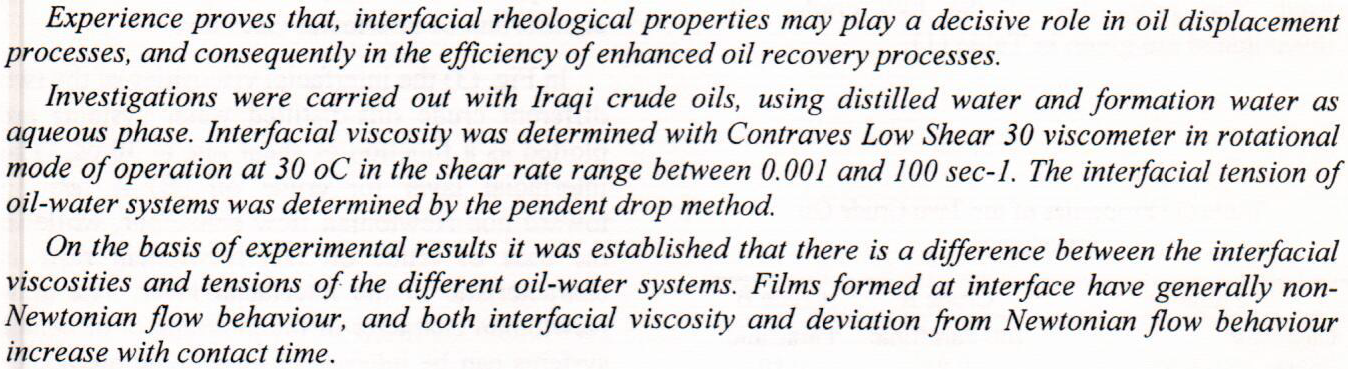
Interfacial Rheological Properties of Iraqi Crude Oils Water System

Large quantities of petroleum-contaminated soil are generated with increased global energy consumption and crude oil production. This theoretical study evaluates the treatment of 1 ton of petroleum-contaminated soil using seven methods: incineration, physical washing, chemical washing, thermal pyrolysis, Fenton-oxidation-pyrolysis, the biological treatment, and asphaltenes. Data were based on experimental results from the Nahran Bin Omar oil lake in Basra Governorate, Iraq, (2019–2021). The methods were compared by waste generation, treatment cost, and duration. Results indicate that using petroleum-contaminated soil as a raw material for asphalt manufacturing is most beneficial since it is sold as a raw material. Incineration is faster a
... Show More

In the present work, the efficiency of Tri-octyl Methyl Ammonium Chloride (TOMAC) ionic liquid was investigated as new and green demulsifier for three types of Iraqi crude oil emulsions (Nafut Khana (NK), Kirkuk and Basrah). The separation efficiency was studied at room temperature and by using microwave heating technique. Several batch experiments were done to specify the suitable conditions for the emulsification and demulsification which were specified as 45 minutes and 3000 rpm for crude oil emulsification while the ionic liquid doses were (500,300,150,50) ppm and the conditions of microwave heating were 1000 watt and 50 second as irradiation time. The results were very encouraging especially for NK and Kirkuk crude oil emulsions whe
... Show MoreUsed automobile oils were subjected to filtration to remove solid material and dehydration to remove water, gasoline and light components by using vacuum distillation under moderate pressure, and then the dehydrated waste oil is subjected to extraction by using liquid solvents. Two solvents, namely n-butanol and n-hexane were used to extract base oil from automobile used oil, so that the expensive base oil can be reused again.
The recovered base oil by using n-butanol solvent gives (88.67%) reduction in carbon residue, (75.93%) reduction in ash content, (93.73%) oil recovery, (95%) solvent recovery and (100.62) viscosity index, at (5:1) solvent to used oil ratio and (40 oC) extraction temperature, while using n-hexane solvent gives (6
There are many configurations of directional control valve. Directional control valve has complex construction, such as moving spool to control the direction of actuator and desired speed. Magneto-rheological (MR) fluid is one of controllable fluids. Utilizing the MR fluid properties, direct interface can be realized between magnetic field and fluid power without the need for moving parts like spool in directional control valves. This paper presents the design of multi configuration MR directional control valve. The construction and the principle of work of the valve are presented. The experiment was conducted to show the working principle of the valve functionally. The valve worked proportionally to control the direction and speed of hydra
... Show More (1)
(1)
 (2)
(2)
This research was carried out to study the effect of plants on the wetted area for two soil types in Iraq and predict an equation to determine the wetted radius and depth for two different soil types cultivated with different types of plants, the wetting patterns for the soils were predicted at every thirty minute for a total irrigation time equal to 3 hr. Five defferent discharges of emitter and five initial volumetric soil moisture contents were used ranged between field capacity and wilting point were utilized to simulate the wetting patterns. The simulation of the water flow from a single point emitter was completed by utilized HYDRUS-2D/3D software, version 2.05. Two methods were used in developing equations to predict the domains o
... Show More
In this research the specifications of Iraqi drinking bottled water brands are investigated throughout the comparison between local brands, Saudi Arabia and the World Health Organization (WHO) for bottled water standard specifications. These specifications were also compared to that of Iraqi Tap Water standards. To reveal variations in the specifications for Iraqi bottled water, and above mentioned standards some quality control tools are conducted for more than 33% of different bottled water brands (of different origins such as spring, purified,..etc) in Iraq by investigating the selected quality parameters registered on their marketing labels. Results employing Minitab software (ver. 16) to generate X bar,
... Show More
(15)
(9)
Rate of zinc consumption during the cathodic protection of copper pipeline which carries saline water was measured by weight loss technique in the absence and presence of bacteria. Variables studied were solution flow rate, temperature, time and NaCl concentration. It was found that within the present range of variables; the rate of zinc consumption increases with the increase of all operating conditions. The presence of bacteria increases the zinc consumption. Fourth order multi-term model and one-term model were suggested to represent the consumption data. Nonlinear regression analysis was used to estimate the coefficients of these models, while statistical analysis was used to determine the effect of each coefficient. Both models were re
... Show More
(36)
The electrochemical behavior of carbon steel in water sweetening station in Libya has been studied in the range of ( 293–333 oC) using weight loss technique. Measurements were carried out over a range of Reynolds number (5000 – 25000).An apparatus was designed for studying the corrosion process in the turbulent regime, which is of industrial significance. It was found that The corrosion rate of carbon steel in water sweetening station is under diffusion control and increases with increasing Reynolds number. On the other hand the variation of corrosion rate with temperature in the range of (293–333 oC) was found to follow Arrhenius equation and the activation energy approximately the same except at low Reynolds
... Show More