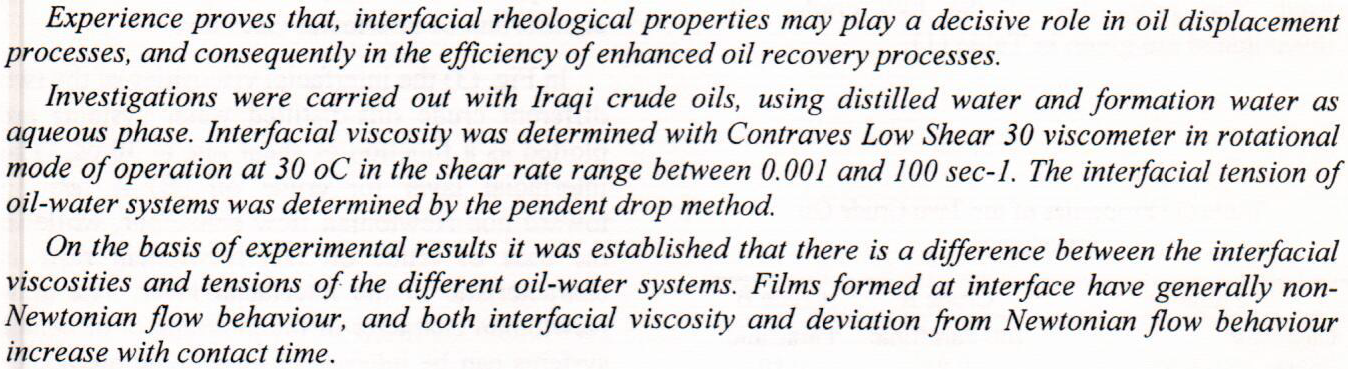
Interfacial Rheological Properties of Iraqi Crude Oils Water System

Background: Fluoridated acrylic resin material can present more stable properties when compared with conventional one.The most widely used fluoride –containing substance added to dental resin materials is sodium fluoride (Naf). This study evaluated the effect of Naf in different concentration to the acrylic resin denture base material and its effect on tensile strength ,modules of elasticity with long –term water immersion (after 4 months immersion in de-ionized water) Materials and methods: Eighty specimens from dumbbells shaped metal pattern for tensile strength test were preparedaccording to ISO 527: 1993 plastic –Determination tensile properties ,in dimensions(60mm, 12mm, 3 ± 0.2mm) length, width and depth respec
... Show MoreThe aim of this work is to evaluate some mechanical and physical
properties (i.e. the impact strength, hardness, flexural strength,
thermal conductivity and diffusion coefficient) of
(epoxy/polyurethane) blend reinforced with nano silica powder (2%
wt.). Hand lay-up technique was used to manufacture the composite
and a magnetic stirrer for blending the components. Results showed
that water had affected the bending flexural strength and hardness,
while impact strength increased and thermal conductivity decreased.
In addition to the above mentioned tests, the diffusion coefficient
was calculated using Fick’s 2nd law.
 (3)
(3)

Background: The healing process involves the restoration of the body’s structural integrity. The extracellular matrix, blood cells, cytokines, and growth factors are all involved in this dynamic, intricate, multicellular process. Hemostasis, the inflammatory phase, the proliferative phase, and the maturation phase are all included. Opuntia ficus-indica oil (OFI) and Punica grantum (PGS) oil are extensively used natural treatments that are regarded as advantageous for their sedative, spasmolytic, and anti-inflammatory properties, as well as for angiogenesis promotion, fibroblast increase, collagen production and deposition, and extracellular-matrix remodeling. Materials and methods: Twenty-four New Zealand rab
... Show More (9)
(3)
(9)
(3)


Were collected three types of medicinal plants from their natural habitat after Astkhalasalziot volatile manner steam distillation and determine the quality and quantity of vehicles chemical for each of the oils obtained using a technique JC discouraged when you merge oily thyme and lemon grass against bacteria either when using oils in three did not have a different effect
In this work, the detection of zinc (Zn) ions that cause water pollution is studied using the CSNPs- Linker-alkaloids compound that was prepared by linking extracted alkaloids from Iraqi Catharanthus roseus plant with Chitosan nanoparticles (CSNPs) using maleic anhydride. This compound is characterized by an X-ray diffractometer (XRD) which shows that it has an orthorhombic structure with crystallite size in the nano dimension. Zeta Potential results show that the CSNPs-Linker-alkaloids carried a positive charge of 54.4 mV, which means it possesses high stability. The Fourier transform infrared spectroscopy (FTIR) shows a new distinct band at 1708.93 cm-1 due to C=O esterification. Scanning electron microscope (SEM) image
... Show More
(3)
(1)
(1)
(1)
With a goal to identify, and ultimately removing from the oil fraction, the carcinogenic components, an oil fraction oil has been analyzed into a main three hydrocarbon groups, paraffins, aromatics, and polycyclic saturates. A multi-stage adsorption apparatus has been used. Four units of 300 g alumina each seems to be sufficient for removing the polynuclear aromatics from 75 g of an oil fraction boiling between 365-375 °C from Qurna crude oil. The usefulness of the ternary diagram for analyzing the oil fraction to the three hydrocarbons groups has been studied and verified. An experimentally based linear relationship of density and refractive index was established to enable of identifying the composition of an oil fraction using th
... Show More
(8)
(7)
This research dealt with desalting of East Baghdad crude oil using pellets of either anionic, PVC, quartz, PE, PP or
nonionic at different temperature ranging from 30 to 80 °C, pH from 6 to 8, time from 2 to 20 minutes, volume percent
washing water from 5 to 25% and fluid velocity from 0.5 to 0.8 m/s under voltage from 2 to 6 kV and / or using additives
such as alkyl benzene sulphonate or sodium stearate. The optimum conditions and materials were reported to remove
most of water from East Baghdad wet crude oil.
The purpose of this study is to measure the levels of quality control for some crude oil products in Iraqi refineries, and how they are close to the international standards, through the application of statistical methods in quality control of oil products in Iraqi refineries. Where the answers of the study sample were applied to a group of Iraqi refinery employees (Al-Dora refinery, Al-Nasiriyah refinery, and Al-Basra refinery) on the principles of quality management control, and according to the different personal characteristics (gender, age, academic qualification, number of years of experience, job level). In order to achieve the objectives of the study, a questionnaire that included (12) items, in order to collect preliminary inform
... Show More