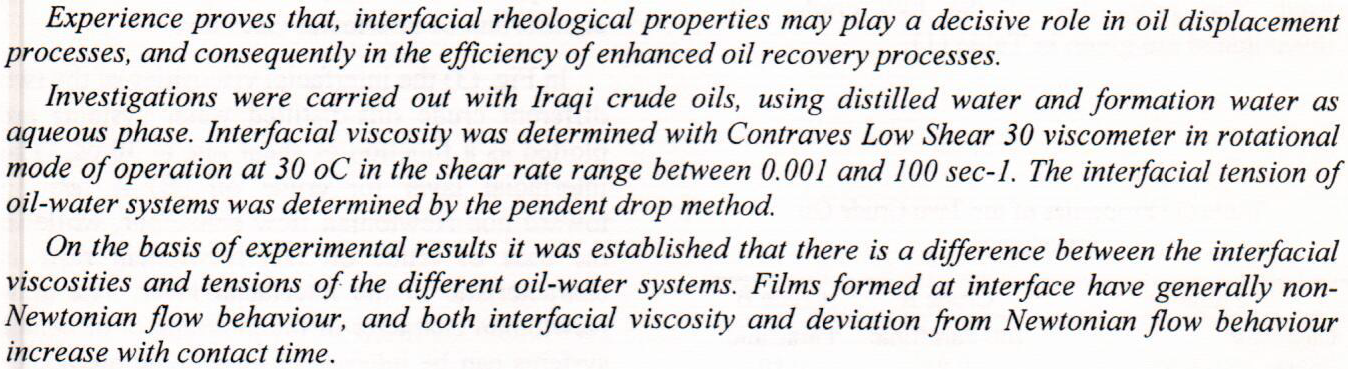
Interfacial Rheological Properties of Iraqi Crude Oils Water System

 (36)
(36)

Abstract
Locally natural occurring Iraqi rocks of Bauxite and Porcelanite (after pre calcinations at 1000oC for 1hr) were used, with the addition of different proportions of MgO and Al2O3, to prepare refractory materials. The effects of these additives on the physical and thermal properties of the prepared refractories were investigated.
Many batches of Bauxite/MgO, Bauxite/Al2O3, Bauxite/MgO/Al2O3, and Porcelanite/ MgO/Al2O3 were prepared. The mixture is milled and classified into different size fractions; fine (less than 45μm) 40%, middle (45-75μm) 40%, and coarse (75-106μm) 20% .
... Show More
(1)
Water stress has a negative impact on the yield and growth of crops worldwide and consequently has a global impact on food security. Many biochemical changes occur in plants as a response to water stress, such as activation of antioxidant systems. Molybdenum (Mo) plays an important part in activating the expression of many enzymes, such as CAT, POD, and SOD, as well as increasing the proline content. Mo therefore supports the defence system in plants and plays an important role in the defence system of mung bean plants growing under water stress conditions. Four concentrations of Mo (0, 15, 30, and 45 mg·L−1) were applied to plants, using two approaches: (a) seed soaking and (b) foliar application. Mung bean plants were subject
... Show More (20)
(16)
(20)
(16)


This research discusses application Artificial Neural Network (ANN) and Geographical InformationSystem (GIS) models on water quality of Diyala River using Water Quality Index (WQI). Fourteen water parameterswere used for estimating WQI: pH, Temperature, Dissolved Oxygen, Orthophosphate, Nitrate, Calcium, Magnesium,Total Hardness, Sodium, Sulphate, Chloride, Total Dissolved Solids, Electrical Conductivity and Total Alkalinity.These parameters were provided from the Water Resources Ministryfrom seven stations along the river for the period2011 to 2016. The results of WQI analysis revealed that Diyala River is good to poor at the north of Diyala provincewhile it is poor to very polluted at the south of Baghdad City. The selected parameters wer
... Show MoreOne of the important units in Sharq Dijla Water Treatment Plant (WTP) first and second extensions are the alum solution preparation and dosing unit. The existing operation of this unit accomplished manually starting from unloading the powder alum in the preparation basin and ending by controlling the alum dosage addition through the dosing pumps to the flash mix chambers. Because of the modern trend of monitoring and control the automatic operation of WTPs due to the great benefits that could be gain from optimum equipment operation, reducing the operating costs and human errors. This study deals with how to transform the conventional operation to an automatic monitoring and controlling system depending on a Programmable
... Show More<span lang="EN-US">Proper employment of Hybrid Wind/ PV system is often implemented near the load, and it is linked with the grid to study dynamic stability analysis. Generally, instability is because of sudden load demand variant and variant in renewable sources generation. As well as, weather variation creates several factors that affect the operation of the integrated hybrid system. So this paper introduces output result of a PV /wind via power electronic technique; DC chopper; that is linked to Iraqi power system to promote the facilitating achievement of Wind/ PV voltage. Moreover, PSS/E is used to study dynamic power stability for hybrid system which is attached to an effective region of Iraqi Network. The hybrid system
... Show More
(15)
(4)
tA novel synthesis procedure is presented for preparing triethanolamine-treated graphene nanoplatelets(TEA-GNPs) with different specific areas (SSAs). Using ultrasonication, the covalently functionalizedTEA-GNPs with different weight concentrations and SSAs were dispersed in distilled water to prepareTEA-GNPs nanofluids. A simple direct coupling of GNPs with TEA molecules is implemented to synthesizestable water-based nanofluids. The effectiveness of the functionalization procedure was validated by thecharacterization and morphology tests, i.e., FTIR, Raman spectroscopy, EDS, and TEM. Thermal conduc-tivity, dispersion stability, and rheological properties were investigated. Using UV–vis spectrometer, ahighest dispersion stability of 0.876
... Show More
(95)
The role of the ABC system in determining the costs of services in Iraqi banks
Background: The healing process involves the restoration of the body’s structural integrity. The extracellular matrix, blood cells, cytokines, and growth factors are all involved in this dynamic, intricate, multicellular process. Hemostasis, the inflammatory phase, the proliferative phase, and the maturation phase are all included. Opuntia ficus-indica oil (OFI) and Punica grantum (PGS) oil are extensively used natural treatments that are regarded as advantageous for their sedative, spasmolytic, and anti-inflammatory properties, as well as for angiogenesis promotion, fibroblast increase, collagen production and deposition, and extracellular-matrix remodeling. Materials and methods: Twenty-four New Zealand rab
... Show More
(9)
(3)